Mouse and Rat Biology and Behavior

Accurate identification and understanding of behavior can help you determine the best strategy for managing a problem with rats or mice. 


Identifying Mice and Rats

What Do Mice and Rats Look Like?

The common species of pest rodents in New York are house mice, white-footed mice, deer mice, and Norway rats. Roof rats are generally not found in NY. Adult mice and rats can be distinguished from each other by their size, some of their features, and fur patterns.

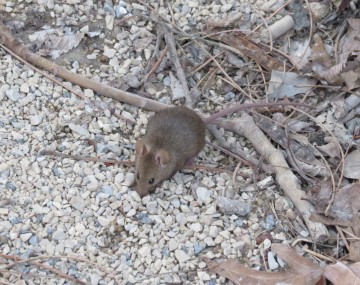
house mouse

House Mouse

House mice can live outdoors if conditions are suitable, but can successfully live their entire life indoors.

Adult mice are 2.5 to 3.75 inches long (63-95mm), with a tail that ranges from 2.75 to 4 inches in length. Compared to young/juvenile rats, they have large ears and eyes, and a pointier nose. Their body is uniformly colored, meaning that their backs and bellies are roughly the same greyish-brown. The tail is semi-naked and is as long as the body. House mice can live outdoors if conditions are suitable, but can successfully live their entire life indoors.

mouse in leaves

White-Footed Mouse and Deer Mouse

White-footed mice and deer mice are two closely-related species that spend most of their time outdoors, but enter structures from fall through spring. They are about the same size and shape as house mice, but have white fur on their belly. Finding these mice indoors means there is an opening they use to enter the structure.

a rat

Norway Rats

Norway rats are opportunistic feeders, and predictably, are found in areas such as parks where food is discarded. 

Adult Norway rats can reach 11 inches (28cm) in length, with a slightly shorter tail for a total length of 16 inches. A field identification test used in areas where roof and Norway rats coexist is to pull the tail toward the head. If the tail extends past the snout, it’s a roof rat; otherwise, a Norway rat. Like white-footed and deer mice, Norway rats tend to have two-tone fur, while the color may vary from brown to gray. These rats have small ears and eyes, and a blunt muzzle.

Evidence of Mice and Rats

Droppings

In general, rodent droppings are cylindrical, with pointed to rounded edges. They are typically black, but can differ in color based on food that was eaten. For example, green or red droppings may indicate that the rodent fed on a rodenticide bait. There are no lines on rodent droppings (compared to the vertical lines found on American cockroach droppings). Mouse droppings are typically 1/8 to 1/4 inches long, Norway rat droppings are 3/4 to 1 inch long, and roof rat droppings are about 1/2 inch in length. The CDC offers a pictorial key to identifying droppings that can help determine which pest is present.

Footprints

Rodents may leave footprints when walking through dirt or dust. Mouse footprints often look like a collection of dots, and the length of the actual footprint is 3/8 to 3/4 inches long.

Rat footprints look like an actual foot, measuring from 3/4 to 1 ¼ inches in length, depending on whether it’s the front or back paw. Adult rats may also leave a ‘tail drag,’ a wavy line between the paw prints.

Gnaw Marks

Impressions left behind after a rodent chews on something are often easy to see. For a pair of teeth (two grooves), gnaw marks from an adult mouse measure 1 to 2 millimeters wide, while adult rat gnaw marks are 3.5 to 4 millimeters wide.

Why do I have Mice and Rats?

Rodent pests are defined as “commensal” because they live in close association with people. When food, water, and shelter are available, we have made a perfect environment for rodents (and other pests).

Food availability

Rodents feed on food items that we grow, harvest, process, store, and discard. Problems exist if people have inadvertently provided a nearby food source, ranging from fresh produce to food and even pet waste.

Water availability

Norway rats need to drink standing water every day. Water can be found in puddles or condensation on a pipe.

Mice will drink water too, but can obtain enough moisture from most food sources to remain hydrated.

Nest site availability

Norway rats prefer to burrow in soil, but will take advantage of voids near a food source. Mice can make nests inside walls, equipment, and other protected places.

rat burrow

Rat burrows indicate that steps need to be taken to seal openings into buildings and reduce outdoor access to food.
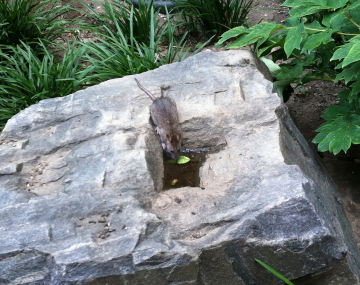
rat drinking water from a puddle in a stone

Some water sources are not obvious. 

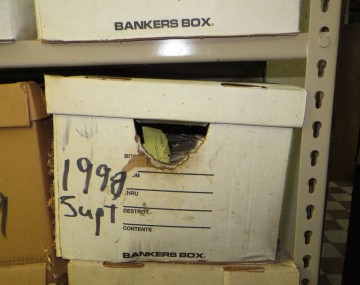
file box with evidence of rodent damage

Rats were nesting in this and other file boxes that were undisturbed near a reliable food source.