Tarnished Plant Bug (Lygus lineolaris)
Fruit Fact Sheet
The tarnished plant bug is found throughout North America, but it is primarily a pest in temperate climates. It damages and feeds on more than fifty economically important plants and most tree fruits grown in the United States.
In this fact sheet
- Biology of tarnished plant bug
- Damage of tarnished plant bug
- Monitoring tarnished plant bug
- Management of tarnished plant bug
- Guide to tarnished plant bug stages
The tarnished plant bug is found throughout North America, but it is primarily a pest in temperate non-desert areas. It feeds on more than fifty economically important plants, including alfalfa, cotton, strawberries, brambles, and most tree fruits grown in the United States. It has two to five generations per year, depending on the location. The tarnished plant bug is a true bug (order Hemiptera), with piercing-sucking mouthparts.
Biology of tarnished plant bug
Adults
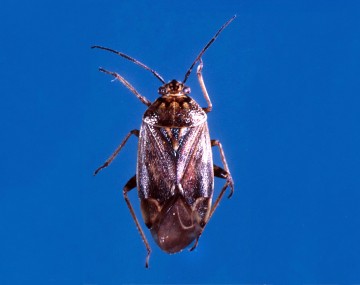
Adults are 6 to 6.5 mm (0.25 in.) long, oval, and somewhat flattened. They are greenish brown in color, with reddish brown markings on the wings. A distinguishing characteristic is a small but distinct yellow-tipped triangle in the center of the back, behind the head (fig. 1 ).
Tarnished plant bugs overwinter as adults under leaf litter, stones, and tree bark and in other protected places. At the end of April, the adults become active and begin laying eggs in crop and weed hosts. The overwintering adult population peaks at about the pink stage of apple (early May in New York State). Two to four indistinct generations can occur annually, with development from egg to adult taking 25 to 40 days. Adults feed throughout the summer, but are found on apple trees from the silver tip stage until 2 to 3 weeks after petal fall.
Eggs
Eggs are about 1 mm (0.04 in.) long, cream colored, and flask shaped. They are laid in plant tissue so only the small anterior end is visible. Eggs can be laid on fruit crops (fig. 2), but are generally deposited on weeds and grasses. On apple trees, although some early oviposition may take place in the buds, most eggs are laid in the developing fruit starting at bloom.
Nymphs
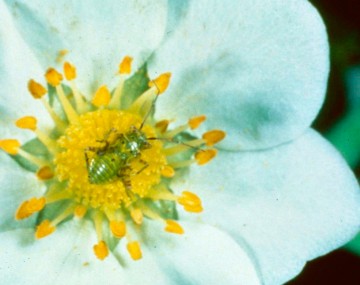
Eggs hatch into nymphs about 7 days after being laid. Young nymphs are pale green and resemble aphids (fig. 3), except that their legs are more robust, their movements are more rapid, and they have no abdominal cornicles (backward-pointing structures that resemble short stems). Because the tarnished plant bug has incomplete metamorphosis, the nymphs resemble adults without wings. Newly hatched nymphs are about 1 mm (0.04 in.) long and remain greenish throughout their five stages, or instars. Nymphs in later instars turn brown and develop wing pads. They have two black dots on their thorax, two between their developing wing pads, and one in the middle of their abdomen (fig. 4).
Damage of tarnished plant bug
The tarnished plant bug causes injury to tree fruits when it feeds and lays eggs. Damage occurs primarily in the spring on flower buds, blossoms, and young fruit, although bleeding of sap may result from twig and shoot injury.
The insect feeds first on buds and later on developing fruit. Small droplets of exudate may be present on the surface of injured buds. Within 1 or 2 weeks, the flower clusters may appear dried and the leaves distorted, with a distinct hole where the insect fed.
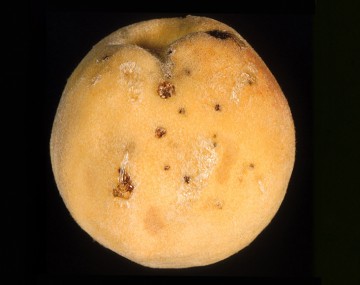
Generally, later damage to developing fruit is more important than earlier feeding on flower buds. In apples, feeding can cause punctures or deep dimples to form as the fruit develops (fig. 5), and in peaches various deformities known as "catfacing" occur (fig. 6). The damage to apples caused by egg laying is usually deeper, resulting in more distorted fruit often with blemishes or "scabs" (fig. 7).
Damage early in the season tends to be near the calyx end of the fruit, and later injuries tend to be elsewhere. Cultivars differ in their susceptibility to damage, with depressions or scabs in some being less pronounced. Damage to mature trees is slight after June, but much damage can occur to nursery stock throughout the summer. In peach trees, the tarnished plant bug punctures the tips of tender growing shoots, causing the leaves to wilt beyond the point of damage and resulting in trees with a dwarfed and bushy appearance. Damage to peach fruit can occur throughout the summer. Nursery apple trees damaged by the tarnished plant bug have curled leaves and stunted growth.
Monitoring tarnished plant bug
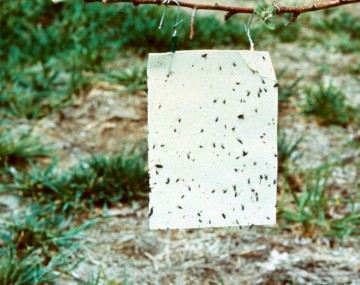
From mid-April to early May, look for adults on flowers and foliage or for bleeding wounds on shoots. Adults fly when disturbed and are difficult to observe in the field. Therefore, the use of unbaited, nonreflective, white sticky boards hung low in the trees is an effective monitoring method (fig. 8). The best places to set the traps are in lower areas such as ditch banks and in hedgerows, which are favorable overwintering sites of the adults. White sticky traps are available commercially.
Management of tarnished plant bug
The tarnished plant bug has a number of natural enemies, such as other true bugs (nabids, geocorids), ladybird beetles, spiders, and parasitic wasps, but they are not able to control the pest effectively. Satisfactory chemical control is difficult on tree fruits because the frequently long bloom period, when no pesticides can be applied, prevents optimum timing of control sprays. Also, prebloom pesticide treatments may dissipate during the prolonged period of bloom. The mobility of the tarnished plant bug also makes control difficult. Despite control efforts, a small amount of fruit injury is often inevitable.
We have seen few orchards in western NY (and only slightly more in the Hudson Valley) where TPB control is warranted, simply because the most effective treatment has been to use a pyrethroid, which: a) kills predator mites, and b) still rarely lowers TPB damage enough to be economically justified. However, if your block history warrants an application, you may elect a spray of Asana, Baythroid, Danitol, Gladiator, Pounce, Warrior or Beseige at pink for plant bug, and you'll take care of rosy apple aphid (plus mullein plant bug and STLM) at the same time.
Guide to tarnished plant bug stages
- Adults
Timing (in New York State): Overwintering generation- dormant to fruit set of apple
Summer generations- summer to fall
Where to look: Overwintering generation- On tree fruit flower buds (look for damage), in alfalfa fields. Use white sticky traps.
Summer generations- Nursery stock, peach fruit, other hosts (legumes such as alfalfa, clovers) - Eggs
Timing (in New York State): Tight cluster to fruit set. Summer generations- summer to fall
Where to look: Inserted in buds, fruit, or similar soft plant parts. Other hosts (legumes such as alfalfa, clovers) - Nymph
Timing (in New York State): May through fall
Where to look: Flower buds, fruit, alfalfa, weedy areas
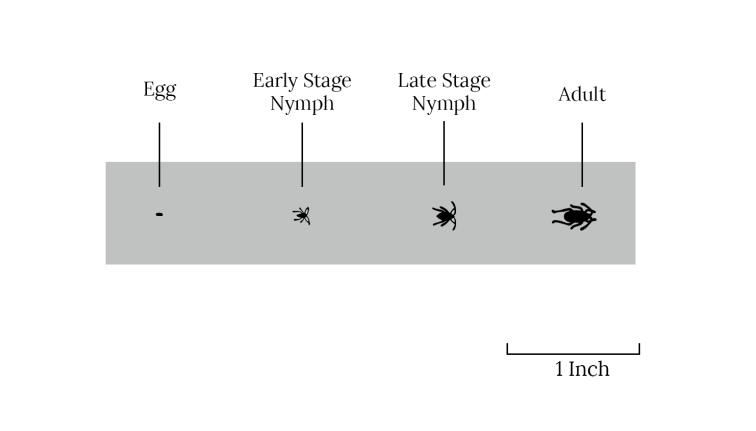
Figure 9
Size comparison between the tarnished plant bug life stages.
Authors
- Monique Rivera
Department of Entomology, Cornell University - Michael Basedow
Eastern New York Commercial Horticulture Program, Cornell Cooperative Extension - Janet van Zoeren
Lake Ontario Fruit Program, Cornell Cooperative Extension
Last updated: 2022
Modified from an article written by Steve M. Spangler, Richard W. Weires, Jr., and Arthur M. Agnello: Spangler, S. M., Weires, R. W., Agnello. A. M. (1991). Tarnished Plant Bug. New York State IPM Program.
- Figure 1. Adult. Photo: NYSAES, Cornell University
- Figure 2. Egg on fruit bud. Photo: NYSAES, Cornell University
- Figure 3. Young nymph. Photo: NYSAES, Cornell University
- Figure 4. Older nymph. Photo: NYSAES, Cornell University
- Figure 5. Dimple on an apple caused by feeding. Photo: NYSAES, Cornell University
- Figure 6. “Catfacing” damage to a peach. Photo: NYSAES, Cornell University
- Figure 7. Dimple on an apple caused by oviposition. Photo: NYSAES, Cornell University
- Figure 8. White sticky trap used for monitoring. Photo: NYSAES, Cornell University
- Figure 9. Guide to stages. Illustration: Hannah Tolz, Cornell Integrated Pest Management
- (585) 797-8368
- jev67 [at] cornell.edu
- (518) 410-6823
- mrb254 [at] cornell.edu
- monique.rivera [at] cornell.edu
- aew232 [at] cornell.edu