Squash Vine Borer (Melittia cucurbitae)

Vegetable IPM Fact Sheet

Squash vine borer (SVB) is an insect pest of cucurbit plants, such as squash, pumpkins and gourds. SVB is mainly problematic on smaller farms with these plants. SVB will bore into the stems and fruit of cucurbits, damaging plants and reducing overall yields.

Squash vine borer is an insect pest that mainly affects cucurbit plants. SVB adult moths will emerge from the soil after overwintering sometime between late June and early July in the Northeast to lay their eggs. After hatching, the larvae of SVB will bore into the stem of cucurbit plants, feeding on the xylem and phloem of the plant. This disrupts the flow of water and nutrients throughout the plant, which can lead to wilting and plant death. Dry growing seasons can exacerbate a SVB infestation, leading to a greater percentage of plant death and loss of yield.

Appearance and identification of squash vine borer

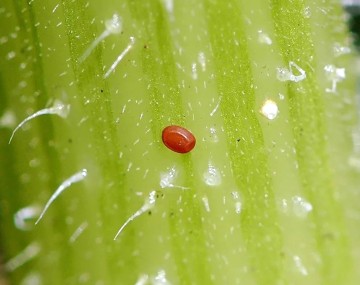
  • Eggs: SVB eggs are small, disk-shaped eggs with a diameter of about 0.04 inch (0.1 centimeters). They also have a reddish-brown color, and are laid singly at the base of host plants or vines.
  • Larvae: The larvae of SVB have a cream-colored, segmented body with a brown head. The larvae will grow to a maximum size of 1.5 inches (3.81 centimeters) long and 0.38 inch (0.95 centimeters) wide.
  • Pupae: Pupae of SVB are about 0.75 inch (1.91 centimeters) long with a reddish-brown color. They are found below the soil’s surface near their host plant.
  • Adults: Adult SVB are moths with a wingspan between 1 and 1.5 inches (2.54 and 3.81 centimeters) wide. The moth has black forewings and clear hindwings, with a black thorax and an orange abdomen. The abdomen has a vertical line of black dots running down its center. Feathery orange scales can also be found on the moth’s legs. SVB adults are often mistaken for wasps, since their clear wings make them look like a wasp when in flight.
A single squash vine borer egg laid on a green cucurbit stem. The egg has a reddish-brown color with a shiny, reflective surface. The egg is about the size of a sharpened pencil tip and has an oval shape.

SVB eggs are laid singly on the stems and vines of cucurbit plants. They have a reddish-brown color, and have a diameter of about 0.04 inch (0.1 centimeters).
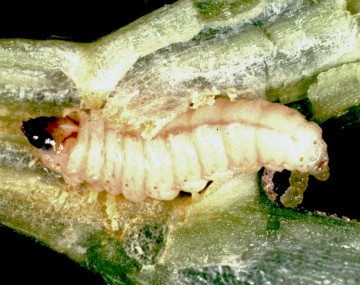
A squash vine borer larva inside a hollowed-out cucurbit stem. The larva has a fleshy, plump, cream-colored body with a brown head. The body of the larva is deeply segmented, and its total length is about the size of a house key. The inside of the stem has brown frass surrounding the larvae from its feeding.

SVB larvae will bore into the stems of cucurbit plants immediately after hatching. They will remain in the stems for 4 to 6 weeks, feeding on the vascular tissue of the plant as they mature.
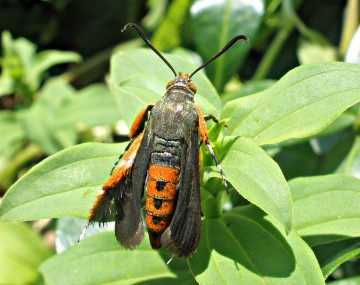
A squash vine borer adult moth resting on a plant leaf. The moth’s wings are slightly spread out, and it has a wingspan about the size of a house key. The moth has black forewings and clear hindwings, with a black thorax, two black antennae, and an orange abdomen. The abdomen has a vertical line of black dots running down its center. Feathery orange scales can also be found on the moth’s legs. The scales covering the moth’s body have a shiny, iridescent surface with a ruffled texture to them.

SVB adults are also known as clearwing moths, since their clear hindwings make them appear similar to wasps when in flight.
Signs and symptoms of squash vine borer

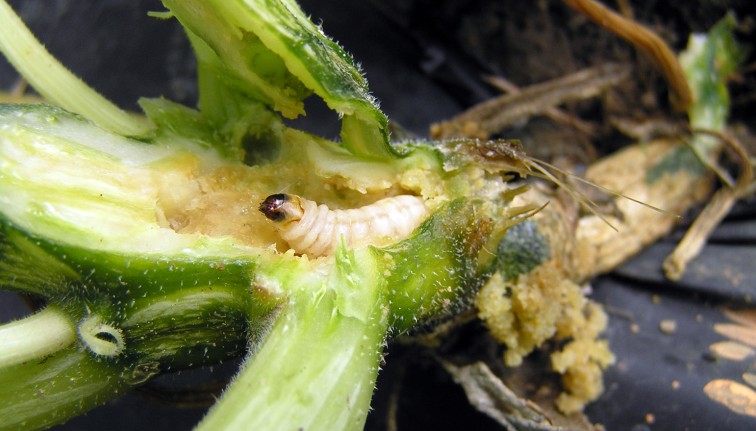
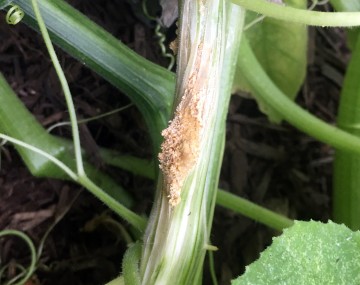
A cucurbit vine with apparent feeding damage from squash vine borer. The center of the vine has an oval-shaped deformity, with brown, sandy frass popping up from within the vine. About an inch above this deformity is another hole with brown frass from the larval feeding.

SVB larvae will feed on the inside of cucurbit vines for 4 to 6 weeks. Sawdust-like frass on the vines or near entry holes is a sign of feeding damage.
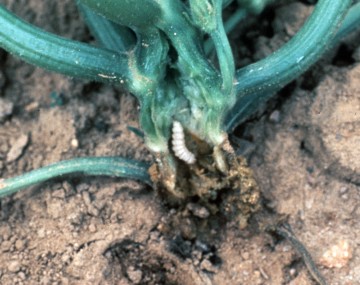
A squash vine borer larva feeding at the base of a squash plant. The squash plant has fallen over at its base, with the base having a black, rotten appearance. The base is also covered with brown, sandy frass, which is an evident sign of squash vine borer feeding.

If left unchecked, severe infestations of SVB can cause critical damage to cucurbit plants. This damage includes reduced yields, plant wilting, and plant death.
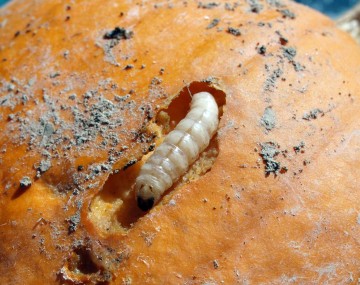
A squash vine borer larva tunneling into the surface of an orange pumpkin. The surface of the pumpkin has a channel in its rind that is about the same size as the larva. The channel has orange, mushy frass in it from larval feeding damage.

Later in the season, SVB larvae can feed on the fruits of cucurbit plants as they ripen. This will further reduce yields in a field, as well as diminish the appearance of harvested fruit.
Life cycle of squash vine borer

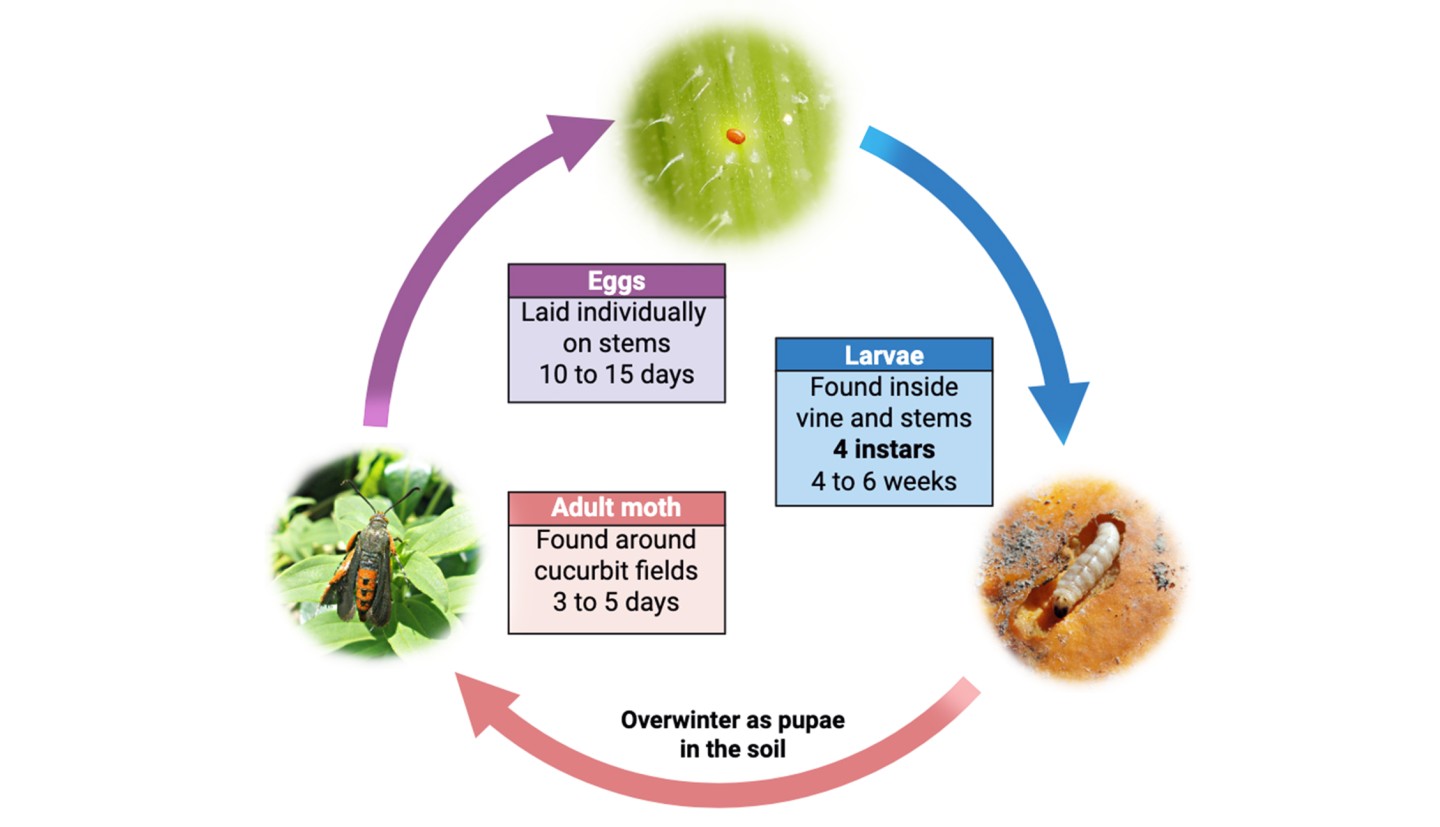
  • SVB will overwinter in the soil as pupae. Adult moths emerge between late June through July in the Northeast, and have a life span of 3 to 5 days. In this time, moths will mate and lay eggs in cucurbit fields.
  • Eggs are laid individually and directly at the base of the host plant. The eggs will hatch after 10 to 15 days have passed, depending on the temperature.
  • Larvae will bore into the stems of their host plant shortly after hatching. They will feed here for 4 to 6 weeks, growing through 4 instars and disrupting the flow of water and nutrients in the plant.
  • Once mature, the larvae will exit their host plant and drop to the soil, where they will burrow 1 to 2 inches (2.54 to 5.08 centimeters) below the ground and pupate until the next season. 

Management of squash vine borer

Pest monitoring

  • Pheromone traps such as yellow and white bucket traps or heliothis traps are commonly used to monitor moth populations. These traps are placed out before moth flights are expected, which is in late May to early June in the northeast.
  • SVB moth flights tend to occur around the same time that chicory (Cichorium intybus) flowers bloom. Chicory is a common flower found along roadsides and in fields, with petals that have a distinct blue-purple color.
  • Thresholds for action beyond monitoring should occur when more than 5 moths per week are captured in traps.
  • Scouting for larvae involves going out into cucurbit fields to look for signs of infestation in plants after 1000 (DD50) degree-days have passed. Look for SVB eggs, early plant wiltings, and sawdust-like frass near entrance holes at the base of vines.
  • Initial infestations usually occur at the edge of fields near weedy or wooded areas, so those spots should be the first priority for scouting.
  • The vines can be cut and split open to confirm the presence of larvae, with larvae most likely being found above the entry hole. 

Control

  • Cultural control: Multiple different cultural control methods can be used with SVB infestations.
    • Disking/tilling under infested plants after harvest will reduce overwintering populations of SVB.
    • Rotate which crops are planted in fields season after season. Try to avoid planting cucurbit plants in a field that experienced a SVB infestation the previous year.
    • Adult SVB moths can fly up to 5 miles (8.05 kilometers) to find host crops, so plant new crops far away from a previous infested site if possible.
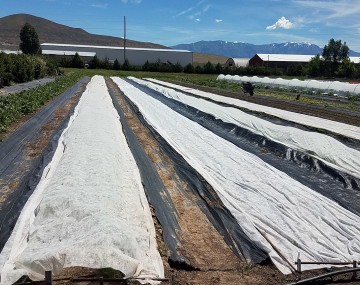
    • Using row covers, straw, or plastic mulch can prevent adult moths from laying their eggs at the base of host plants.
    • Early planting of cucurbits before peak moth flights can help the plants establish themselves, making them more resilient to a SVB infestation.
  • Perimeter trap cropping: Trap crops that are greatly preferred by SVB such as Blue Hubbard squash can be used to concentrate insect damage away from a desirable main crop. After they are infested, the trap crop can be treated with insecticides or destroyed to reduce the SVB population in the field.
  • Chemical control: Refer to your local Cornell Cooperative Extension or state guidelines when applying insecticides to crops.
    • Responsible pesticide application should be planned when applying any insecticide to crops. This ensures that resistance to pesticides is minimized in the targeted pest population, while minimizing damage to beneficial insects and pollinator populations.
    • Use the EIQ (Environmental Impact Quotient) calculator to assess the environmental and health impacts different pesticides have before selection.

Any time you use a pesticide, you must read and follow the label directions and comply with all applicable laws and regulations related to pesticide use. Also be sure that any pesticide used is approved for use in your country and state/province.

A farmed field with multiple row covers over crops. Four rows in the field have black plastic mulch along the sides of the crops, with a thin, mesh-like white net over the top of the crops. The net and the mulch span the full length of each row.

Row covers are an effective management tool to reduce SVB infestations in cucurbits if used between the transplant of new seedlings and flowering. 
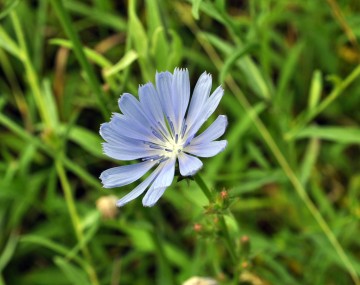
A purple chicory flower in a grassy field. The flower has 15 purple petals that fade into white towards their center. The diameter of the flower is about the same size as a bottle cap. The flower has a slender green stem, with multiple alternating buds growing down the length of the stem.

Chicory (Cichorium intybus) blooms at roughly the same time as SVB moths begin their flight into cucurbit fields, making the flower a good indicator of when to begin scouting and managing their population.
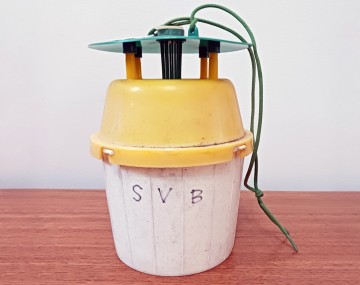
A squash vine borer bucket trap used to capture and monitor adult moth populations. The whole trap is slightly smaller than a 5 gallon (18.93 liters) bucket. The trap consists of a white base, a yellow top and an elevated green lid above the yellow top. There is a hole in the center of the yellow top that allows for SVB moths to enter the trap and be captured. The trap has a string attached to the elevated lid so it can be hung above the ground.

SVB traps use lures and insecticides to collect adult moths during flight. Collected moths then can be used to estimate the SVB population in an area and if further management is required.

Authors

  • Marion Zuefle
    Vegetable IPM Coordinator, Cornell Integrated Pest Management

  • Lukas Rood
    Temporary Program/Extension Aide, Cornell Integrated Pest Management

Last updated: March 2026

This factsheet was developed in part with funding support from the New York State Department of Agriculture and Markets.

  • SVB larvae will feed…—photo by Abby Seaman, Cornell IPM
  • SVB eggs are laid…—photo by Michael J. Raupp, University of Maryland
  • SVB larvae will bore…—photo from USDA Cooperative Extension Slide Series, Clemson University
  • SVB adults are also…—photo by Ansel Oommen, Bugwood
  • SVB larvae will feed…—photo by Amara Dunn, Cornell IPM
  • If left unchecked, severe…—photo by Alton N. Sparks, Jr., University of Georgia
  • Later in the season, SVB…—photo by Jim Jasinski, Ohio State University Extension
  • Row covers are an effective…—photo by Nick Volesky, South Dakota State University Extension
  • Chicory (Cichorium intybus) blooms…—photo by unknown, Cornell IPM
  • SVB traps use lures…—photo by Lukas Rood, Cornell IPM
portrait of Marion Zuefle
Marion Zuefle

Vegetable IPM Coordinator

Cornell Integrated Pest Management

Marion Zuefle
Invasive species
Exotic pests and diseases
Using soil temperature readings to suggest when weeds are likely to germinate
portrait of Abby Seaman
Abby Seaman

Extension Support Specialist

Cornell Integrated Pest Management

Abby Seaman
Vegetables
Organic Production