Striped Cucumber Beetle (Acalymma vittatum)

Vegetable IPM Fact Sheet

The striped cucumber beetle (Acalymma vittatum) is the primary pest of cucurbits in the northeastern United States. It causes damage by feeding on plants and vectoring several plant diseases. There are two generations per year in New York State.

The striped cucumber beetle is a specialist on cucurbits. Adults feed on foliage, stems, flowers and fruit, while larvae feed on roots and sometimes on the rind of the fruit that contacts the ground. Adults are also a key vector of economically important cucurbit diseases, most notably bacterial wilt. As a result, this abundant, widespread, and persistent pest can be difficult to manage effectively and poses a challenge for growers year after year.

Identifying striped cucumber beetle

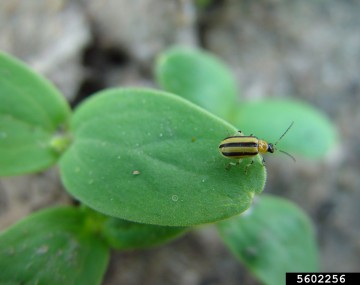
A single striped cucumber beetle adult perches on the edge of a cotyledon.

Adult striped cucumber beetles are small (around a quarter of an inch), with a black head and bright yellow and black striped back.

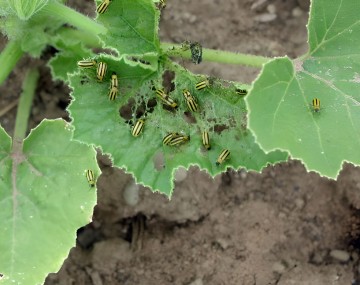
About 20 striped cucumber beetles aggregate on the emerging leaf of a young cucurbit plant. Their damage to the leaf is visible.

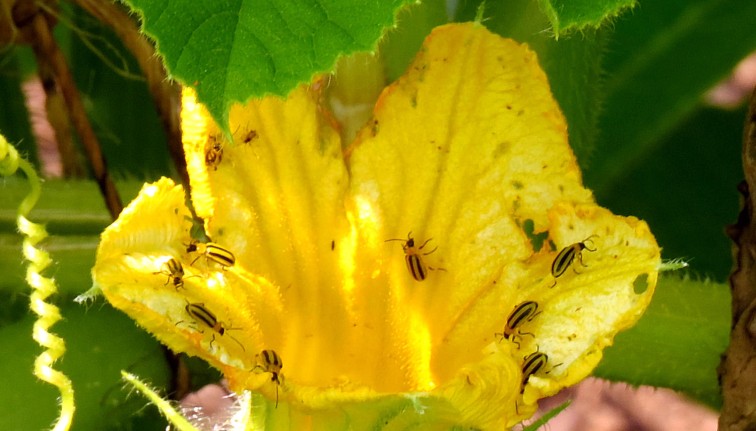
Striped cucumber beetles often feed in aggregations, sometimes consisting of hundreds of individuals.

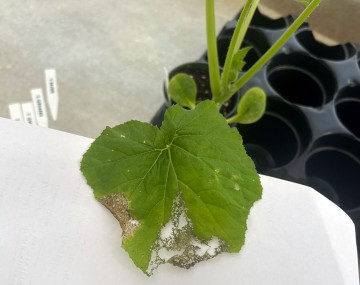
A squash leaf showing striped cucumber beetle damage.

Leaf and flower damage caused by striped cucumber beetles has a characteristic lacy, webbed pattern.

Life cycle of striped cucumber beetle

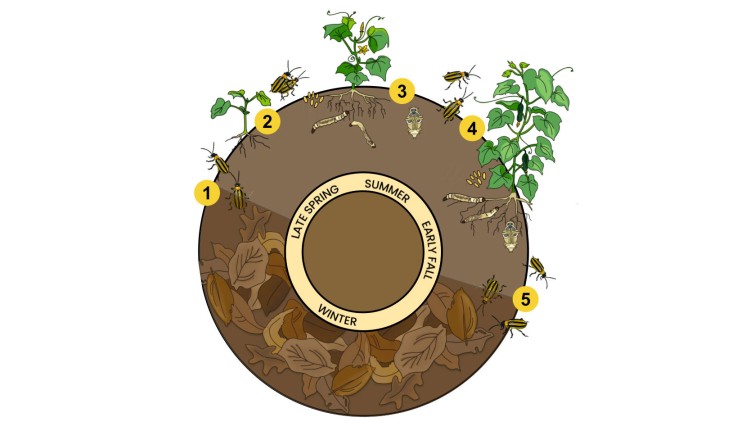
Adult striped cucumber beetles emerge from the leaf litter in the spring once average daily temperatures reach 55°F – typically several weeks before cucurbits are planted. They feed on a wide range of non-preferred host plants (including hawthorn, willow, goldenrod, and apple) as they wait for the first cucurbits to become available. 

Once cucurbit foliage is present, adult beetles aggregate there to feed and mate. Adults colonize the crop over an extended period in the early summer. Feeding damage by beetles at this time can severely harm young plants. 

Adults typically live for 2 months and females lay eggs continuously throughout their lives. An average female in good condition will lay around 125 eggs, though occasionally, an individual can lay as many as 1,000 eggs. 

Development of eggs and larvae is highly dependent on temperature and varies across regions and years. In New York State, adults begin to lay eggs in the soil at the base of cucurbit plants about 2 weeks after mating. Eggs develop within a week before hatching into larvae. Larvae feed on roots and develop through three instars over 3 to 4 weeks, then pupate underground. The pupal stage lasts for around a week, after which adult beetles emerge from the soil, typically around late July.

These new adults feed on mature cucurbits and produce a second generation of eggs, larvae, and pupae, which emerge as second generation adults in early September – this two-generation life cycle is common across New York State. Upon emergence, second generation adults feed briefly to build up reserves before digging an inch or two into nearby leaf litter to overwinter. 

Cucurbit diseases associated with striped cucumber beetle

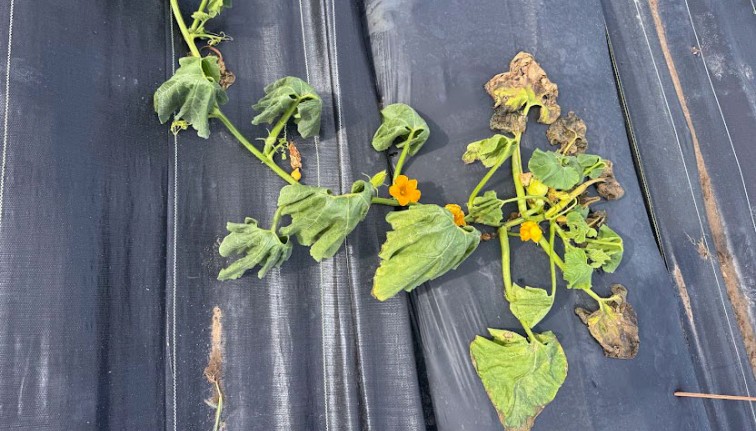
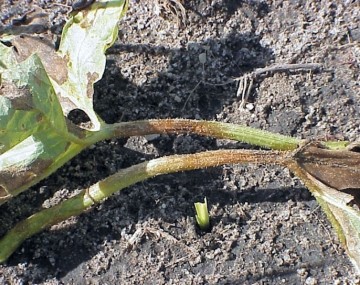
Erwinia tracheiphila, the pathogen responsible for bacterial wilt, reproduces in the plant vascular system after it enters the plant, and eventually obstructs vasculature completely. The pathogen relies on cucumber beetles in several ways – it survives winter in the gut of adults, before being transmitted by them throughout the growing season. The beetles passively spread the pathogen when their bacteria-contaminated excrement enters feeding wounds on leaves and in floral nectaries. Adults acquire the pathogen by feeding on infected plants, and prefer to feed on infected leaves over healthy ones.

Brown, slightly shriveled stems and brown blotches on two cucurbit leaves resting on the soil.

Gummy stem/black rot

This fungal pathogen (Didymella bryoniae) infects the leaves and stems to cause gummy stem blight, and infects the fruit to cause black rot. The first symptoms of infection are yellowing leaf margins and brown spots on cotyledons. This further progresses into lesions, cracking, and cankers along the stem, and lesions on fruit. The spores of the pathogen spread readily on splashing water, but cucumber beetles also carry them and increase disease incidence. Controlling cucumber beetles, along with removing infected tissues and using drip irrigation, can help to manage this disease.

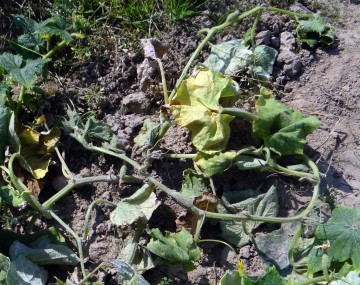
A fully wilted, collapsed and yellowing cucurbit vine.

Fusarium wilt

This fungal pathogen (Fusarium oxysporum) causes leaf wilting starting at the base of the plant and spreading upward. In severe cases, this can cause full plant collapse and death. There is no treatment or cure for infected plants. Though the disease is primarily attributed to warm, wet conditions promoting fungal growth, striped cucumber beetle larvae also increase the spread and incidence of Fusarium wilt.


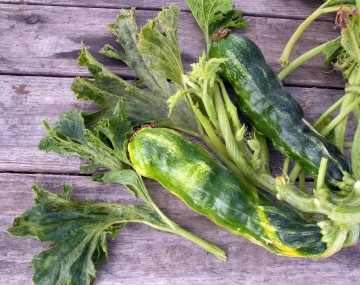
Yellow and light green mottling, as well as some bumpy warping, on two zucchini fruit.

Squash mosaic virus

This virus (Comovirus cucurbitae) is primarily spread by cucurbit-feeding beetles, including striped cucumber beetles. Symptoms of the disease are mottling and physical distortion of leaves and fruit. Disease incidence can be controlled by managing cucumber beetle populations, along with sourcing clean, virus-free seed.

Management of striped cucumber beetle
A targeted IPM strategy for striped cucumber beetles can provide an opportunity for growers to cut costs. Routine scouting was determined to be more cost effective than preventative foliar insecticide treatments in fields across the midwest. Scouting thresholds for pumpkin, squash, and melon are 1 beetle per seedling, and up to 5 beetles per plant after the 4-leaf stage. Thresholds for cucumber and muskmelons are lower because these cultivars are susceptible to bacterial wilt: 1 beetle per every 2 seedlings, or 1 beetle per plant past the 4-leaf stage. Weekly scouting of foliage is recommended.

Physical control

  • Floating row covers or exclusion netting – If plantings are small enough, this can be a highly effective way of reducing beetle damage early in the season, though the covers must be removed after flowers emerge to facilitate pollination.
  • Black plastic mulch – Covering the soil around the base of cucurbit plants can reduce the survival of cucumber beetle larvae when compared to exposed soil, but only if temperatures exceed a critical threshold.
  • Attract-and-kill traps – Commercially available traps for cucumber beetles are baited with synthetic cucurbit flower volatiles. However, these traps can also attract and kill important pollinators. Current work is trialing attract-and-kill traps baited instead with the aggregation pheromone produced by male striped cucumber beetles, which broadly attracts cucurbit pests.

Cultural control

  • Perimeter trap cropping – The principle of trap cropping is to provide a more attractive host for cucumber beetles than the cash crop. This attractive host is planted along field edges and used to draw the beetles away from the cash crop, where it can be managed with targeted insecticides. Blue hubbard squash and buttercup squash are particularly attractive to cucumber beetles, and planting these varieties on field edges two weeks before the cash crop can be an effective trap.
  • Companion planting – This has not been studied extensively to manage cucumber beetles, but has shown some early promise. In preliminary trials, planting alternating rows of melon and radish, with a perimeter of buckwheat reduced beetles and increased melon yield. Alternating rows of amaranth or sunn hemp have also been shown to reduce beetle densities and damage in cucumber and zucchini. 

Biological control

  • Cucumber beetle parasitoids – A tachinid fly (Celatoria setosa) and brachonid wasp (Centistes diabroticae) parasitize striped cucumber beetles. Both parasitoids occur naturally in New York, and rates of parasitism are high in some beetle populations (up to 43% with C. setosa and up to 54% with C. diabroticae). However, the extent to which these parasitoids reduce beetle populations, feeding damage, and the spread of wilt is unknown.
  • Insect-infecting nematodes (Steinernema riobravis) – Introducing these commercially available nematodes to the soil via drip irrigation in early summer (to target cucumber beetle larvae) or early fall (to target overwintering cucumber beetle adults) can reduce adult emergence.
  • Generalist predators – Wolf spiders, harvestmen, ground beetles, and lady beetles all eat striped cucumber beetles. The presence of wolf spiders, specifically, was demonstrated to reduce beetle feeding and increase the yield of cucumber and squash in small plots. 

Chemical control

  • Systemic insecticides that contain either thiamethoxam or cyantraniliprole are effective at reducing beetle damage on cucurbit seedlings. Typically, a soil application or transplant tray drench treatment of thiamethoxam is sufficient to protect the crop until near flowering. In contrast, a soil application or transplant tray drench of cyantraniliprole likely will need to be followed with a foliar insecticide application 2-3 weeks after planting.
  • There are many foliar insecticide options for cucumber beetle control. However, many of these insecticides are harmful to pollinators. To minimize harm to pollinators, applications should be made before flowering. If applications are needed during flowering, it is recommended to make applications at night when bees are not foraging.

There are three chemicals approved for organic use:

  • Kaolin clay – Clay must be applied before beetles arrive, as it acts as a physical colonization deterrent and irritates and disorients beetles searching for host plants. Repeated applications will be needed, especially after rain because the material will wash off the leaves.
  • Select pyrethrins – Pyrethrins occur naturally in chrysanthemum flowers, and are now manufactured for commercial use. They act on the insect nervous system once they have been ingested, causing paralysis and death.
  • Spinosyns – Spinosyn compounds are naturally produced by some types of bacterial fermentation, and have been isolated and commercially synthesized. They act as an acute poison, causing paralysis and death to insects after ingestion. 

For detailed information about insecticide options, rates, pre-harvest intervals and bee precautions, refer to the Cornell Vegetable Guidelines

Any time you use a pesticide, you must read and follow the label directions and comply with all applicable laws and regulations related to pesticide use. Also be sure that any pesticide used is approved for use in your country and state/province.

Authors

  • Naomi Murray
    Ph.D. student, Department of Entomology
    Cornell CALS at Cornell University
  • Brian Nault 
    Professor, Department of Entomology 
    Cornell AgriTech
  • Marion Zuefle 
    Vegetable IPM Coordinator 
    Cornell Integrated Pest Management

Last updated: October 2025

Special thanks to Brian Nault and Marion Zuefle for valuable feedback on drafts of the content for this factsheet, and to Kensy Rodriguez-Herrara and Brian Nault for providing photos. Additional thanks to Henry Zelenak for graciously offering guidance on formatting and assembling the web page.

  • Bergstrom, G.C., Knavel, D.E., Kuc, J. 1982. Role of insect injury and powdery mildew in the epidemiology of the gummy stem blight disease of cucurbits. Plant Disease, 66:683-686.

  • Bond, C.; Buhl, K.; Stone, D. 2014. Pyrethrins General Fact Sheet; National Pesticide Information Center, Oregon State University Extension Services. http://npic.orst.edu/factsheets/pyrethrins.html 

  • Cornell Vegetables. 2021. Virus Diseases of Cucurbits. https://www.vegetables.cornell.edu/pest-management/disease-factsheets/virus-diseases-of-cucurbits/haber 

  • Ellers-Kirk, C.D., Fleischer, S.J., Snyder, R.H., Lynch, J.P. 2000. Potential of entomopathogenic nematodes for biological control of Acalymma vittatum in cucumbers grown in conventional and organic soil management systems. Journal of Economic Entomology, 93(1):605-612. https://doi.org/10.1603/0022-0493-93.3.605 

  • Ellers-Kirk, C.D & Fleischer, S.J. 2006. Development and life table of Acalymma vittatum (Coleoptera: Chrysomelidae), a vector of Erwinia tracheiphila in cucurbits. Environmental Entomology, 35(4):875-880. https://doi.org/10.1603/0046-225X-35.4.875 

  • Freitag, J.H. 1956. Beetle transmission, host range, and properties of squash mosaic virus. Phytopathology, 46:73-81. 

  • Haber, A. I., Wallingford, A. K., Grettenberger, I. M., Ramirez Bonilla, J.P., Vinchesi-Vahl, A. C., Weber, D. C. 2021. Striped cucumber beetle and western striped cucumber beetle (Coleoptera: Chyrsomelidae). Journal of Integrated Pest Management, 12(1). https://doi.org/10.1093/jipm/pmaa026 

  • Hinds, J. & Hooks, C. R. R. 2013. Population dynamics of arthropods in a sunn-hemp zucchini interplanting system. Crop Protection, 53:6-12. https://doi.org/10.1016/j.cropro.2013.06.003 

  • Khairy, M., Ayoub, H. A., Rashwan, F. A., Abdel-Hafez, H.F. 2018. Chemical modification of commercial kaolin for mitigation of organic pollutants in environment via adsorption and generation of inorganic pesticides. Applied Clay Science, 151:124-133. https://doi.org/10.1016/j.clay.2017.12.014 

  • Kirst, H.A. 2010. The spinosyn family of insecticides: realizing the potential of natural products research. Journal of Antibiotics, 63:101-111. https://doi.org/10.1038/ja.2010.5 

  • Kline, G. R., Sedlacek, J. D., Hillman, S. L., Parker, S.K., Silvernail, A.F. 2008. Organic management of cucumber beetles in watermelon and muskmelon production. HortTechnology. 18(3):436-444. https://doi.org/10.21273/HORTTECH.18.3.436 

  • Latin, R. X. & Reed, G.L. 1985. Effect of root feeding by striped cucumber beetle larvae on the incidence and severity of Fusarium wilt of muskmelon. Phytopathology, 75:209-212.

  • Mabin, M. D., Welty, C., Gardiner, M.M. 2020. Predator richness predicts pest suppression within organic and conventional summer squash. Agriculture, Ecosystems, and Environment, 287:106689. https://doi.org/10.1016/j.agee.2019.106689 

  • Paret, M.L, Dufault, N. S., Newark, M., Freeman, J.H. 2021. Management of Gummy Stem Blight (Black Rot) on Cucurbits in Florida. IFAS Extension, University of Florida. https://doi.org/10.32473/edis-pp280-2018 

  • Piñero, J.C. 2017. Trap cropping to control cucumber beetles and squash bugs in cucurbit crops. Lincoln University Missouri Cooperative Extension. https://www.lincolnu.edu/_files/publications/trap-cropping-curcubits.pdf 

  • Quesada-Ocampo, L. 2018. Fusarium Wilt of Watermelon. NC State Extension Publications. https://content.ces.ncsu.edu/fusarium-wilt-of-watermelon 

  • Radin, A.M. & Drummond, F.A. 1994. Patterns of initial colonization of cucurbits, reproductive activity, and dispersion of striped cucumber beetle, Acalymma vittata (Coleoptera: Chrysomelidae). Journal of Agricultural Entomology, 11:115-123. 

  • Saalau Rojas, E., Batzer, J.C., Beattie, G.A., Fleischer, S.J., Shapiro, L.R., Williams, M.A., Bessin, R., Bruton, B.D., Boucher, T.J., Jesse, L.C.H., Gleason, M.L. 2015. Bacterial wilt of cucurbits: Resurrecting a classic pathosystem. American Phytopathological Society, 99(5):564-574. https://doi.org/10.1094/PDIS-10-14-1068-FE 

  • Schuh, M., &  Grabowski,, M. 2022. Gummy stem blight and black rot. University of Minnesota Extension. https://extension.umn.edu/disease-management/gummy-stem-blight-and-black-rot 

  • Smyth, R.R., & Hoffman, M.P. 2010. Seasonal incidence of two co-occurring adult parasitoids of Acalymma vittatum in New York State: Centistes (Syrrhizus) diabroticae and Celatoria setosaBioControl, 55:219-228. https://doi.org/10.1007/s10526-009-9232-y 

  • Snyder, W.E. & Wise, D.H. 2001. Contrasting trophic cascades generated by a community of generalist predators. Ecology, 82(6):1571-1583. 

  • Ternest, J.J., Ingwell, L.L. Foster, R.E., Kaplan, I. 2020. Comparing prophylactic versus threshold-based insecticide programs for striped cucumber beetle management in watermelon. Journal of Economic Entomology, 113(2):872-881. https://doi.org/10.1093/jee/toz346 

  • Volesky, N., Murray, M., Nischwitz, C. 2022. Fusarium and Verticillium Wilts of Vegetables. Utah State University. https://extension.usu.edu/planthealth/research/fusarium-verticillium-wilts 

  • Yardim, E.N., Arancon, N.Q., Edwards, C.A., Oliver, T.J., Byrne, R.J. 2006. Suppression of tomato hornworm and cucumber beetle populations and damage by vermicomposts. Pedobiologia, 50(1): 23-29. https://doi.org/10.1016/j.pedobi.2005.09.001
portrait of Marion Zuefle
Marion Zuefle

Vegetable IPM Coordinator

Cornell Integrated Pest Management

Marion Zuefle
Invasive species
Exotic pests and diseases
Using soil temperature readings to suggest when weeds are likely to germinate
Brian Nault portrait
Brian Nault

Professor

Department of Entomology

Cornell AgriTech

Brian Nault
Portrait of Amara Dunn
Amara Dunn-Silver

Biocontrol Specialist

Cornell Integrated Pest Management

Amara Dunn-Silver