Plum Curculio (Conotrachelus nenuphar)

Fruit Fact Sheet

The plum curculio (PC), a native of North America, is a major pest of pome and stone fruits in the United States and Canada east of the 100th meridian.

The plum curculio (PC), a native of North America, is a major pest of pome and stone fruits in the United States and Canada, east of the 100th meridian. The PC has a single generation in most areas but may have a partial second generation in the southern areas of its range. Most commercial orchards are free of resident PC populations and are infested by adults moving in from adjoining hedgerows and woodlands. Therefore, injury in most commercial orchards is normally heaviest close to these sites. These out-of-orchard sites should also be examined in scouting for first plum curculio activity in the spring.

Biology of plum curculio

Adults

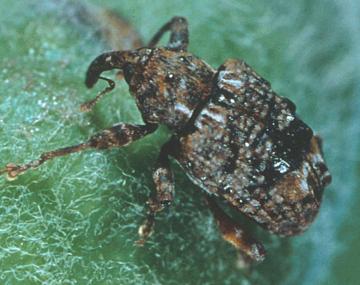
Adult PC are typical snout beetles (Fig. 1). They are dark brown to steely gray in color with patches of white or gray. They have four humps on their wing covers (elytra) and measure 4-6 mm in length. The beak or snout is 1/4 the body length, with the mouth parts located at the end. 

PC overwinter as adults in ground litter or the soil and become active in the spring following several days of either a mean temperature above 15.5°C (60°F) or maximum temperatures above 24°C (75°F). This time period normally coincides with the blossom period of apples. If temperatures drop and conditions become unfavorable, the adults may return to hibernation sites. Although the emergence period for PC lasts for several weeks, 40 to 60% of the total emergence occurs on a single day. 

Upon emerging in the spring, the PC fly to the trees where they feed on the buds, flowers, and newly set fruit. In feeding, the adult cuts a hole in the skin of the fruit and hollows out a cavity about 3 mm deep (Fig. 2). 

The beetles then mate. The length of the preoviposition period, following hibernation, is temperature-dependent and varies from 6 to 17 days. In egg laying, a female cuts a cavity under the fruit's skin with her snout. She then turns around and deposits an egg in the hole. Turning around again, she pushes the egg into the cavity with her snout. In front of the hole in which she has laid her egg, the female cuts a crescent-shaped slit which extends beneath the egg cavity so as to leave the egg in a flap of flesh (Fig. 3). This protects the egg from being crushed by the rapidly developing fruit. Feeding and oviposition wounds on apples frequently exude sap that dries to a white crust (Fig. 4). 

The progeny of adults that emerged in the spring appear as adults in July or August. They fly to the trees and feed on the developing fruit but do not reproduce in most instances. They are the adults that find hibernation sites in which to overwinter and produce their offspring the following year.

Eggs

PC eggs are laid singly in  newly developing fruit. The white, oval eggs measure about 0.35 by 0.6 mm and hatch in 2 to 12 days.

Larvae

Upon hatching, the young larvae bore into the fruit. On stone fruits, the larvae will feed to but not on the seed. Larvae will feed on the seeds of pome fruits. Larvae are killed in apples by the pressure of  growing fruit cells and can only complete their development in dropped fruit. 

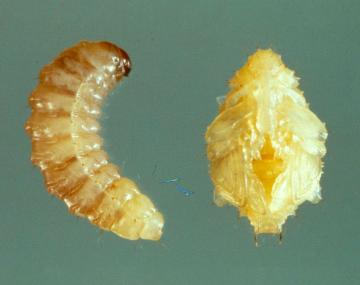
PC larvae are grayish-white, legless grubs with curved bodies and brown heads (Fig. 5a). The newly hatched larvae are about 1 mm long, while full grown larvae measure between 6 and 9 mm in length. The larval developmental time spent within the fruit is between 2 to3 weeks. Once they are full grown, larvae burrow an inch or two into the soil and construct a pupal chamber. It is normally 12 to 16 days before the larvae pupate after leaving the fruit. 

Pupae

The pupae are white and measure 4.5 to 7 mm long (Fig. 5b). Two to three  weeks are spent in the pupal stage before PCs become adults. Several additional days pass before the cuticles of the adults harden and they emerge from the ground.

Damage of plum curculio 

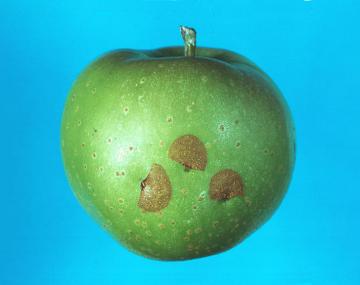
PC injury to fruit falls into several categories: surface feeding and oviposition wounds from overwintered beetles that can scar (Fig. 6) and/or misshape the fruit by harvest; internal injury produced by burrowing larvae (Fig. 7); premature dropping of the fruit; and feeding punctures made by adults in the late summer and fall (Fig. 8).

An adult plum curculio, shown as a typical weevil/snout beetle. Its body is reddish brown, gray, and black with lighter punctures along its wings. It has a long, dark rounded snout that extends from its head to the fruit below.

Figure 1. Adult plum curculio.

Three bright green apple fruitlets are seen hanging from their stems in a row. The first and the third fruits in the row have visible damage from PC feeding. They are brown punctures into the fruit taking up about 15% of the visible side of the fruitlet.

Figure 2. Feeding damage on newly set fruit following the emergence of PC in spring.

Crescent shaped slits seen at the bottom side of two green apples. The slits are brown and look almost as if a fingernail was pushed into the fruit. The second apple has a visible white ooze in the middle of the slit.

Figure 3. Crescent shaped slits left behind after oviposition.

Visible feeding and oviposition wounds on recently set apples. The feeding damage are brown punctures with white ooze seeping out. The sap is dried.

Figure 4. Feeding and oviposition wounds seen exuding sap which has dried to a white crust.

A close-up of a Plum curculio larva, showcasing its creamy white, C-shaped body with a distinct brownish head. Next to the larva is a  pupa, exhibiting a smooth, oval shape with a pale yellowish color. The pupa is segmenting showing where its features such as its legs will develop.

Figure 5. Plum curculio larva and pupa.

An apple showing three brown scars from surface feeding and oviposition wounds by overwintered Plum curculio beetles. Each scar is half-moon shaped, with a dark spot at the center of the flat edge, indicating damage to the fruit's surface.

Figure 6. Scars made by surface feeding and oviposition wounds from overwintered beetles.

An image of a misshapen apple cut in half  revealing internal damage caused by burrowing larvae. The first half shows the damaged rotting interior with  tunneling and a visible larva. The other half displays the fruit's outer skin, featuring a brown puncture mark that highlights the external damage.

Figure 7. Internal injury produced by burrowing larvae.

The bottom of a red apple is seen face up with four feeding punctures evenly spaced apart. The damage is a darker spot with an indent into the apple in the center.

Figure 8. Feeding punctures made by adults in the late summer and fall.

Monitoring plum curculio

Adults move into orchards from overwintering sites in hedgerows or the edges of woods, and adults are active when temperatures exceed 60°F, which usually corresponds to bloom. Adult females oviposit in fruit during both day and night but feed mostly at night. Depending on temperature, overwintering adults remain active for 2 to 6 weeks after petal fall. Because adults are not highly mobile, orchards near overwintering sites, woodlands, and hedgerows are most susceptible to infestation.  Fruit damage is usually most common in border rows next to sites where adults overwinter, and scouting for early damage should commence in orchard perimeters near these features.

Management of plum curculio

Although initial postbloom sprays for plum curculio control should begin at petal fall, growers are often unsure how many additional sprays will be necessary to maintain protective chemical residues to prevent subsequent damage throughout the PC oviposition cycle, which varies according to temperatures and weather patterns after petal fall.

As  PC activity and oviposition are largely determined by temperature, an oviposition model can be used to estimate when control sprays after petal fall are no longer necessary to protect fruit from PC damage. This model is based on the assumption that residues from sprays applied after petal fall need to be maintained on fruit and foliage only until PC adults stop immigrating into orchards, which happens to correspond to the time when about 40% of the oviposition cycle is complete. This is predicted by the model to occur at 308 DD (base 50°F) after petal fall of McIntosh. This strategy likely works because, after 40% of PC oviposition is complete, adults usually do not move into the orchard from outside sources, or within orchards from tree to tree. Therefore, by this time, adults residing in treated trees have already been killed by insecticide residues and are unable to complete the remainder of their normal oviposition cycle.

Using the degree day model for PC

  1. Treat the entire orchard at petal fall with an effective insecticide (e.g., Imidan, Actara, Avaunt, Verdepryn). 
  2. Start calculating the accumulation of DD after petal fall of McIntosh (base 50°F). This is is easily done from the NEWA Apple Insect Risk Models page by entering the petal fall date for your area. 
  3. No additional sprays are necessary whenever the date of accumulation of 308 DD falls within 10 to 14 days after a previous spray.

 In addition to  industry standard broad-spectrum materials such as Imidan, some additional options may be considered: Avaunt and Actara are effective for plum curculio in apples and pears, and Avaunt is also labeled in stone fruit as another PC option. Delegate, Assail and Altacor all have some activity on PC, but should not be considered as the first choices in high-pressure blocks. Another option would be Exirel, a second generation diamide with better efficacy against this pest.

Guide to plum curculio stages

  • Adults first flight
    Timing: Spring when temperatures exceed 15.5°C (60°F).
    Where to look: In orchards adjacent to hedgerows. Feeding wounds are frequently the first sign of adult presence.
  • Adults second flight
    Timing: Late July to hibernation when temperatures drop below 15.5°C (60°F).
    Where to look: In orchards adjacent to hedgerows. 
  • Eggs
    Timing: Petal fall and 30 days there-after.
    Where to look: On developing fruit within crescent shaped oviposition wounds.
  • Larvae
    Timing: Early June through mid-July.
    Where to look: Within injured, dropped fruit.
  • Pupae
    Timing: Mid-July through mid-August.
    Where to look: In soil within 25 mm (1 inch) of surface.

Authors

  • Monique Rivera
    Department of Entomology, Cornell University

  • Michael Basedow
    Eastern New York Commercial Horticulture Program, Cornell Cooperative Extension

  • Janet van Zoeren
    Lake Ontario Fruit Program, Cornell Cooperative Extension

Last updated: 2022

Modified from an article written by S. E. Lienk: Lienk, S. E. (1980). Plum curculio. New York State IPM Program.

  • Figure 1. Adult plum curculio. Photo: NYSAES, Cornell University
  • Figure 2. Feeding damage on newly set fruit. Photo: NYSAES, Cornell University
  • Figure 3. Crescent shaped slits. Photo: NYSAES, Cornell University
  • Figure 4. Feeding and oviposition wounds. Photo: NYSAES, Cornell University
  • Figure 5. Plum curculio larva and pupa. Photo: NYSAES, Cornell University
  • Figure 6. Scars made by surface feeding and oviposition. Photo: NYSAES, Cornell University
  • Figure 7. Internal injury produced by burrowing larvae. Photo: NYSAES, Cornell University
  • Figure 8. Feeding punctures made by adults. Photo: NYSAES, Cornell University
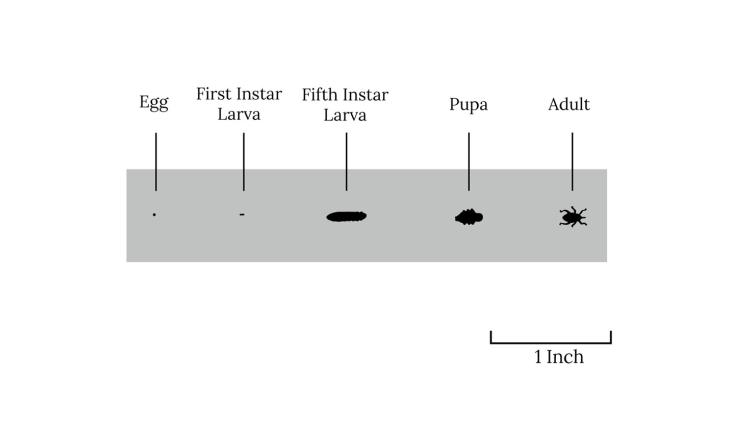
  • Figure 9. Size comparison of life stages. Illustration: Hannah Tolz, CIPM
portrait of Anna Wallis
Anna Wallis

Fruit IPM Coordinator

Cornell Integrated Pest Management

Anna Wallis
  • aew232 [at] cornell.edu
Janet van Zoeren
Janet van Zoeren

Integrated Pest Management Specialist

Cornell Cooperative Extension

Janet van Zoeren
Michael Basedow
Michael Basedow

Extension Associate Tree Fruit Specialist

Cornell Cooperative Extension

Michael Basedow
Fruit thinning
Applied pest management
Headshot of a woman outside in a blue shirt
Monique Rivera

Assistant Professor

Department of Entomology

Cornell AgriTech

Monique Rivera
  • monique.rivera [at] cornell.edu