Oriental Fruit Moth (Grapholita molesta)
Fruit IPM Fact Sheet
The Oriental fruit moth, native to China, primarily affects peaches but also targets apples, pears, plums, cherries, apricots, nectarines, and some ornamental plants.
In this fact sheet
- Biology of Oriental fruit moth
- Damage of Oriental fruit moth
- Monitoring Oriental fruit moth
- Managing Oriental fruit moth
- Guide to stages of Oriental fruit moth
Featured image
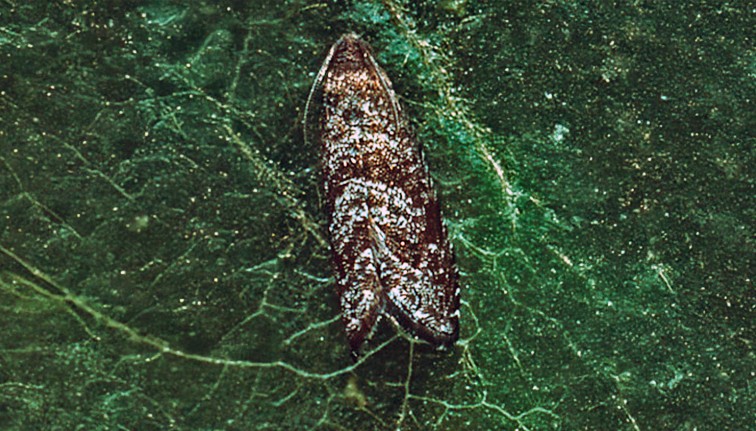
Figure 1. Adult OFM.
The Oriental fruit moth (OFM), native to China, was introduced to the United States from Japan about 1913 on infested nursery stock. The OFM is now found in all regions of North America where peaches are grown. Although it is most important as a pest of peach, the OFM has an extensive host range that includes apple, quince, pear, plum, cherry, apricot, nectarine, and some rosaceous ornamentals. In the northeastern United States, the OFM has three generations (flights) per year. In areas with a longer growing season, it may have up to five generations per year.
Biology of Oriental fruit moth
Adults
The adult OFM (fig. 1) is a small, grayish moth with a wingspan of approximately 13 mm (0.5 in.). Adults of the overwintering generation begin to emerge about the time of apple bloom, and females begin to lay eggs after a two- to five-day pre-oviposition period. Each female can lay up to 200 eggs during her seven- to ten-day oviposition period.
Eggs
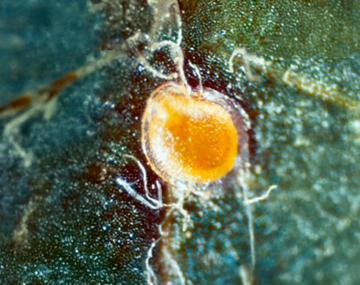
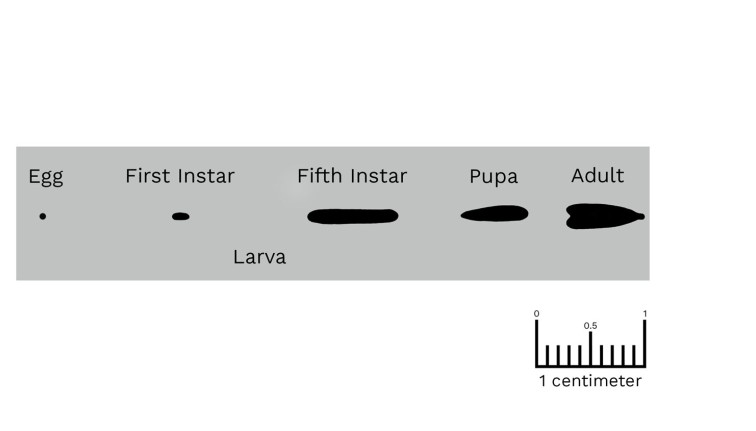
Eggs are found on upper leaf surfaces, frequently on the terminal leaf of a young shoot. Each egg is slightly oval, measuring 0.6 x 0.7 mm (.02 x .03 in.). It is translucent white when first laid, changing later to an amber color (fig. 2). The incubation period varies with temperature, ranging from three to four days at midsummer, to seven to fourteen days during the cooler part of the season. Just before the larva hatches, the dark head capsule can be seen through the egg. This is known as the "black head" stage.
Larvae
Shortly after hatching, larvae enter young terminals or fruit and begin to feed. The larvae pass through four to five instars, and range in length from 1.5 mm (.06 in.) when newly hatched to approximately 12 mm (.5 in.) when mature. Newly hatched larvae are white, with a black head capsule.
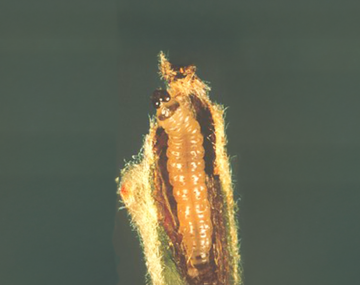
Mature larvae are dirty white to pink in color, with a reddish brown head capsule (fig. 3). If a terminal becomes unsuitable as a food source before larval development is complete, larvae seek other terminals, or move to fruit to complete their development. Mature larvae leave their feeding sites to spin cocoons in which they either pupate, or enter diapause to overwinter. Diapause is a resting period that allows many species of insects to suspend development until weather conditions become favorable. In the OFM, diapause is induced by decreasing day length in late summer.
Pupae
Pupae are found within cocoons on the trunk (usually within two feet of the ground) or in debris on the ground under the tree. The cocoons are constructed of silk, and are covered with particles of the surface on which they are spun. Early in the season, nearly all of the larvae pupate soon after spinning a cocoon. The pupal stage lasts from twelve to fifteen days in the summer, and somewhat longer at cooler temperatures during the spring. Later in the season, as day length decreases, an increasing proportion of larvae enter diapause to overwinter. Diapausing larvae pupate and emerge the following spring.
Figure 2. OFM egg.
Figure 3. OFM Larvae.
Damage of Oriental fruit moth
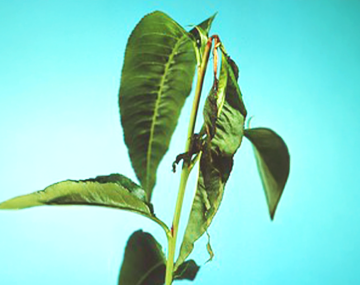
On peach, the OFM feeds on both vegetative growth and fruit. The first generation, which is feeding when terminals are succulent and tender, develops almost exclusively in the vegetative growth. The larvae often enter the terminal at the base of a young leaf, and tunnel toward the base of the shoot. Infested terminals wilt and die back to the margin of feeding, and are commonly called "strikes" or "flagged shoots" (fig. 4). Heavy twig infestations of nursery stock can adversely affect the shape of the tree. Axillary buds often begin to grow when the terminal shoot is killed, causing the tree to have a bushy appearance.
Fruits that are infested when very small often drop. Early-infested peaches that do not drop have obvious entrance holes with frass and gum exuding from them (fig. 5). Larvae attacking nearly ripe peaches usually enter the fruit near the stem, leaving only a very small, inconspicuous entrance hole. The larvae tunnel in the fruit, and frequently excavate cavities near the pit (fig. 6).
Terminal feeding on apple is similar to that on peach. Infested apples have a collection of frass at the exit hole of the insect's feeding tunnel (fig. 7), or at the calyx end. It is difficult to distinguish between OFM damage and codling moth damage. OFM larvae feed randomly in the apple, and usually do not feed on the seeds (fig. 8), while codling moth larvae usually tunnel directly to the core of the apple and feed on the seeds. Later instar larvae of the two species may be distinguished by the presence or absence of the anal comb at the tip of the abdomen. The anal comb is present in the OFM and absent in the codling moth (fig. 9).
Figure 4. Damage to peach shoots and leaves caused by OFM larva.
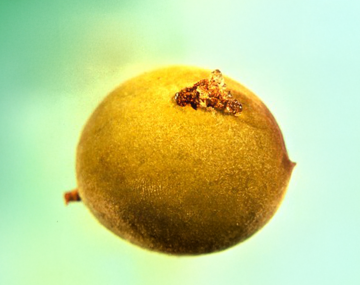
Figure 5. Damage to peach fruit caused by OFM.
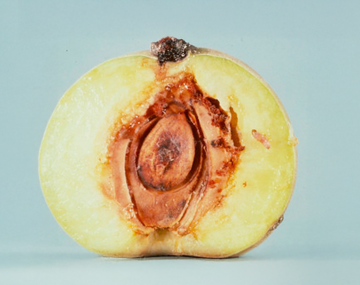
Figure 6. Damage to peach fruit caused by OFM (cross-sectioned).
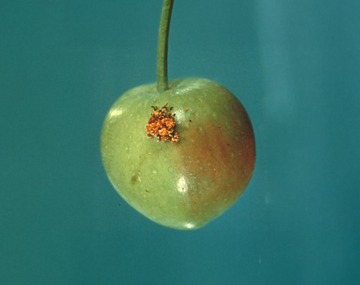
Figure 7. OFM larval damage to an apple.
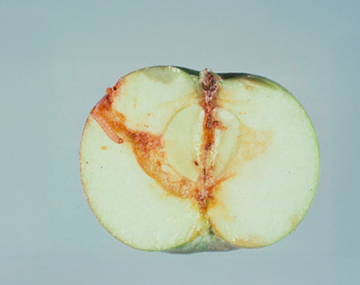
Figure 8. OFM damage to an apple (cross-sectioned).
Monitoring Oriental fruit moth
Monitoring for OFM is performed using delta traps hung in the orchards to determine when adult flights begin. There are about three flights of this insect per year. Typical traps are triangular in shape with a sticky inner surface (e.g, delta or Pherocon IIB traps). The OFM pheromone comes in a rubber capsule that you can simply place in the trap on the sticky surface and replace as directed.
Oriental fruit moth management
Predators and parasites feed on CM, but these natural enemies cannot keep this pest from reaching damaging levels in commercial orchards.
Mating disruption (available products include Isomate-CM/OFM TT, OFM TT or CM/ OFM Mist; Cidetrak OFM-L Meso; Checkmate OFM-F or Puffer CM-OFM) is a recommended complement to any management program. These materials should be deployed prior to the first adult moth flight in the spring.
To maximize the efficacy of 1st brood control, peach growers should use one of the suggested options from the Cornell Tree Fruit Guidelines starting at petal fall, backed up 10–14 days later. In apples, in addition to Delegate, Altacor, Exirel, and Verdepryn, a number of the petal fall selection of insecticides will do an acceptable job of controlling this generation, including Imidan, the pyrethroids, Intrepid, Assail, Avaunt and Grandevo. For resistance management, rotate to a different material for the 2nd generation larvae in the summer.
For growers wishing to save A-list products like Altacor or Delegate until after petal fall, a B.t. product would be an option from pink through bloom. For the second generation in the summer, in sites with more modest pressure, applications of a B.t. product on a 7–10-day schedule helps to maintain populations below an economic level; options include Deliver, Dipel, Biobit, Javelin, and Agree. This is also an appropriate time for Madex HP or Virosoft CP4; these products will help to lower overall population levels over the long term. Alternate row middle applications will not be as effective as whole orchard sprays in high-pressure blocks.
Any time you use a pesticide, you must read and follow the label directions and comply with all applicable laws and regulations related to pesticide use. Also be sure that any pesticide used is approved for use in your country and state/province.
Guide to Oriental fruit moth stages
- Adults (first flight)
Timing (in New York State): Half-inch green (apple); half-inch green to bloom (peach); until mid harvest-June
Where to look: Pheromone traps - Adults (second and third flights)
Timing (in New York State): Early July through August
Where to look: Pheromone traps - Eggs
Timing (in New York State): Tight cluster through harvest (apple); pink through harvest (peach)
Where to look: Upper leaf surface and fruit - Larvae
Timing (in New York State): Bloom through harvest
Where to look: In tender shoots and fruit - Overwintering
Timing (in New York State): August to mid-March
Where to look: In cocoons under bark scales and in leaf litter under tree - Pupae
Timing (in New York State): Early spring through summer
Where to look: In cocoons under bark scales and in leaf litter under tree
Life stages
Figure 9. Size comparison between the OFM life stages.
Authors
Monique Rivera
Department of Entomology, Cornell UniversityMichael Basedow
Eastern New York Commercial Horticulture Program, Cornell Cooperative ExtensionJanet van Zoeren
Lake Ontario Fruit Program, Cornell Cooperative Extension
Last updated: 2022
- Figure 1. Adult Oriental Fruit Moth. Photo: NYSAES, Cornell University
- Figure 2. Oriental Fruit Moth Egg. Photo: NYSAES, Cornell University
- Figure 3. Oriental Fruit Moth Larvae. Photo: NYSAES, Cornell University
- Figure 4. Damage to peach shoots and leaves. Photo: NYSAES, Cornell University
- Figure 5. Damage to peach fruit. Photo: NYSAES, Cornell University
- Figure 6. Damage to peach fruit Photo: NYSAES, Cornell University
- Figure 7. Oriental Fruit Moth larval damage to an apple. Photo: NYSAES, Cornell University
- Figure 8. Oriental Fruit Moth damage to an apple (cross-sectioned). Photo: NYSAES, Cornell University
- Figure 9. Size comparison between OFM life stages. Illustration: Sean O’Hehir, Cornell IPM
- aew232 [at] cornell.edu
- (585) 797-8368
- jev67 [at] cornell.edu
- (518) 410-6823
- mrb254 [at] cornell.edu
- monique.rivera [at] cornell.edu