Obliquebanded Leafroller (Choristoneura rosaceana)
Fruit Fact Sheet
The obliquebanded leafroller (OBLR) is native to temperate North America. Larvae feed on various plants, especially those in the rose family. OBLR can cause severe damage to apple, peach, and pear fruit, with 1-2 generations per year.
In this fact sheet
- Biology of obliquebanded leafroller
- Damage of obliquebanded leafroller
- Monitoring obliquebanded leafroller
- Managing obliquebanded leafroller
- Guide to obliquebanded leafroller stages
The obliquebanded leafroller (OBLR) is native to and widely distributed throughout temperate North America. Larvae feed on a wide range of plants; members of the rose family are their preferred hosts. OBLR outbreaks have resulted in severe damage to apple, peach, and pear fruit. The OBLR may have 1-2 generations a year, depending on the locality.
Biology of obliquebanded leafroller
Adults
The spring flight of OBLR adults begins about 3-4 weeks after petal fall on apples, and continues for 3-4 weeks. In areas where the OBLR has 2 generations, a second flight occurs from early August through early September.
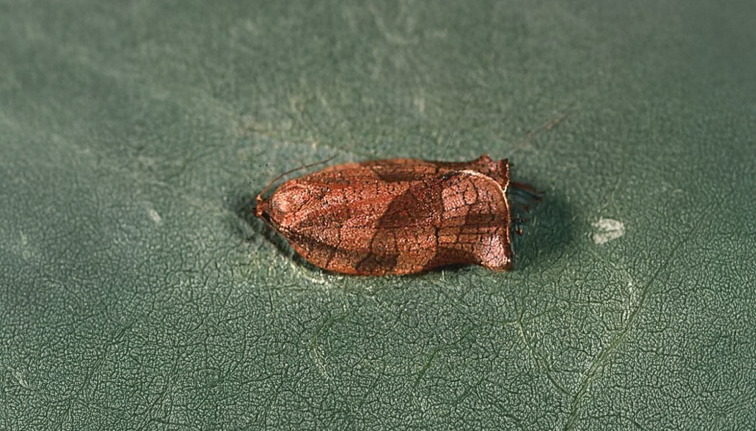
OBLR adults are 9-12 mm in length and have a wingspan of 20-27 mm. The forewings are reddish-brown and crossed by 3 oblique chocolate brown bands (Fig. 1). The hind wings, which are not visible when the moth is at rest, are pale yellow. After emergence, females have a 24 hr preoviposition period. They then begin laying egg masses which gradually diminish in size with each succeeding egg mass laid. A female is capable of laying up to 900 eggs during her 7-8 day oviposition period.
Eggs
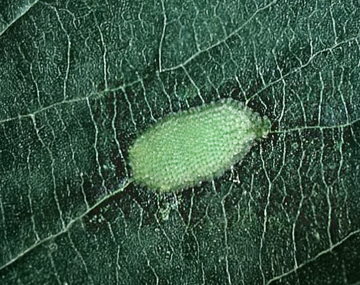
OBLR eggs are laid on the upper surface of leaves. They appear as greenish yellow masses measuring about 5 by 9 mm (Fig. 2) and may contain 200 or more eggs. The black head capsules of embryonic larvae become visible prior to hatching which usually occurs in 10-12 days.
Larvae
OBLR larvae are indiscriminate feeders that pass through 6 instars. Newly hatched larvae have a yellowish green body and a black head and thoracic shield. Mature larvae are 20-25 mm in length and the head and thoracic shield may be either black or various shades of brown (Fig. 3). The first summer brood of larvae emerge in early July and complete their development in late July or early August. Second brood larvae begin to emerge in mid August, and feed until they reach the third instar in the fall, when they construct hibernation sites on twigs or bark and enter winter diapause. These overwintering larvae resume activity the following spring when the tree breaks dormancy and complete their development about 3 weeks after the apple blossom period.
Overwintered OBLR larvae (springbrood) first feed on water sprouts and then move throughout the tree. Those feeding on developing flower buds do so before bloom and continue to consume floral parts throughout the blossom period. After petal fall, these larvae continue feeding on the developing fruit. Newly hatched larvae of the first summer brood move to and feed on tender growing terminals, water sprouts, or developing fruit. As these larvae reach the third instar they display an increasing propensity to damage fruit. The second brood larvae, which develop in late summer and fall, feed primarily on leaves until they enter diapause, although they may occasionally damage fruit.
Pupae
OBLR pupae are dark brown, about 11 mm in length, and are usually found in rolled leaves on the tree.
Figure 2. Obliquebanded leafroller egg mass.
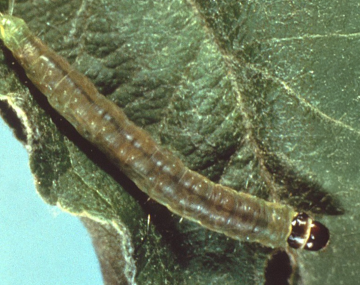
Figure 3. Obliquebanded leafroller larva.
Damage of obliquebanded leafroller
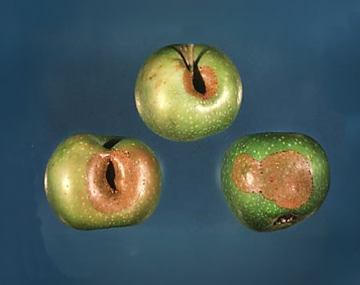
The most serious injury from overwintering OBLR larvae occurs just prior to and shortly after petal fall when the developing fruit is damaged. Many of these damaged fruits drop prematurely, but a small percentage remain on the tree, exhibiting deep corky scars and indentations at harvest (Fig. 4). Leaf injury by all broods is characterized by the larvae rolling leaves and feeding on surrounding foliage (Fig. 5). The first summer brood larvae feed on the surface of developing fruit in late July and early August (Fig. 6). This injury is similar to that caused by several other species of leafrollers. Fruit damage caused by first summer brood OBLR larvae is usually more serious than spring feeding by overwintered larvae because more of the fruit injured later in the season remains on the tree at harvest.
Monitoring obliquebanded leafroller
Ahead of your petal fall applications, it would be prudent to have a quick look for later-stage larvae in problem blocks to determine whether a treatment against the overwintered brood should be included in your petal fall plans. Scout the blossom clusters or foliar terminals for larvae feeding within both the flowers and rolled leaves; a 3% infestation rate could justify an application to minimize overwintered fruit damage and help reduce summer populations; there's a sequential sampling chart to facilitate this process in the Cornell Tree Fruit Guidelines.
Monitoring for OBLR can also include hanging pheromone traps to determine when adult flights begin. There are two adult flights per year. Typical traps are triangular in shape with a sticky inner surface (e.g, delta or Pherocon IIB traps). The OBLR pheromone comes in a rubber capsule that you can simply place in the trap on the sticky surface and replace as directed.
To monitor OBLR, set traps in mid-May (Hudson Valley), early June (western NY or Champlain Valley). Trap placement is about 60 ft. into the orchard and separate traps from other OBLR traps by about 160 ft. and from other species' traps by about 60 ft. Check traps at least once per week for OBLR males.
OBLR weekly trap catch provides an indication of insect pressure in the orchard. If pressure is high, use the NEWA OBLR model. First trap catch is the biofix date for the OBLR model. Use this date to increase precision of the degree day model spray windows. We recommend sampling at 600 DD (base 43°F) after the first adult catch, to determine the need and timing for treatment.
For problem orchards with a reliable OBLR history where sampling is generally not needed, egg hatch (which equates to the first occurrence of susceptible larvae) occurs more or less 350 DD after the 1st adult catch. The suite of NEWA risk models for apple insect pests can help you zero in on these events in your specific area.
Figure 4. Damage to apples caused by obliquebanded leafroller larvae.
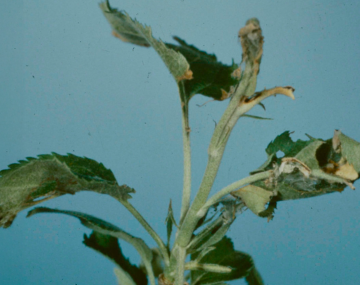
Figure 5. Leaf injury caused by obliquebanded leafroller larvae.
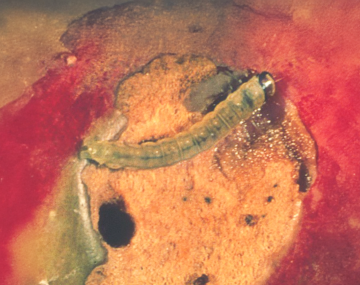
Figure 6. Obliquebanded leafroller larva and damage to an apple.
Managing obliquebanded leafroller
Where OBLR have historically been problematic, an application of Intrepid, Proclaim, Rimon, Grandevo, or a B.t. product (e.g., Agree, Dipel, Deliver, Javelin) at petal fall will help diminish the population for better management during the summer. Although Altacor, Delegate, or Exirel are also very effective against OBLR, it would be advisable to save these big guns for the summer generation larvae, which are more of a direct threat to the developing fruits.
Orchards with historically high OBLR pressure should normally receive an application of a suitable material during the first part of July. Delegate, Altacor, Verdepryn, Exirel, Rimon and Proclaim are appropriate choices, particularly in cases where the larvae are a bit larger. B.t. products such as Dipel, or the IGR Intrepid are also options, but tend to be more effective when applied against the earlier stages. If you are applying any of the diamides (Altacor, Exirel, Verdepryn, plus the various premixes containing the same a.i.s) or Delegate to control codling moth and oriental fruit moth, they will also be very effective against OBLR for control of the first summer generation. This July spray is the most critical for preventing fruit-feeding damage at harvest, so put this at the top of your list of priorities if OBLR has tormented you in the past.
If you struggle to manage the 1st summer brood, keep an eye on your fruits in late July to determine whether a late application of Altacor, Delegate, Exirel, Verdepryn, Minecto Pro, Proclaim, Rimon or a B.t. material might be of use in heading off late-season feeding damage.
Any time you use a pesticide, you must read and follow the label directions and comply with all applicable laws and regulations related to pesticide use. Also be sure that any pesticide used is approved for use in your country and state/province.
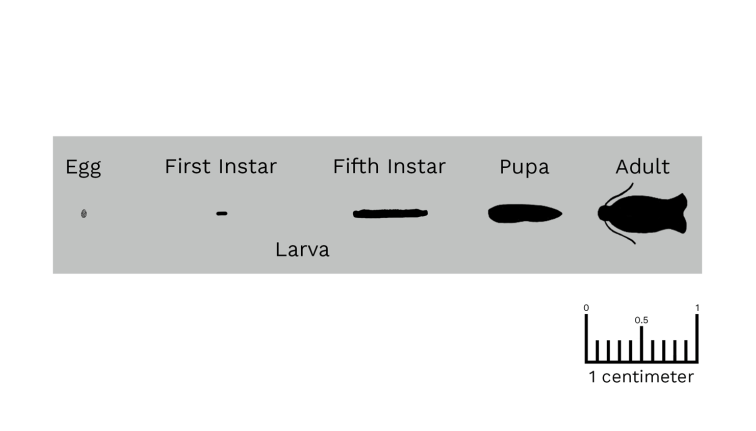
Figure 7. OBLR life stages diagram.
Authors
Monique Rivera
Department of Entomology, Cornell UniversityMichael Basedow
Eastern New York Commercial Horticulture Program, Cornell Cooperative ExtensionJanet van Zoeren
Lake Ontario Fruit Program, Cornell Cooperative Extension
Last Updated: 2022
- Figure 1. Obliquebanded leafroller adult. Photo: NYSAES, Cornell University
- Figure 2. Obliquebanded leafroller egg mass. Photo: NYSAES, Cornell University
- Figure 3. Obliquebanded leafroller larva. Photo: NYSAES, Cornell University
- Figure 4. Damage to apples caused by obliquebanded leafroller larvae. Photo: NYSAES, Cornell University
- Figure 5. Leaf injury caused by obliquebanded leafroller larvae. Photo: NYSAES, Cornell University
- Figure 6. Obliquebanded leafroller larva and damage to an apple. Photo: NYSAES, Cornell University
- Figure 7. Obliquebanded Leafroller life cycle diagram. Illustration: Sean O’Hehir, Cornell Integrated Pest Management.
- aew232 [at] cornell.edu
- (585) 797-8368
- jev67 [at] cornell.edu
- (518) 410-6823
- mrb254 [at] cornell.edu
- monique.rivera [at] cornell.edu