Fall Armyworm (Spodoptera frugiperda)
Vegetable IPM Fact Sheet
Fall armyworm (FAW) is a pest that is resident in the southern United States. Adult moths migrate to the northeast in June, and remain there until freezing temperatures. In that time, FAW can be a serious problem in corn, damaging ears and greatly reducing yield.
In this fact sheet
- Appearance of Fall armyworm
- Signs and symptoms of Fall armyworm
- Life cycle of Fall armyworm
- Managing Fall armyworm
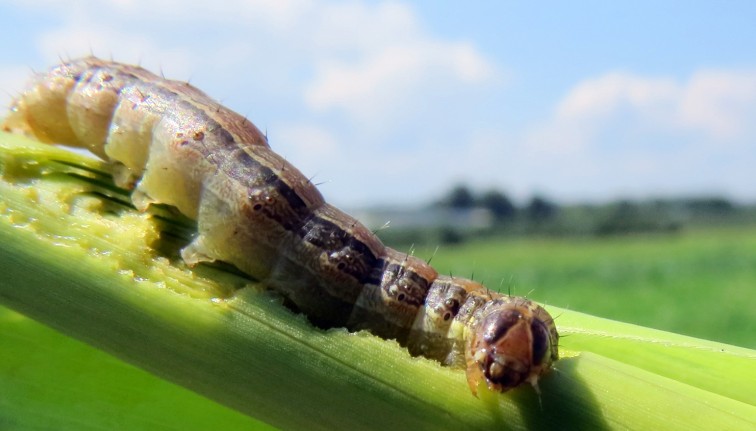
FAW is a pest species that is a year-round resident in warmer areas, such as Florida, Texas, and the tropics of Central and South America. FAW moths migrate further north annually, arriving in the Northeast between early and late July. Depending on temperatures in the late summer and early fall in the Northeast, there may be a partial second generation following the first generation of FAW. Warming climate is contributing to greater frequencies of FAW outbreaks in the northern U.S., while expanding its winter range in the southern U.S. FAW feeds on a variety of crops, including corn, sorghum, small grains, and grasses. In corn, larvae feed on the whorl and ears, greatly reducing yields during years with high infestations.
Appearance of Fall armyworm
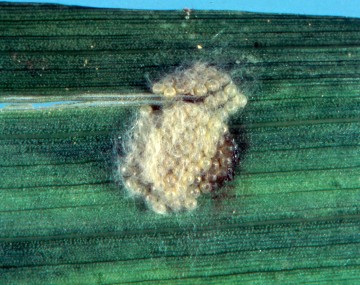
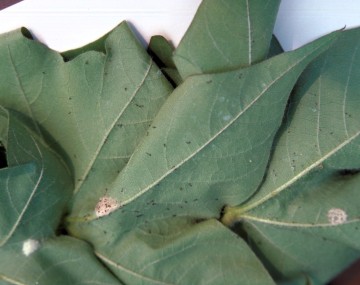
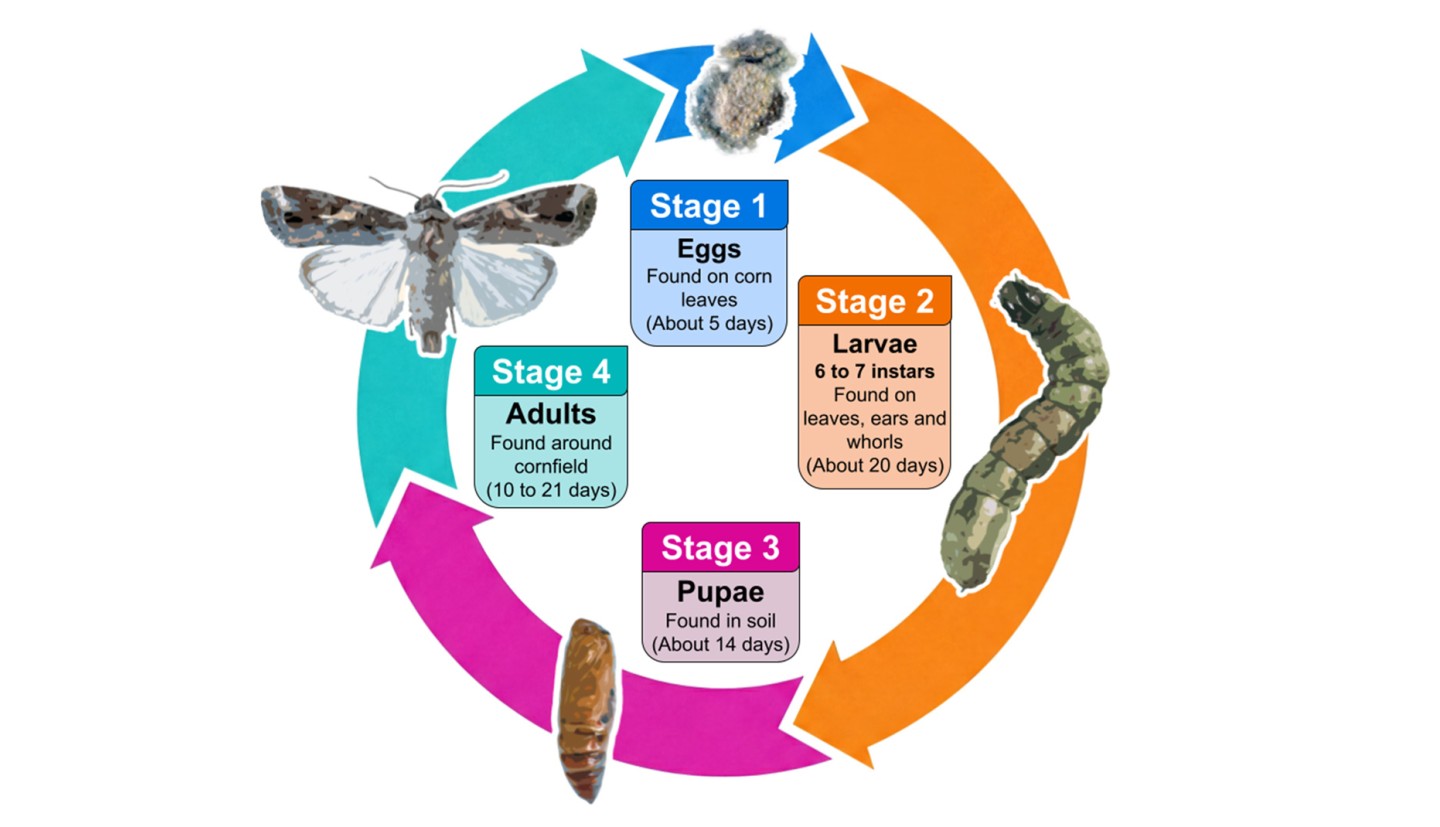
- Eggs: FAW eggs are very small, with a diameter of less than 1/32 of an inch wide. They are laid by moths during the nighttime directly on corn plants in clusters of up to hundreds of eggs. The egg clusters are covered with fluffy hairs from the female moths. Eggs when first laid will have a pale yellow color, and darken to a black color closer to hatching.
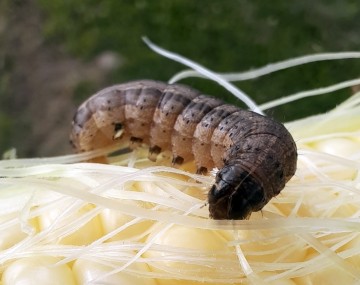
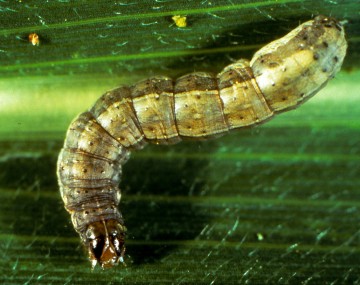
- Larvae: The larvae of FAW go through 6 to 7 instars before pupation, growing up to 1.5 inches long. The body color of the larvae can vary between greens, brown and black, but there are two distinct characteristics all larvae share. One is an inverted pale “Y” shape on the head capsule, and the other is 4 black dots arranged in a square at the rear of their body.
- For more information on how to ID FAW larvae, see the Cornell IPM Sweet Corn Larval Pest Identification fact sheet (pdf).
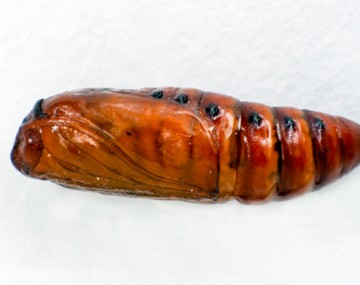
- Pupae: Pupae of FAW have a reddish-brown color, similar to other armyworms and cutworms. They are about 1 inch in length, and are found below the soil surface.
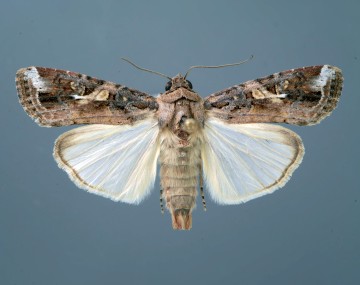
- Adults: Adult FAW are moths with hind wings that are grayish-white in color. The forewings are dark gray with mottled patches and a white spot at the tip of the wing. Their wingspan is typically 1.5 inches wide.
Signs and symptoms of Fall armyworm
Life cycle of Fall armyworm
- Adult FAW migrate annually to the Northeast during the month of July. Female moths lay their eggs directly on the crop, with a single female producing up to 1,000 eggs in her lifetime (10 to 21 days).
- Depending on the moth’s arrival time and temperatures from the end of summer to the beginning of fall, there may be one whole generation and a partial second generation of FAW.
- Eggs once laid by moths will typically hatch in around 5 days, though this is also temperature dependent.
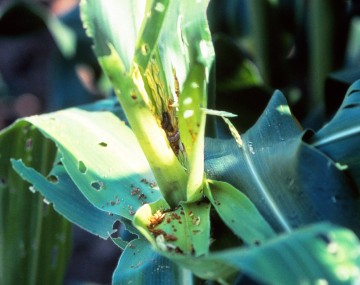
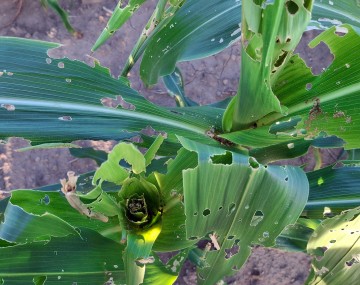
- Larvae are the most destructive stage of FAW development to crops. Once hatched, larvae take around 20 days to fully grow, going through six or seven instars. In this time, the larvae first feed on the whorl of leaves in the center of the plant. This gives the leaves a ragged, hole-ridden appearance and stunts plant growth.
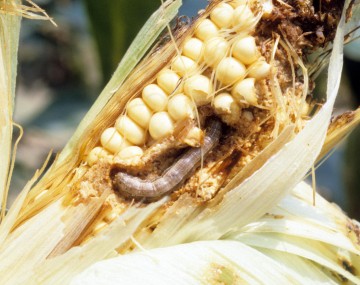
- Later in the season once the ears develop, the larvae will feed on the ears, entering the ear through its silk channel or by boring a hole in the side. Years with heavy infestations will see a high percentage of corn ears in a field with this type of damage.
- Pupation begins when fully grown larvae burrow into the soil near their host crop. This stage lasts for around two weeks until moths of the second generation emerge around September to early October in the Northeast
- These newly hatched moths lay eggs for the second generation, which survive until freezing temperatures. Fall armyworm is unable to overwinter in the northeast.
Management of Fall armyworm
Pest monitoring
- FAW larvae are hard to scout for initially during the season, since the early larval instars are very small and don’t do much damage to crops. It is still essential to scout for FAW at this stage because once larvae grow beyond 3/4 of an inch in length, their susceptibility to insecticides decreases.
- Trap catches in New York State begin around mid-July for migrating moths, and peak around mid-September.
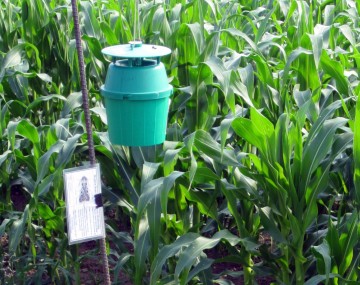
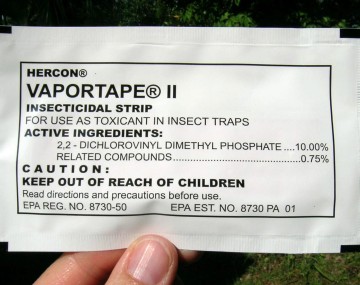
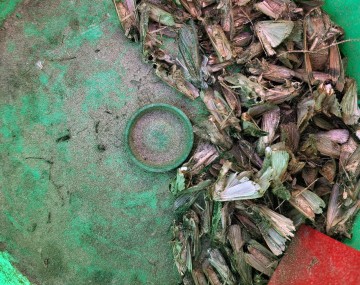
- It is better to rely on green bucket pheromone or black light traps to monitor FAW populations. Spray intervals for FAW can be based on weekly trap catches.
- After early arrivals of moths are trapped, regularly scout fields for whorl damage to estimate population levels. Action thresholds for FAW in corn are 15% of total plants damaged or 5% for silking corn.
- For more information on monitoring FAW, see the Cornell Pheromone Traps for Sweet Corn fact sheet.
- For more instruction on sweet corn trap monitoring, watch Cornell IPM’s Sweet Corn Pheromone Trap Network Setup and Monitoring video.
- The Sweet Corn Pheromone Trapping Network has been monitoring FAW populations in NY since 1997. To get weekly trapping reports visit the IPM sweet corn network website.
Control
- Cultural control: Planting earlier or using earlier-maturing varieties can help crops escape peak FAW pressure, reducing the risk of severe damage. Controlling grassy weeds and volunteer cereals near fields removes alternative hosts that can support early FAW larvae before they move into the crop.
- Biological control: Common beneficial organisms such as ground beetles, soldier bugs, birds and rodents are known to prey on FAW. They are often unable to suppress outbreaks of large populations of FAW, and other control methods must be used instead.
- Bt corn hybrids: Certain field and sweet corn hybrids are available that possess resistance to FAW. These hybrids contain the Bt trait, which enables the plant to produce insecticidal proteins that help protect against FAW feeding. Refer to seed company guidelines when using Bt or other corn hybrids.
- Chemical control: Refer to your local Cornell Cooperative Extension or state guidelines when applying insecticides to crops.
- Responsible pesticide application should be planned when applying any insecticide to crops. This ensures that resistance to pesticides is minimized in the targeted pest population, while minimizing damage to beneficial insects and pollinator populations.
Use the EIQ (Environmental Impact Quotient) calculator to assess the environmental and health impacts different pesticides have before selection.
Any time you use a pesticide, you must read and follow the label directions and comply with all applicable laws and regulations related to pesticide use. Also be sure that any pesticide used is approved for use in your country and state/province.
Authors
Marion Zuefle
Vegetable IPM Coordinator, Cornell Integrated Pest ManagementLukas Rood
Temporary Program/Extension Aide, Cornell Integrated Pest Management
Last updated: February 2026
Modified from an article written by A.A. Muka: Muka, A. A. (1983). Fall armyworm. Cornell University Library eCommons. https://hdl.handle.net/1813/42368
This factsheet was developed in part with funding support from the New York State Department of Agriculture and Markets.
- Tilmon, Kelley and Michel, Andrew. “Fall Armyworm in Ohio Field Crops.” Ohio State University Extension, https://ohioline.osu.edu/factsheet/ent-0093. Accessed 10 February 2026.
- Bohnenblust, Eric and Tooker, John. “Fall Armyworm as a Pest of Field Corn.” Penn State Extension, https://extension.psu.edu/fall-armyworm-as-a-pest-of-field-corn. Accessed 10 February 2026.
- One of the most…—photo by Ken Wise, Cornell IPM
- Eggs laid by FAW…—photo by Abby Seaman, Cornell IPM
- The larvae of FAW…—photo by Ronald Smith, Auburn University
- Another one of the…—photo by Abby Seaman, Cornell IPM
- FAW larvae can vary…—photo by Marion Zuefle, Cornell IPM
- Pupae of FAW are…—photo by Daniel Reiland, North Carolina State University
- FAW moths are similar…—photo by Lyle Buss, University of Florida
- FAW larvae will feed…—photo by Marion Zuefle, Cornell IPM
- FAW larval feeding can…—photo by Marion Zuefle, Cornell IPM
- Later in the season…—photo by John C. French Sr., Retired, Universities:Auburn, GA, Clemson and U of MO
- FAW bucket traps are…—photo by Keith Waldron, Cornell IPM
- Strips laced with insecticide…—photo by Julieta Brambila, USDA APHIS PPQ
- FAW moths are collected…—photo by Marion Zuefle, Cornell IPM
- (315) 787-2379
- mez4 [at] cornell.edu