Pheromone Traps for Sweet Corn
Vegetable IPM Fact Sheet Overview
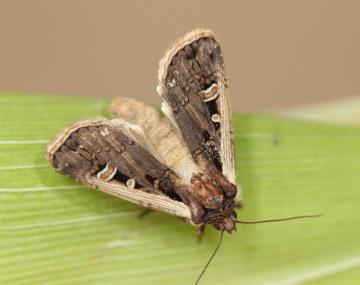
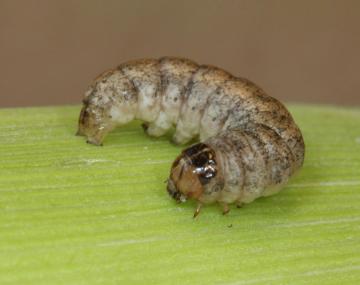
Pheromone traps are used to monitor lepidopterous pests in sweet corn. These traps help detect pest presence early, allowing for timely management decisions and reducing crop damage. Regular trapping is essential for effective, sustainable pest control.
In this fact sheet:
- Types of pheromone traps
- Pheromone trap placement and handling
- Corn lepidopteran pests in the New York State area
Insects attract individuals of the opposite sex through the release of sex pheromones. These chemical volatiles allow for the transmission of highly specific signals that convey information about an individual's species, sex, and even their reproductive readiness. Synthetic pheromone traps mimic male/female emitted reproductive chemical volatiles to lure and trap insects. There are three main benefits to using pheromone traps in the field:
- Early detection of pests
- Aid in chemical pesticide usage and efficiency
- Directly decreasing abundance of pest populations
Types of pheromone traps
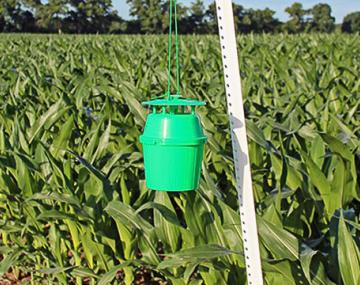
Insect monitoring in sweet corn uses two types of traps: bucket traps and net traps. Bucket traps are composed of a lid housing a cage that suspends a pheromone lure above a funnel, directing insects down into a collection bucket. On the other hand, net traps are typically constructed from lightweight materials and feature a conical or pyramid-shaped design with a pheromone lure compartment at the top that guides insects into the trap, making it difficult for them to escape. While both of these traps are versatile, they each offer different advantages and disadvantages. Trap type used for each species was determined based on which trap type is most effective in trapping each species.
- Bucket traps are durable, low-cost, easy to store/clean, but have lower pest catch-rates
- Net traps are more likely to catch more insects to give a more accurate pest assessment but are less durable, high-cost, and take up a lot of space
Pheromone trap placement and handling
Using pheromone traps for insect monitoring can be highly effective, but there are some essential guidelines to keep in mind. To ensure you capture the first adult flight and get early warnings of insect presence, it's best to set traps and pheromones in the field before the expected period of adult insect activity, as well as follow all standard protocols below.
- Traps for different species should be placed a minimum of 40-60 feet apart and positioned along the edge of a cornfield or windward side so that the pheromone will be blown into the field.
- To optimize pheromone spreading and moth congregation, it is highly recommended to avoid placing traps on hedgerows or bare ground
- Net traps should be placed at least 1 meter high and bucket traps should be placed at the height of the corn canopy
- Store pheromones frozen in a sealed container until they are ready to use, though refrigeration is the minimum requirement
- Avoid exposing pheromones to high temperatures before using them in the field
- Always use latex gloves or forceps when handling lures, to avoid cross-contamination of different lures
- Change out lures every two weeks to maintain trap effectiveness
- Check traps at least weekly, preferably two to three times a week
Corn lepidopteran pests in the New York State area
Corn lepidopteran pests pose a significant threat to sweet corn crops. These pests in their larval form can cause substantial damage to corn plants by feeding on various parts of the plant resulting in reduced crop yield and quality. The following are the most common corn pests in New York State, as well as when to set up their respective traps.
- European Corn Borer (E/Z) - set up traps mid to late May
- Corn Earworm - set up traps mid to late May
- Fall Armyworm - set up traps mid to late May
- Western Bean Cutworm - set up traps early to mid June
| Pest | Trap Design | Lure | Lure Field Life (Freezer storage life) | Growth Stage of Corn |
|---|---|---|---|---|
| European Corn Borer | Scentry (TM) Heliothis net | Trece (TM) E-race (ECB II) Z-race (ECB I) | 2 weeks (3 years) | Mid-whorl to silk |
| Corn Earworm | Scentry (TM) Heliothis net | Hercon (TM) | 2 weeks (1 year) | Green silks present |
| Fall Armyworm | IPS (TM) Universal moth trap or unitrap (all green trap) | Scentry (TM) (4-component) or (2-component), TreceTM (3-component) | 3 weeks (2 years) | Late whorl to green silk |
| Western Bean Cutworm | IPS (TM) Universal moth trap or unitrap (all green trap) | Scentry (TM) | 2 weeks (1 year) | Pre-tassel to silk |
Note: TM denotes a trademarked name.
European corn borer (E/Z)
The European corn borer (Ostrinia nubilalis), a grain pest native to Europe, particularly infesting maize and various millet varieties, was first reported in North America in 1917 and likely introduced from Europe. Since then, it has spread westward across the United States, impacting crops and expanding its range into Canada and the Rocky Mountains. This species is divided into the E and Z race, which are physically indistinguishable from each other but can be separated based on the predominant type of sex pheromone produced. Notably, an E:Z hybrid ECB can be present in certain areas.
Here are the descriptors of this insect:
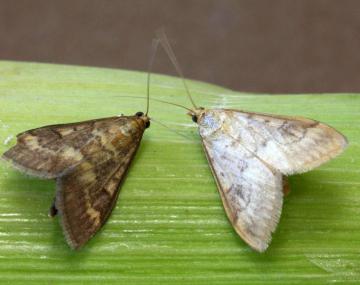
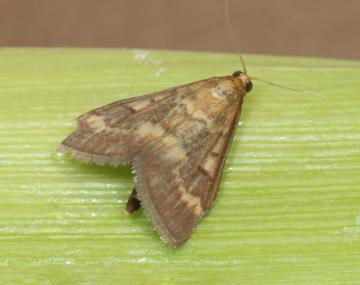
- Adult moths have a yellowish-brown to tan color, with dark wavy bands across their wings, and a wingspan of about 1 inch.
- Univoltine Z-race has one generation per season, with a flight in July.
- Bivoltine Z-race and Bivoltine E-race have two or more generations per season, with flights in June and August.
- The first generation of larvae emerges from late June to early July, targeting the vegetative growth stages of the corn plant
- The second generation of larvae appears in August and September, attacking corn during its reproductive growth stages
- Traps for both Z and E-races are recommended at each field site to monitor ECB populations
- Plowing can reduce overwintering numbers.
- In pheromone traps targeting European corn borer, it is common to find the carrot seed moth and celery leaftier as off-target catches.
Corn earworm
The corn earworm (Helicoverpa zea), also called the cotton bollworm and tomato fruitworm, is a significant agricultural pest by exhibiting polyphagous behavior through its feeding on various plants, negatively impacting a diverse range of crops.
Here are the descriptors of this insect:
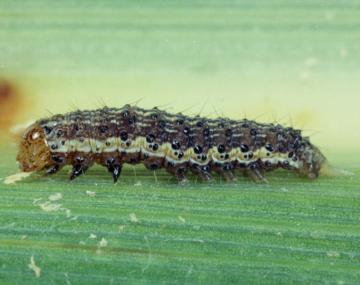
- The larvae have microspines covering their body and come in a range of colors including yellowish, tan, green, brown, or pink.
- Mature larvae can reach a length of 1.5 inches and have a dark yellowish brown or orange head capsule.
- These larvae pose a threat from July to September, with the first generation causing defoliation in the whorl stage of corn.
- Traps should always be placed near green silking corn as adult moths prefer to lay eggs on fresh new silk.
- It's crucial to note that once the silks have dried, applying insecticides is no longer effective.
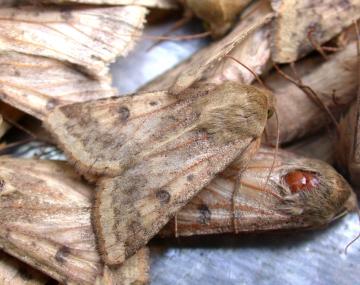
- In pheromone traps targeting corn earworm, it is common to find the spongy moth as an off-target catch.
- For effective corn earworm control, follow the spray schedule in the table below.
| Per Day | Per Five Days | Per Week | Days Between Sprays |
|---|---|---|---|
| <0.2 | <1.0 | <1.4 | No Spray (for CEW) |
| 0.2-0.5 | 1.0-2.5 | 1.4-3.5 | 6 days |
| 0.5-1.0 | 2.5-5.0 | 3.5-7.0 | 5 days |
| 1-13 | 5-65 | 7-91 | 4 days |
| Over 13 | Over 65 | Over 91 | 3 days |
| Add one day to the recommended spray interval if daily maximum temperatures are less than 80°F for the previous 2-3 days. | |||
Fall armyworm
The fall armyworm (Spodoptera frugiperda), is another polyphagous pest causing extensive damage to a diverse range of crops and leading to significant economic losses.
Here are the descriptors of this insect:
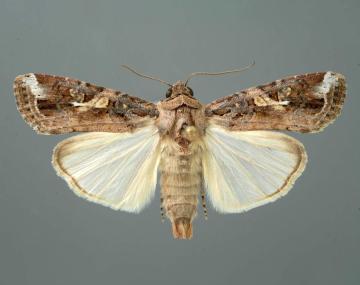
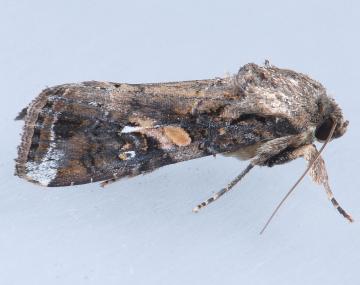
- The adult fall armyworm moth has a wingspan of 1.5 inches, characterized by mottled gray and brown forewings with a distinctive orange/white spot, lighter hindwings, and a robust dark-colored.
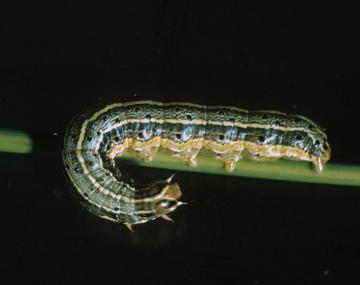
- The larva typically appears as light tan or green to black with a smooth skin, with three yellow-white lines along their back and wider dark stripes on each side of these lines.
- Fully grown larvae will have a dark brown head with a distinctive white inverted Y on the front, and when fully grown, they reach about 1.25 inches in length.
- These larvae can cause feeding damage on corn leaves, tassel, ear, and developing kernels from July through September.
- If practical, apply insecticides early in the morning or late in the evening when the larvae are most active and likely to come into contact with the spray.
- In pheromone traps targeting fall armyworm, it is common to find the intermediate hooded owlet moth as an off-target catch.
Western bean cutworm
The western bean cutworm (Striacosta albicosta) is native to the western regions of the United States. However, it has expanded its range to the eastern part of the country. Larvae feed on beans and corn.
Here are the descriptors of this insect:
- The adult insects have forewings with a brownish background and a light tan stripe on the leading edge, along with a prominent small white "eyespot" and a white kidney-shaped spot. Their hind wings are pale white, and they have a wingspan of about 1.5 inches.
- The larvae of these insects begin as dark brown with faint diamond markings on their backs. When they mature, they become gray to pinkish brown and have two dark rectangles located on the prothoracic shield just behind the head. At maturity, they reach about 1.5 inches in length.
- These adults are active during late July and early August, and they typically lay their eggs on pre-tassel stage corn.
- Feeding damage from these larvae on sweet corn occurs from July through September on green silks, pollen, or tassels and later move to the ear, where they chew holes through the husk and consume the developing kernels.
- In pheromone traps targeting Western bean cutworm, it is common to find the spongy (gypsy) moth as an off-target catch.
Authors
Naoki Kihata
Cornell University Department of Entomology.
Last updated: December 2024
Thanks to Cornell IPM editors:
- Marion Zuefle
- Abby Seaman
- Jody Benedict
- Henry Zelenak
- Cooperative Extension New York State Cornell University, 1983. Fall Armyworm.
- Cooperative Extension New York State Cornell University, 1983. Corn Earworm.
- European Corn Borer | Cornell CALS, n.d.
- Johnson, D., 1994. Using Pheromone Traps in Field Crops, n.d.
- Kihata, N., 2024. Western Bean Cutworm Vegetable Fact Sheet, n.d.
- Knodel, J., Petzoldt, Curtis, Hoffman, Michael, 1995. Pheromone Traps–Effective Tools for Monitoring Lepidopterous Insect Pests of Sweet Corn.
- Pheromone traps | The Beatsheet , 2021.
- Green bucket trap used for both the fall army worm and the Western bean cutworm—Photo by Scott Williams, DTN Entomologist, DTN Progressive Farmer
- Heliothis trap used for both the E and Z race European corn borers and the corn earworm—Photo by Marion Zuefle, CIPM
- European corn borer adults. Males are slightly darker and smaller than females and will be the ones caught in pheromone traps—Photo by Adam Sisson, Iowa State University, Bugwood.org
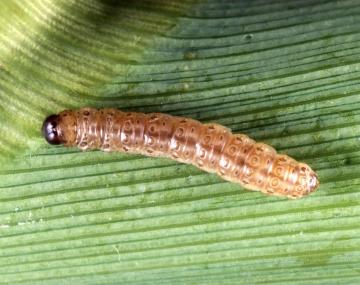
- European corn borer larva. Creamy white to pink in color, with a dark brown head capsule—Photo by Keith Weller, USDA Agricultural Research Service, Bugwood.org
- European corn borer adult. A moth with triangular wings and wavy lines across the forewings—Photo by Adam Sisson, Iowa State University, Bugwood.org
- Corn earworm adult. A moth with a darker brown spot midway along the outer edge of the front wings. Live moths typically have green eyes—Photo by Sturgis McKeever, Georgia Southern University, Bugwood.org
- Corn earworm larva (coloration may vary)—Photo by Clemson University - USDA Cooperative Extension Slide Series , Bugwood.org
- Corn earworm adults. Note the green eyes of the live adult nearest the top—Photo by Eric Burkness, Bugwood.org
- Fall armyworm adult. Typically, adult moths lack the characteristic markings due to the loss of scales during migration—Photo by Lyle Buss, University of Florida, Bugwood.org
- Fall armyworm larva. Features a prominent inverted "Y"-shaped marking on its head, and four dark spots arranged in a square near the end of its abdomen—Photo by John C. French Sr., Retired, Universities:Auburn, GA, Clemson and U of MO, Bugwood.org
- Fall armyworm adult—Photo by Mark Dreiling, Bugwood.org
- Adult western bean cutworm moth showing the white stripe along the leading edge of the forewing, small dot, and U-shaped brown dot on the forewing—Photo by Adam Sisson, Iowa State University, Bugwood.org
- Western bean cutworm larva (later instar). Characterized by three dark stripes behind the head—Photo by Adam Sisson, Iowa State University, Bugwood.org
- Adult western bean cutworm moth showing the white stripe along the leading edge of the forewing, small dot, and U-shaped brown dot on the forewing—Photo by Eric Burkness, Bugwood.org
- (315) 787-2379
- mez4 [at] cornell.edu
- (315) 787-2422
- ajs32 [at] cornell.edu