European Crane Flies (Tipula paludosa and Tipula oleracea)

Ornamental IPM Fact Sheet

The European crane flies (Tipula paludosa and T. oleracea) in their larval stage are invasive pests of turfgrasses, lawns, pastures, and hayfields in the United States and Canada.

The larvae of the European crane flies Tipula paludosa and T. oleracea (commonly referred to as leatherjackets) were first detected in New York State as problematic pests of turfgrasses in 2004. These two species are very similar in both appearance and type of damage caused; however they have slightly differing life histories in New York State, with T. paludosa producing one generation per year and T. oleracea producing two, requiring slightly different management practices. Both species are believed to have been introduced to North America through infested soil media and are now established across the majority of states in the continental United States. They typically feed on roots of turfgrass systems, but can also surface to feed on crowns, stems, and blades. They can cause substantial damage in a range of grass-based systems, from low and high maintenance turf (such as home lawns and golf courses) to production based systems (including sod farms and grass seed fields). Both species are dependent on moist soil conditions and prefer areas with poor drainage and thatch buildup in turfgrass systems specifically.

Biology of Tipula paludosa and T. oleracea

Overview

Crane flies are a globally distributed group of insects with nearly 16,000 described species. There are over 250 species native to New York State with 30 of those species in the genus Tipula, so it is important to recognize that not every crane fly you see is a pest species. Many native adult crane flies have varying wing patterns ranging from a single spot on the wing (stigmal spot), to elaborate spotting across the wing veins. It is important to note that several native Tipula species can occur in managed grassy areas and possess clear, unpatterned wings similar to those of T. paludosa and T. oleracea. If you are uncertain about a species identification, consult your local extension specialist. 

Adults

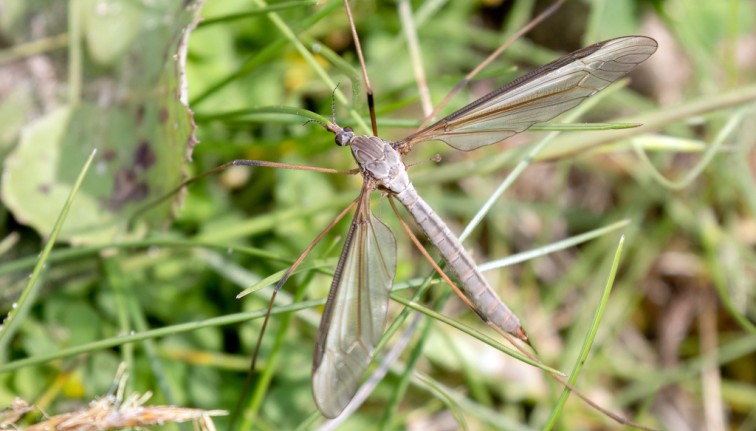
Adults of T. paludosa and T. oleracea are large crane flies, approximately 2.5-3 inches (6.27-7.5 centimeters) in length with a typical brownish gray body. The wings of both species are not patterned, but have a narrow smoky colored band along the leading edge of the wing and are typically 2-3 inches (5-7.5 centimeters) long. The wings of T. oleracea are typically as long as the abdomen or slightly longer, while the wings of T. paludosa are shorter than the abdomen. Additionally, wings of female T. paludosa are sometimes even shorter and considered brachypterous, or very reduced. T. paludosa has 14 antennal segments while T. oleracea has 13 segments. Another distinguishing characteristic between the two species is that in T. paludosa, there is a wide separation between the eyes on the underside of the head, while the eyes are almost touching with a very narrow separation in T. oleracea. Adults can sometimes be seen swarming as a result of mass emergence from infested turfgrasses. Adults are non feeding and relatively short-lived. Gravid females of T. paludosa are weak fliers, with sometimes reduced wings while gravid females of T. oleracea are stronger fliers, traveling further to distribute their eggs. 

Eggs

Eggs are shiny black, ovular, and approximately 0.04 inches (1 millimeter) in length, very difficult to see with the naked eye. Gravid females will lay up to 300 eggs at or near the soil surface. Eggs are extremely sensitive to drought and require damp conditions to survive. Females of T. paludosa typically lay their eggs within 2 days of emergence and mating, while T. oleracea lay their eggs over a 2 week period after emergence and mating. 

Larvae

First larval instars of T. paludosa typically emerge 1.5-2 weeks after eggs are laid, while instars of T. oleracea emerge 1 week after eggs are laid. Larval development is also highly dependent on moist soil conditions. Most larvae inhabit the top 1.18 inches (3 centimeters) of soil where they feed on root hairs, roots, and crowns of grasses. Both species have four larval instars before pupation. Larvae of T. paludosa overwinter in their third instar, while larvae of T. oleracea overwinter in their fourth and final instar. It is extremely difficult to distinguish between the two species at the larval stage. 

Pupae

Pupae usually wriggle to the surface of the turf, leaving behind a distinct pupal exuviae protruding from the site of eclosion when the adult emerges. In New York State, adults of both species emerge in late July to early September, with a second generation of T. oleracea additionally emerging in late April to early May. 

Life cycle of Tipula paludosa and T. oleracea

Tipula paludosa and T. oleracea have very similar life cycles, with the major difference being T. oleracea having two generations per year, and T. paludosa having one generation. Heavy damage can be seen in late winter to early spring when the larvae are feeding most rapidly. Scalping damage by crane fly larvae can be observed surrounding turf, similar in appearance to cutworm damage. 

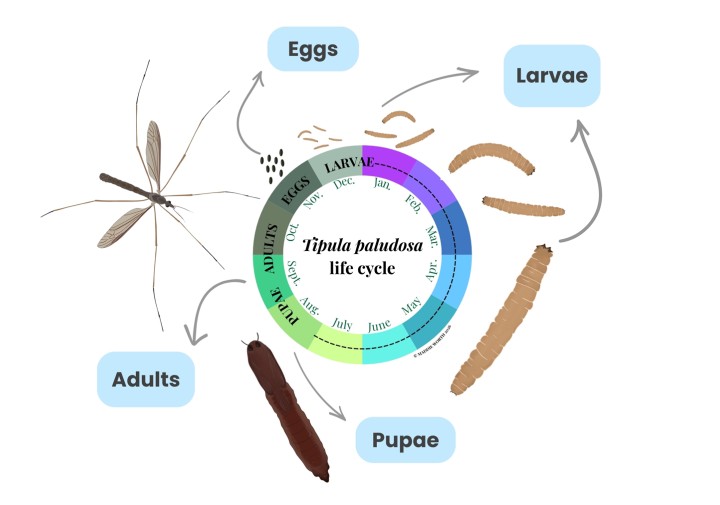
Tipula paludosa life cycle diagram

Tipula paludosa has one generation per year with adults laying 2-300 eggs at a time at or near the soil surface in November. Larvae emerge 10-15 days later and have four instars, overwintering as the third instar. Larvae feed on roots, crowns, stems, and blades of grasses. By mid June, larvae stop feeding and move deeper in the soil, beginning to pupate in late August to early September. Adults emerge in September over a 2-3 week period, mating shortly after emergence and laying eggs 2 days later.

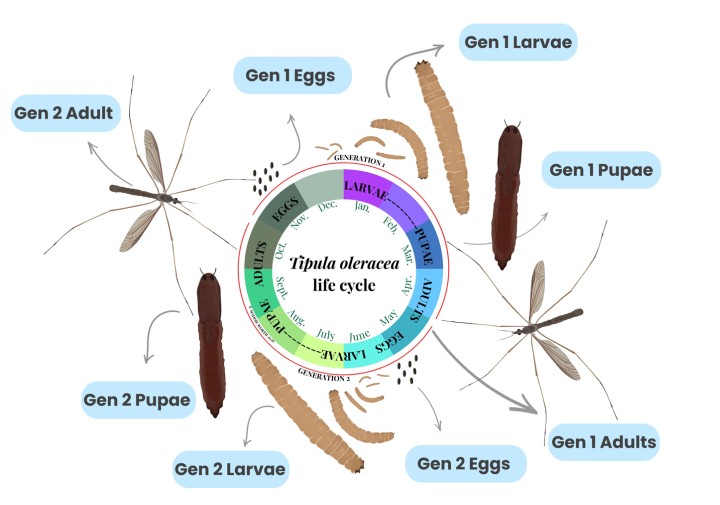
Tipula oleracea life cycle diagram

Tipula oleracea has two generations per year, with the first generation of eggs (2-300 per female) being laid in November at or near the soil surface. First generation larvae emerge a few days later, going through four instars and overwintering as the fourth instar. Larvae pupate in March and emerge as adults in April, mating shortly after emergence and laying the second generation of eggs up to 2 weeks after mating. The second generation of larvae emerge a few days after eggs are laid and go through four instars, pupating in late August to early September. Second generation adults emerge in late September to early October.

A medium brown adult female crane fly lying flat against a white wall with legs splayed out. The wings are approximately ⅔ the length of  a typical female specimen's wing.

T. paludosa (female) with reduced (brachypterous) wings and appearingly gravid.
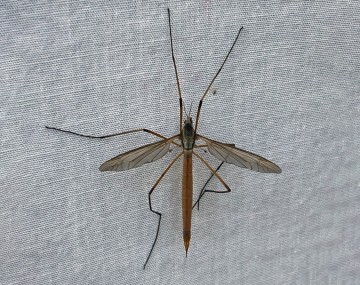
A medium brown female adult crane fly sitting on white fabric with a long, slender abdomen and upper legs splayed out. The wings are slightly shorter than the length of the abdomen.

T. paludosa (female) with normal length wings.
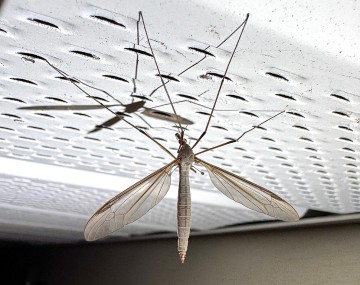
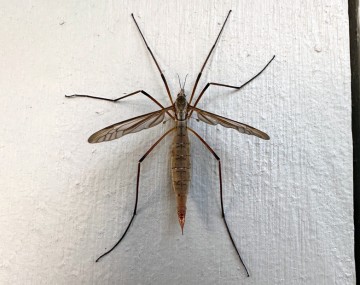
A medium brown female crane fly hanging onto the side of fencing with four legs present. The wings are slightly longer than the length of the abdomen.

T. oleracea (female).

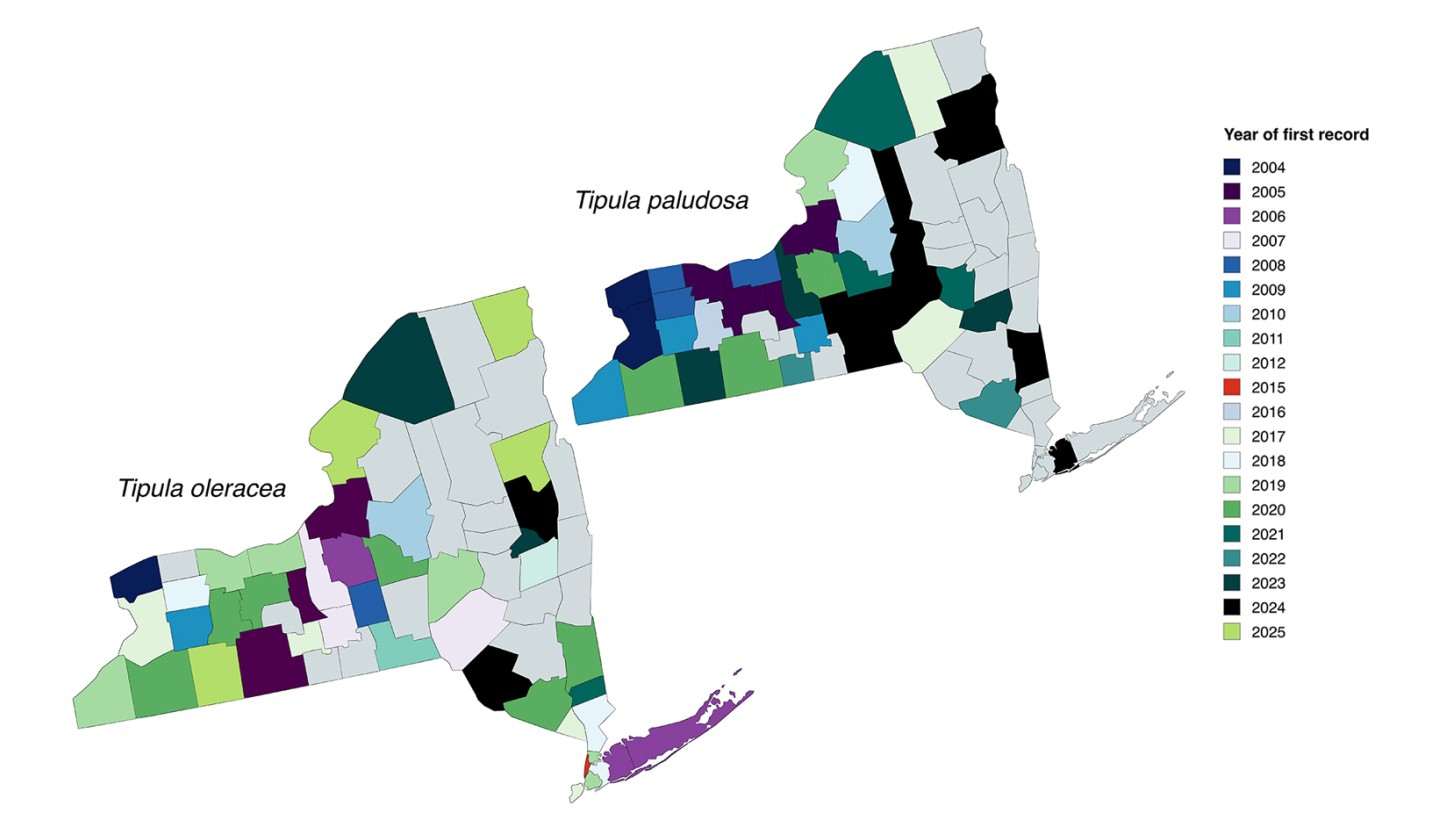
Range and presence of Tipula paludosa and T. oleracea in New York State

Distribution maps of T. paludosa and T. oleracea across counties of New York State from introduction in 2004 to 2025.

Damage of Tipula paludosa and T. oleracea

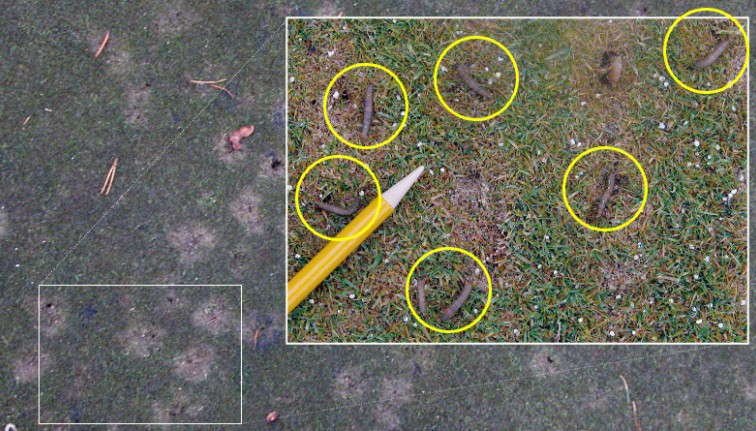
Because Tipula paludosa and T. oleracea can feed close to the surface, their damage can include both root injury as well as crown and foliar feeding.  Similar to white grubs, crane flies can also trigger turf disruption caused by mammals searching and digging/pecking for larvae. Yellow spotting and bare patches can typically be correlated with pest damage caused by foliar feeding on crowns and leaf blades along with disruption of the rooting zone. Damage can appear similar to that of black cutworm (Agrotis ipsilon). Damage in New York State is most likely to be seen when larvae are largest and feeding rapidly (fourth instar), typically in early to mid May. 

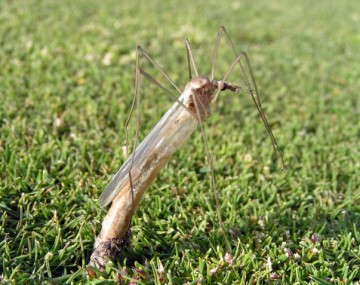
An adult crane fly emerging from turf with its legs and wings present. Its legs are bent nearly double as it pushes itself up and out of its pupal casing—its abdomen is more than halfway removed from  the pupal casing, a half inch (1.27 centimeters) of which is visible at the site of emergence.

Tipula paludosa emerging from its pupal casing in turf.
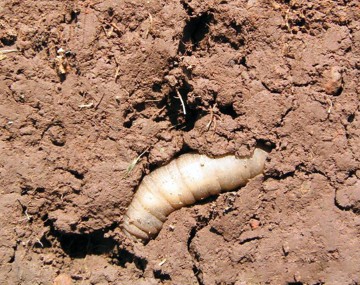
A cross section image of a chunky, pale tan larval crane fly surrounded by heavy clay soil, approximately 3-5 inches deep. Tunnels are present, indicating subsurface travel by the larva.

A Tipula larva developing in soil below turf roots.

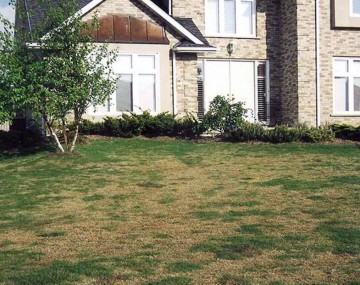
Front yard of a house showing patchy lawn damaged by European crane flies. Lawn is mostly brown, with some patches of green highlighting immense damage and missing grass sections.

Home lawn damage caused by T. paludosa and/or T. oleracea.
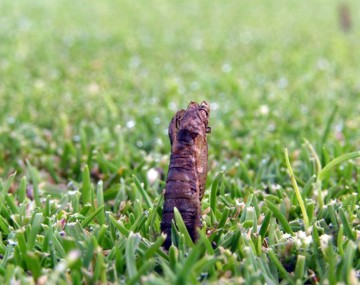
Brown pupal exuviae (pupal casing) of a crane fly, roughly the thickness of a pencil, protruding about an inch (2.54 centimeters) out of short-mowed turf after an adult has emerged.

Tipula exuviae (pupal casing) sticking out of turf after adult emergence. 
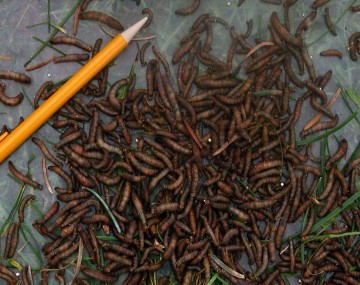
A large amount of crane fly larvae collected from turf in a pile in a clear bin  with a pencil for scale. Larval size varies but are averagely slightly longer than the pencil tip.

Tipula larval accumulation collected from turf on a golf course. 

Monitoring and management of Tipula paludosa and T. oleracea

Monitoring for Tipula paludosa and T. oleracea can begin by paying attention to adult crane fly activity, especially in wet/poorly drained areas of turf. Because adults lay eggs so soon after emergence (and very close to emergence sites in T. paludosa), adult activity can be a good indicator for the next generation of larvae. The best way to monitor for crane fly larvae in your turf is to take cup cutter samples in suspect areas of turf in fall or spring. The cores can be fairly shallow (3 inches/7.62 centimeters) and should be hand sorted for larvae. One additional thing to look for specifically on greens and tees is pupal cases protruding above the mowed line, indicating adult emergence. For assistance with identification, reach out to your local extension specialist. 

Management for T. paludosa and T. oleracea should be directed against the larvae, opposed to the adults which are very short-lived. Due to the larval sensitivity to dry conditions, management of soil moisture, where feasible, can be a useful control tactic to reduce populations. The timing and frequency of irrigation (during female oviposition period) could be manipulated to better drain the infested areas, causing the surrounding soil to dry up. 

If necessary, preventative applications of insecticides are best made in September to October at the time of egg laying, or when larvae are smaller and still active at the soil surface. Curative applications can be made in May once higher populations and/or feeding populations are detected. If T. oleracea is present, a late fall application would be beneficial to target both species and both generations of T. oleracea. Recommended pesticide treatments for New York State can be found on the Bureau of Pesticides Management Information Portal.

Any time you use a pesticide, you must read and follow the label directions and comply with all applicable laws and regulations related to pesticide use. Also be sure that any pesticide used is approved for use in your country and state/province.

Authors

  • Maddie Worth
    PhD Candidate, Cornell University Department of Entomology

  • Kyle Wickings
    Professor, Cornell University Department of Entomology, Cornell AgriTech

Reviewed by Joellen Lampman, Cornell IPM

Last updated: May 2026

Modified from an article written by Dan Peck: Peck, Dan. “European crane fly.” Cornell University, “http://www.hort.cornell.edu/turf/shortcourse/european_crane_fly.pdf” 

Thank you to Cornell CALS' Department of Entomology’s Extension Outreach Assistantship program for funding this work. Also thank you to Cornell IPM's Joellen Lampman for additional content review for web publication, and Henry Zelenak for web development and assisting with formatting and troubleshooting.

  • Daniel C. Peck, Daniel L. Olmstead, Matthew J. Petersen, Pest Status of Invasive Crane Flies in New York Turfgrass and the Repercussions for Regional Plant Protection, Journal of Integrated Pest Management, Volume 1, Issue 1, 1 October 2010, Pages E1–E8, https://doi.org/10.1603/IPM10007
  • Oosterbroek P. (2026). Catalogue of the Craneflies of the World. https://ccw.naturalis.nl.
  • Matthew J. Petersen, Daniel L. Olmstead, Daniel C. Peck, Best Management Practices for Invasive Crans Flies in Northeastern United States Sod Production, Journal of Integrated Pest Management, Volume 2, Issue 3, 1 December 2011, Pages C1–C6, https://doi.org/10.1603/IPM11002
  • Female T. oleracea perched on grass—photo by ckirby-lambert via iNaturalist
  • T. paludosa life cycle diagram—illustration by Maddie Worth, Cornell University
  • T. oleracea life cycle diagram—illustration by Maddie Worth, Cornell University
  • Female T. paludosa with reduced wings—photo by suestew101 via iNaturalist
  • Female T. paludosa with normal wings—photo by soo_moths via iNaturalist
  • Female T. oleracea—photo by sgalick via iNaturalist
  • Tipula paludosa emerging—photo by T. Cook, Oregon State University
  • Tipula larvae developing—photo by T. Cook, Oregon State University
  • Surface feeding damage—photo from Dan Olmstead and Dan Peck, Cornell University
  • Home lawn damage—photo by A Schattman, Weed Man
  • Tipula exuviae—photo by T. Cook, Oregon State University
  • Tipula larval accumulation—photo from Dan Olmstead and Dan Peck, Cornell University
Kyle Wickings holding a tuft of grass and dirt
Kyle Wickings

Professor

Department of Entomology

Cornell AgriTech

Kyle Wickings
portrait of Joellen Lampman
Joellen Lampman

Tick and School IPM Coordinator

Cornell Integrated Pest Management

Joellen Lampman
Ticks, Public health, Biodiversity, Pollinators, Invasive species, Wildlife, Science communication

Maddie
Maddie Worth

PhD Student

Department of Entomology

Maddie Worth
  • msw263 [at] cornell.edu
portrait of Betsy Lamb
Elizabeth Lamb

Ornamental IPM Coordinator

Cornell Integrated Pest Management

Adjunct Assistant Professor

School of Integrative Plant Science

Horticulture Section

Elizabeth Lamb
Ornamental and greenhouse integrated pest management