European Corn Borer (Ostrinia nubilalis)
Vegetable IPM Fact Sheet
European Corn Borer (ECB) is a major pest insect of many different host crops in the United States, including the northeast. These include sweet and field corn, snap beans, peppers, potatoes, apples, hemp, small grains and ornamental plants.
In this fact sheet
- Identification of ECB
- Damage from ECB
- Managing ECB
ECB was first detected in the United States in Massachusetts in 1917, later spreading to New York State by 1919. Since that time, ECB has spread across most of the eastern United States, going as far west as the Rocky Mountains. ECB can cause extensive damage and contribute to increased mycotoxin levels. In corn, ECB will initially feed on the leaves and tassel, then bore into the stem and into developing ears as they begin to form. This will cause visible damage to the plant, and lower the yield and quality of the corn ears.
Identification of ECB
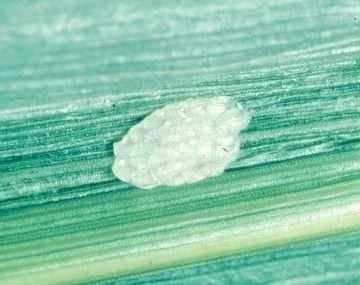
- ECB eggs when first laid are white in color and overlap each other. They are typically laid in clusters of 5-50 eggs on the underside of host crop leaves. Eggs hatch in 4-9 days depending on temperature.
- Right before they hatch, the eggs will change color to an orange-tan color with the larvae’s black head visible through the eggshell.
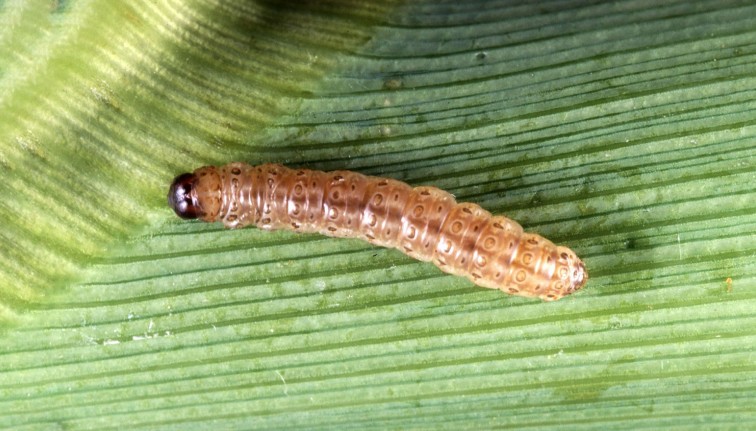
- The larvae are distinguished by their flesh colored bodies and dark brown heads. Mature larvae will measure between ¾ to 1 inch in length. See Cornell IPM’s larval ID factsheet (pdf) for more details.
- ECB consists of two biologically distinct but visually indistinguishable races (E and Z). Larvae overwinter as mature larvae in host plant stalks and stems and pupate in the spring. In New York State, the E race is typically univoltine (one generation per year), while the Z race occurs as both univoltine and bivoltine (two generations per year) populations.
- In New York State, the one generation strain will emerge in July. The two generation strain will emerge first in late May to early June, and again in August.
- Adult ECB will be a moth that is around 0.75 inches long. See the image below to distinguish between male and female moths. Both genders will have two dark serrated lines that run across their forewings, and light markings on their hindwings.
ECB eggs when first laid are white and are overlapped like fish scales. They are typically found on the undersides of host crop leaves.
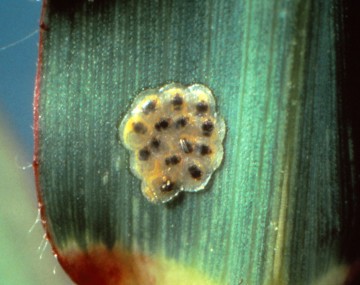
ECB eggs will develop to have an amber color right before they hatch. At this stage, the black head of the larvae will also be visible in the center of the egg.
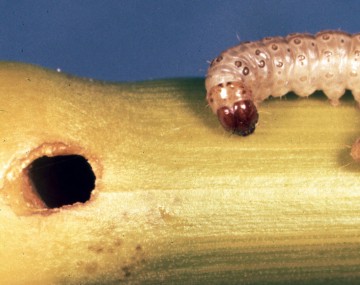
ECB larvae will bore into the stalks of host plants and overwinter in them.
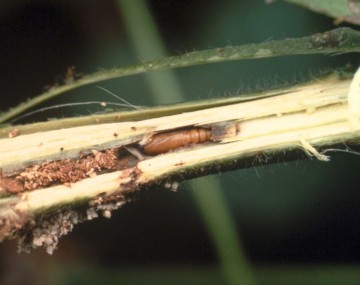
The ECB pupa has a reddish-brown color and can be found where the mature larvae have been feeding, such as in the stems or ears of corn. The pupal stage will last for around 2 weeks before the moths emerge.
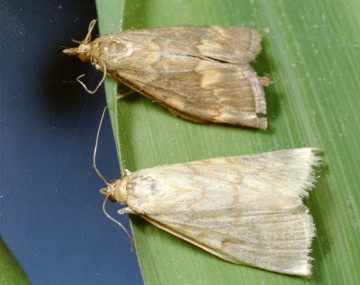
The top moth is an adult ECB male, while the bottom is a female. The female moth has forewings with a creamy, light color while the male has a reddish-brown color. The male’s body is also slightly smaller than the female.
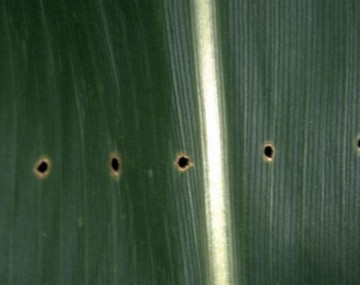
European Corn Borer Damage
- ECB larvae will attack all parts of the corn stalk and ear, as well as other host crops.
- For corn, ECB will first eat and bore into the leaves and tassel of corn plants. This can be seen with “shot-hole” damage on leaves or broken/bent tassels.
- Later in the season, ECB will bore into the ears of corn, eating the corn and reducing its quality and marketability.
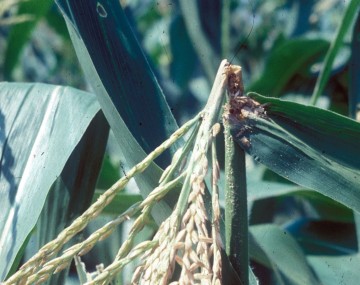
ECB may also enter the stalk and tassels of plants, damaging them and causing them to break.
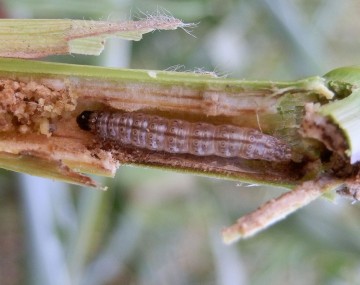
Close-up image of ECB inside a bored stalk of corn.
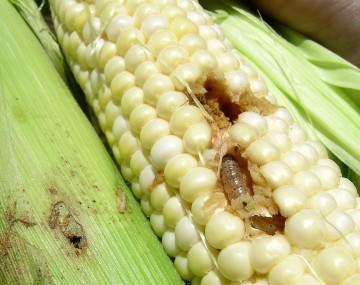
ECB will eat into ears of corn, reducing its saleability and aesthetics.
ECB will also target many different host crops for food. Seen in this picture is ECB damage to a pepper.
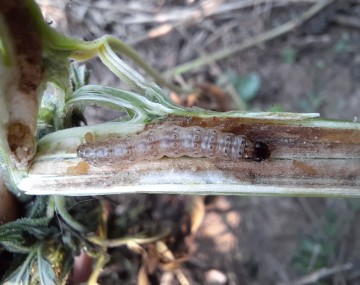
Hemp is another host plant that the ECB will target. The larvae will damage parts of the plant, including the stalk.
Management of ECB
Pest Monitoring
- ECB moths can be monitored using blacklight or pheromone traps. See Cornell IPM's Pheromone Traps for Sweet Corn factsheet.
- Pheromone traps use different lures that target the two races of ECB, E-race and Z-race, as well as the hybrid between the two. For more instruction on sweet corn trap monitoring, watch Cornell IPM's Sweet Corn Pheromone Trap Network Setup and Monitoring video.
- Degree-day models can be used to predict flight patterns and development of ECB populations based on daily temperatures.
- Field scouting should be done for ECB on a weekly basis once corn reaches the whorl stage. To learn how to scout, watch Cornell IPM's How to Scout Fresh Market Sweet Corn video.
- The Sweet Corn Pheromone Trapping Network has been monitoring ECB populations in NY since 1997.
Control
- Cultural control: ECB overwinters as larvae in plant residue. Actions such as harvesting silage, stalk shredding and deep plowing can reduce these overwintering populations in the immediate field.
- Biological control: Trichogramma wasps can be used to control ECB populations. They are egg parasitoids that are most effectively applied during moth egg-laying flights. See Cornell IPM's guide to using Trichogramma for ECB control.
- Bt corn hybrids: Genetically engineered field and sweet corn hybrids are available that possess resistance to ECB. The most common corn hybrids contain the Bt trait, which allows the plant to produce insect-specific toxins to resist ECB feeding. Refer to seed company guidelines when using Bt or other corn hybrids.
- Natural control: Heavy rains tend to drown populations of ECB in plants, or physically remove them from the plant
- Chemical control: Refer to your local Cornell Cooperative Extension guidelines or state guidelines when applying insecticides to crops.
Any time you use a pesticide, you must read and follow the label directions and comply with all applicable laws and regulations related to pesticide use. Also be sure that any pesticide used is approved for use in your country and state/province.
Authors
Marion Zuefle
Vegetable IPM Coordinator, Cornell Integrated Pest ManagementLukas Rood
Temporary Program/Extension Aide, Cornell Integrated Pest Management
Last updated: October 2025
Modified from an article written by J.T. Andaloro, A.A. Muka, and R.W. Straub:
Andaloro, J.T., Muka, A.A., Straub, R.W. “European Corn Borer.” Cornell University Library eCommons,
https://hdl.handle.net/1813/42367.
This factsheet was developed in part with funding support from the New York State Department of Agriculture and Markets.
- Andaloro, J.T., Muka, A.A., Straub, R.W. “European Corn Borer.” Cornell University Library eCommons, https://hdl.handle.net/1813/42367.
- Glogoza, Phillip, and Boetel, Mark. “Corn Insects of North Dakota: Affecting the Crop after Emergence.” NDSU Extension Service, August 2005,
https://library.ndsu.edu/server/api/core/bitstreams/e6922f52-c0e7-4ed0-8273-021c7f9dadd7/content
- ECB larvae is easily…—photo by Keith Weller, USDA Agricultural Research Service
- ECB eggs when first…—photo by Frank Peairs, Colorado State University
- ECB eggs will develop…—photo by Joe Ogrodnick, Cornell Agritech
- ECB larvae will bore…—photo by USDA Cooperative Extension Slide Series, Clemson University
- The ECB pupa has…—photo by Ronald Smith, Auburn University
- The top moth is…—photo by USDA Cooperative Extension Slide Series, Clemson University
- ECB larvae will feed…—photo by Frank Peairs, Colorado State University
- ECB may also enter…—photo by Department of Plant Pathology, North Carolina State University
- Close-up image of…—photo by Mariusz Sobieski, unknown
- ECB will eat into…—photo by Marion Zuefle, Cornell IPM
- ECB will also target…—photo by Marion Zuefle, Cornell IPM
- Hemp is another host…—photo by Marion Zuefle, Cornell IPM
- (315) 787-2379
- mez4 [at] cornell.edu
Professor Emeritus
Department of Entomology
- rws9 [at] cornell.edu