Dogwood Borer (Synanthedon scitula)

Fruit Fact Sheet

The dogwood borer (DWB), a native clearwing moth, is a pest with a wide host range including dogwood, pecan, oak, plum, and apple.


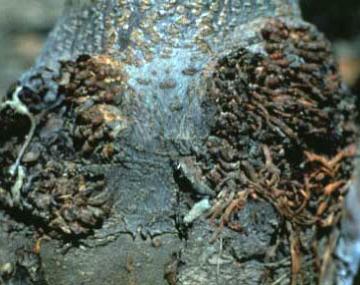
Dogwood borer (DWB), a native clearwing moth, can be found from southeastern Canada to Florida, and as far west as the Mississippi. The insect has a wide host range including dogwood, pecan, oak, plum, and apple. The DWB has one generation per year throughout its geographic distribution. On apple, DWB larvae feed primarily in burrknot tissue on clonal rootstocks. Burrknots are aggregations of root initials which can develop on the above ground portion of the rootstock (Fig. 1). Commercial dwarfing and semi-dwarfing rootstocks have a tendency to develop burrknots, to varying degrees. Many of the Malling series rootstocks have a higher likelihood of developing burrnots (e.g. M.9 and M.26), while some of the G series are less prone to burrknots (e.g. G11).

Biology of dogwood borer

Adults

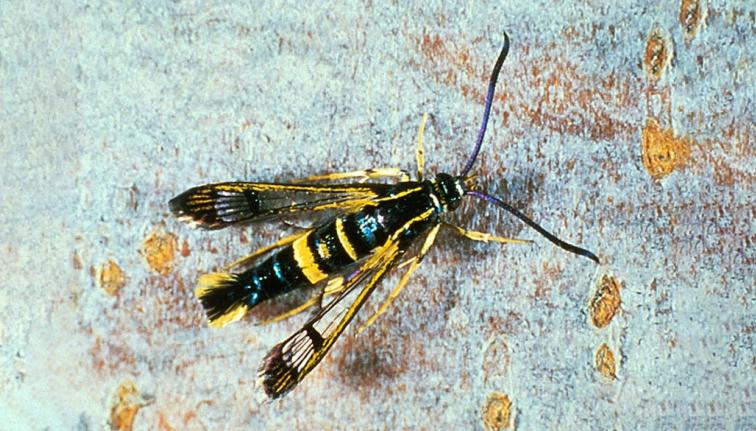
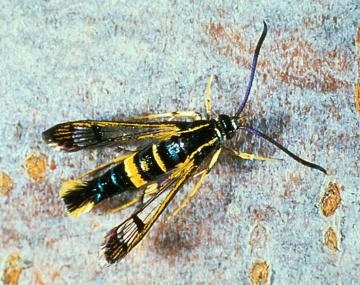
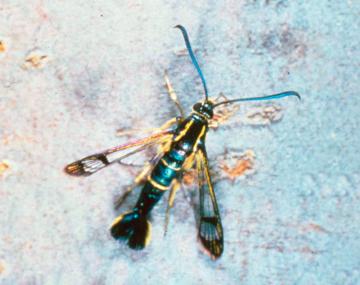
The DWB adult has a wing span of 18-22 mm. Both the fore and hind wings are mostly clear. The thorax and abdomen are deep blue-black with yellow markings. In the female, the entire 4th abdominal segment is yellow (Fig. 2), whereas in the male it is black with a narrow yellow ring (Fig. 3). In the Northeast, adult emergence begins in early June and continues into early September, peaking in mid July. Emergence begins earlier further south.

Eggs

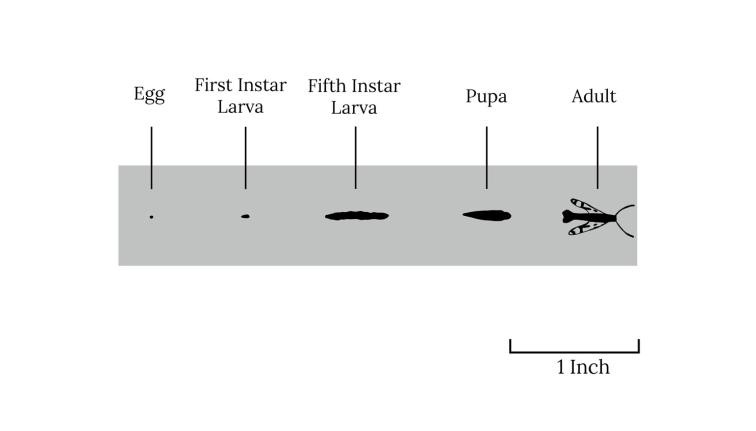
The eggs are light chestnut brown, oval, 0.6 by 0.4 mm, and are marked with a hexagonal pattern of slightly raised lines. Eggs are laid singly on the trunk, and hatch after an incubation period of 8-9 days.

Larvae

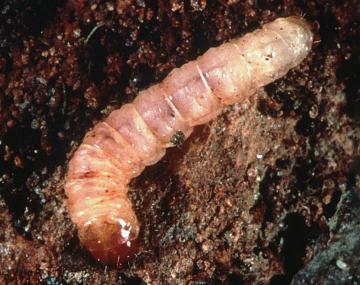
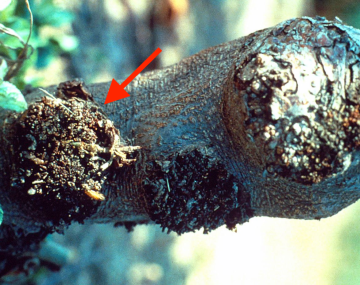
The larvae are off-white to cream colored with a reddish head capsule (Fig. 4). Larvae pass through six instars ranging in length from 1 mm when newly hatched to 15 mm or more in the last instar. Soon after hatching, the larvae begin to burrow into the soft burrknot tissue, or areas under bark scales. As the larvae feed, reddish-brown frass is pushed to the surface, where it collects, held together by silk (Fig. 5, arrow). Larvae overwinter in the feeding tunnel. Feeding resumes whenever the temperature is above 45-50°F (7-10°C).

Larvae of the American plum borer (APB), Euzophera semifuneralis (Walker), have been found on apple in habitats similar to those preferred by the dogwood borer. The larvae of the two species are similar in size. However, the DWB larva is white to cream-colored, and has only one row of crochets on the abdominal prolegs, while the APB larva is dusky purple to gray in color, and has two rows of crochets on the prolegs.

Pupae

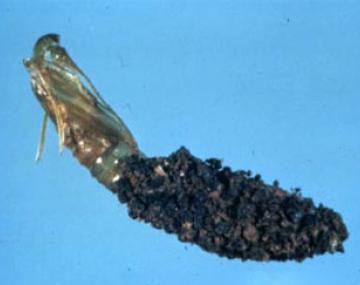
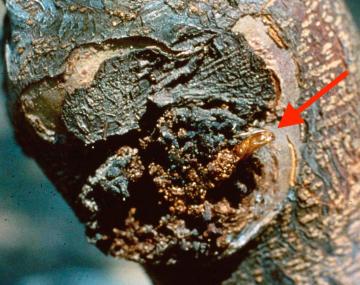
Pupation occurs in the feeding tunnel in a tough silken cocoon covered with bits of frass (Fig. 6). The duration of the pupal stage is variable, lasting from 8-20 days depending on the temperature. Prior to emergence, the pupa pushes out of the cocoon and to the surface of the burrknot. The amber-colored pupal case often remains on the burrknot after the adult emerges (Fig. 7, arrow).

Damage of dogwood borer

Three general feeding types have been identified for DWB on clonal apple rootstocks (Fig. 8). Most frequently, feeding is confined to the burrknot (Type I). One or more larvae feed in irregular tunnels beneath the surface of the root initials. At first, feeding is quite shallow, but subsequent feeding may extend as far as 3/4-inch toward the center of the trunk. Feeding confined to the burrknot is believed to be least harmful to the tree. The second type of feeding may occur as a result of heavy or repeated infestation of a burrknot. As the burrknot tissue is consumed, the larvae move outward and begin to feed on the cambium adjacent to the burrknot (Type II). The third feeding type is not associated with a burrknot, but with bark scales and Injured bark, and occurs infrequently (Type III). Feeding outside the burrknot is thought to be more harmful to the tree because healthy cambium tissue is destroyed. DWB infestations can girdle and kill a tree, but more commonly contribute to a slow decline and yield reduction if they continue over a long period of time.

Monitoring dogwood borer

Check trunks in the spring, particularly under trunk guards, for active infestations. Pheromone traps are available for DWB to estimate peak adult flight.  Traps should be placed 4 to 6 feet above the ground.

A close-up view of a tree trunk with dark, irregularly shaped burrknots on the above-ground portion of the rootstock. There are two visible  burrknots that appear like small, bumpy masses, varying in size and texture, creating a rough, uneven surface. The protrusions are darker than the surrounding bark and stand out against the smooth, lighter-colored trunk.

Figure 1. Burrknots that have developed on the above ground portion of the rootstock.

A close-up of a female dogwood borer, showing its slender body and distinctive yellow coloring on the entire 4th abdominal segment. The rest of the body is dark, with a black thorax and abdomen. The borer has accents of yellow throughout, long straight antenna, and transparent wings. The wings are black along the edges and the tips.

Figure 2. An adult female dogwood borer.

A close-up of a female dogwood borer, showing its slender body and distinctive narrow yellow band on the 4th abdominal segment. The rest of the body is dark, with a black thorax and abdomen. The borer has accents of yellow throughout, long straight antenna, and transparent wings. The wings are black along the edges and the tips.

Figure 3. An adult male dogwood borer.

The larva pictured is an off-white to cream colored smooth caterpillar. The larva is segmented along its body and it has a reddish brown head capsule.

Figure 4. A dogwood borer larva.

There are three visible  burrknots that appear like small, bumpy masses, varying in size and texture, creating a rough, uneven surface. The protrusions are darker than the surrounding bark and stand out against the smooth, lighter-colored trunk. There is a small light brown protrusion that appears to be pushed up and outwards from the burrknot. This is dogwood borer frass that has risen to the surface.

Figure 5. Reddish-brown frass that has been pushed to the surface as dogwood borer larvae feed.

The dogwood borer pupa is a very light brown, translucent, and elongated specimen. The top half of its body is exposed and the second half is covered in dark brown frass that looks like dirt.

Figure 6. A dogwood borer pupa, as seen typically covered with bits of frass.

A burrknot is seen on a tree’s trunk. It appears bumpy, patchy, and rough. There is an empty pupal case attached in the middle of the burrknot. The case is an elongated shape and a translucent amber color. The adult has emerged from the case, thus leaving it empty and hollow.

Figure 7. An amber-colored pupal case on a burrknot following the adult’s emergence.

Management of dogwood borer

One coarse application of Assail between pink and mid-June is labeled for DWB, but is only considered to be moderately effective. If fresh borer activity is noted in early July, follow up with an additional application of Assail before early August. 

Mating disruption with Isomate-DWB has been shown to significantly reduce established local populations when used over multiple years. Mating disruptors must be deployed prior to the beginning of adult flight each season (i.e. mid-May to early June). Mating disruption has been found to be very effective in interfering with these insects' pheromone communication process, thus preventing mating and reproduction; however, it may not be effective in small, irregularly shaped blocks with high pest pressure, and may need to be used along with Assail applications when pressure is high. In plantings with annual DWB pressure, mating disruption should be considered as a critical complement to a trunk spray program. 

Several parasitoids and a fungal pathogen have been reported attacking the dogwood borer, but none provide appreciable commercial control. 

Guide to dogwood borer stages

  • Adults
    Timing (in New York State):  June through August
    Where to look: Not commonly seen. May linger on the trunk immediately after emergence. Can be monitored using pheromone-baited sticky traps.
  • Eggs
    Timing (in New York State):  June through August
    Where to look: On burrknots and on bark surface near cracks. Very difficult to see.
  • Larvae
    Timing (in New York State):  Throughout the year
    Where to look: Tunneling beneath the surface of burrknot tissue or bark.

Authors

  • Monique Rivera
    Department of Entomology, Cornell University

  • Michael Basedow
    Eastern New York Commercial Horticulture Program, Cornell Cooperative Extension

  • Janet van Zoeren
    Lake Ontario Fruit Program, Cornell Cooperative Extension

Last updated: 2025

Modified from an article written by A. Seaman. H. Riedl. and J. Cummins: Seaman, A., Riedl, H., Cummins, J. (1985). Dogwood Borer. New York State Agricultural Experiment Station.

  • Figure 1. Burrknots on rootstock. Photo: NYSAES, Cornell University
  • Figure 2. An adult female dogwood borer. Photo: NYSAES, Cornell University
  • Figure 3. An adult male dogwood borer. Photo: NYSAES, Cornell University
  • Figure 4. A dogwood borer larva. Photo: NYSAES, Cornell University
  • Figure 5. Reddish-brown frass. Photo: NYSAES, Cornell University
  • Figure 6. A dogwood borer pupa. Photo: NYSAES, Cornell University
  • Figure 7. Pupal case on burrknot. Photo: NYSAES, Cornell University
  • Figure 9. Size comparison of life stages. Illustration: Hannah Tolz, CIPM
portrait of Anna Wallis
Anna Wallis

Fruit IPM Coordinator

Cornell Integrated Pest Management

Anna Wallis
  • aew232 [at] cornell.edu
Janet van Zoeren
Janet van Zoeren

Integrated Pest Management Specialist

Cornell Cooperative Extension

Janet van Zoeren
Michael Basedow
Michael Basedow

Extension Associate Tree Fruit Specialist

Cornell Cooperative Extension

Michael Basedow
Fruit thinning
Applied pest management
Headshot of a woman outside in a blue shirt
Monique Rivera

Assistant Professor

Department of Entomology

Cornell AgriTech

Monique Rivera
  • monique.rivera [at] cornell.edu