Cucurbit Yellow Vine Disease (Serratia ureilytica)
Vegetable IPM Fact Sheet
Cucurbit yellow vine disease (CYVD), caused by Serratia ureilytica and transmitted by the squash bug, is an emergent disease in New York State. CYVD can infect all cucurbits, especially pumpkin, zucchini, squash, melon and watermelon.
In this fact sheet
- Symptoms and signs of cucurbit yellow vine disease
- Disease cycle and epidemiology of cucurbit yellow vine disease
- Management of cucurbit yellow vine disease
CYVD has been found in the midwestern and eastern U.S.. It was first detected in New York State in 2021. Losses due to CYVD can vary from 5% to 100%. This disease is transmitted by the squash bug (Anasa tristis), a serious pest of cucurbits. The most common hosts of this pathogen include melon, squash, zucchini, pumpkin, and watermelon. No resistant cucurbit varieties are available to manage CYVD.
Symptoms of cucurbit yellow vine disease
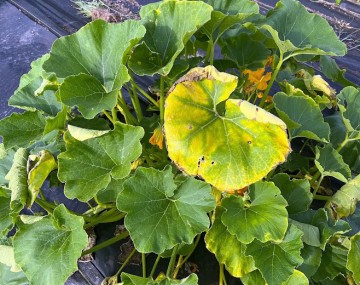
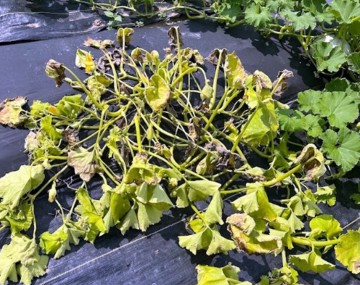
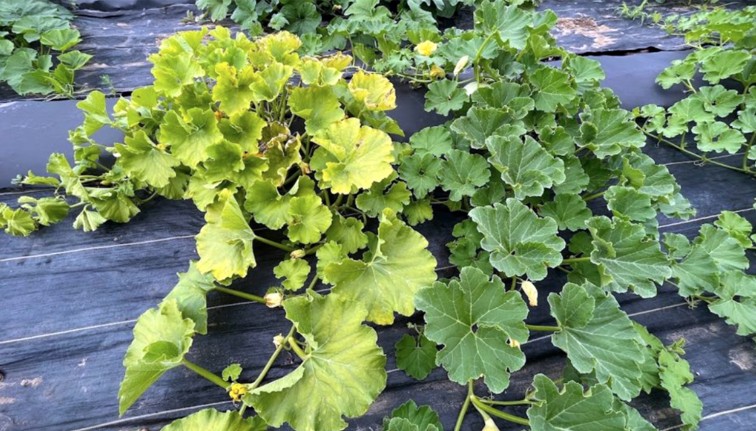
Symptoms begin with plant decline (fig. 1), interveinal yellowing leaves (fig. 2), followed by the yellowing of entire vines. Plant wilting may begin as soon as two weeks after the first symptoms appear. Other symptoms include stunting and plant collapse (fig. 3A). The bacterium moves systemically in the vascular tissue of the plants. The vascular tissue of affected plants can sometimes have a honey-brown color when looking at the cross-section of the stem at the crown of the plant.
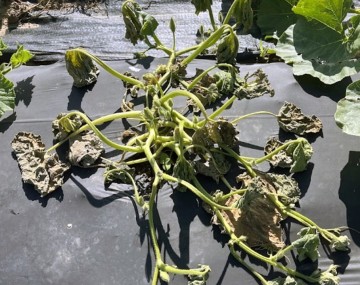
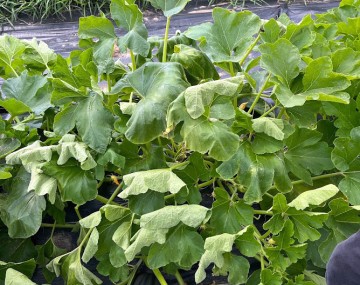
Symptoms may be similar to those caused by bacterial wilt, which is caused by the bacterium Erwinia tracheiphila and transmitted by the striped cucumber beetle (Acalymma vittatum) and spotted cucumber beetle (Diabrotica undecimpunctata). Although both diseases can be seen as wilting and scorching of leaf margins, the main difference between them is the yellow appearance in CYVD compared to bacterial wilt (no yellow appearance, fig. 3).
Fig. 1. Early symptoms of cucurbit yellow vine disease on squash in the field are seen as plant decline.
Fig. 2. Symptoms of cucurbit yellow vine disease are shown as interveinal leaf yellowing and scorching of leaves.
Fig. 3A. Late cucurbit yellow vine disease symptoms shown as yellowing of the entire plant, decline, and wilting.
Fig. 3B. Bacterial wilt symptoms are shown as wilting and scorching of leaf margins without yellowing.
Disease cycle of cucurbit yellow vine disease
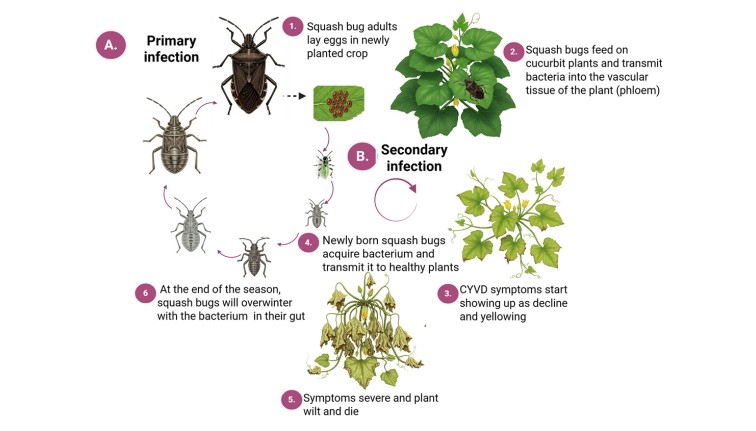
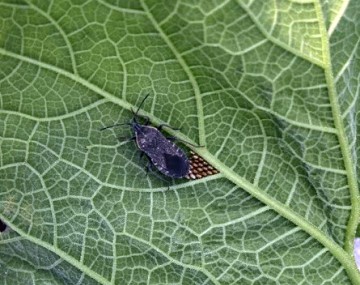
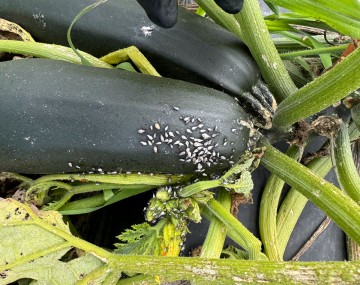
The bacterium overwinters in the adult squash bug. Early infection of cucurbit crops is caused by squash bugs feeding on the plant (fig. 4). Other potential vectors are striped cucumber beetle and spotted cucumber beetle. Squash bugs also acquire S. ureilytica while feeding on infected plants, and infected insects can transmit the bacterium to other cucurbit plants as they feed. The acquired bacteria can persist in the squash bug gut during molting and/or hibernation and serve as primary inoculum for the next cropping season. When adult squash bugs emerge from hibernation (typically early to mid-June), they feed on cucurbit plants and lay egg masses (fig. 4) on the underside of leaves and other parts of the plant. After eggs hatch, squash bugs go through a nymphal stage before becoming an adult (fig. 5). This process can take from four to six weeks. The climate in New York State usually prevents more than one generation of squash bugs per year. The disease cycle can be seen in figure 6.
Disease cycle diagram
Fig. 6. Cucurbit yellow vine disease cycle of disease. Image made with Biorender.
Fig 4. Squash bug (Anasa tristis) adult laying eggs on the underside of the cucurbit leaf.
Fig. 5. Squash bug (Anasa tristis) nymphs feeding on a zucchini plant.
Management of cucurbit yellow vine disease
Current disease management practices aim to control the squash bug vector. Squash bugs usually aggregate on the underside of leaves or at the base of cucurbit plants (fig. 2), allowing them to escape from foliar-applied insecticides. Although plastic mulch can help control other pests, it gives the squash bug a place to shelter, which can increase its population.
Therefore, managing the first generation of squash bugs during their nymphal stage (end of June in New York State) is crucial to reducing the size of the adult population. Cultural practices to control the squash bug include crop rotations with non-cucurbit plants or at a sufficient distance from where previous cucurbits were, removing crop debris and old fruit that will not be harvested, so that the overwintering population can be reduced. Using Hubbard squash as a trap crop on plot edges can help reduce disease in the main plot. Although squash bugs are challenging to manage, insecticide use remains one of the most effective control strategies. Refer to your local Cornell Cooperative Extension guidelines or your state guidelines when applying insecticides to crops.
Any time you use a pesticide, you must read and follow the label directions and comply with all applicable laws and regulations related to pesticide use. Also be sure that any pesticide used is approved for use in your country and state/province.
Authors and contributors
Kensy D. Rodriguez-Herrera
Plant Pathology and Plant-Microbe Biology Section, School of Integrative Plant Science, Cornell AgriTech, Cornell UniversitySarah J. Pethybridge
Plant Pathology and Plant-Microbe Biology Section, School of Integrative Plant Science, Cornell AgriTech, Cornell UniversitySteve Reiners
Horticulture Section, School of Integrative Plant Science, Cornell AgriTech, Cornell UniversityBrian Nault
Department of Entomology, Cornell AgriTech, Cornell UniversityBryan Swingle
Plant Pathology and Plant-Microbe Biology Section, School of Integrative Plant Science, Cornell University
Robert W. Holley Center, United States Department of Agriculture-Agricultural Research Service, Emerging Pests and Pathogens Research UnitChristine D. Smart
Plant Pathology and Plant-Microbe Biology Section, School of Integrative Plant Science, Cornell AgriTech, Cornell University
Reviewed by
Marion Zuefle
Cornell Integrated Pest Management, Cornell AgriTech, Cornell University
Last updated: November 2025
This material is based upon work supported by the National Institute of Food and Agriculture, U.S. Department of Agriculture, through the Northeast Sustainable Agriculture Research and Education program under subaward number GNE24-321.
- Rodriguez-Herrera, K. D., Ma, X., Swingle, B., Pethybridge, S. J., Gonzalez-Giron, J. L., Herrmann, T. Q., Damann, K., & Smart, C. D. (2023). First Report of Cucurbit Yellow Vine Disease Caused by Serratia marcescens on Cucurbits in New York. Plant Disease, 107(10), 3276–3276. https://doi.org/10.1094/pdis-06-23-1051-pdn
- Fig 1 - photo by Kensy Rodriguez-Herrera, Cornell University
- Fig 2 - photo by Kensy Rodriguez-Herrera, Cornell University
- Fig 3A and 3B - photos by Kensy Rodriguez-Herrera, Cornell University
- Fig 4 - photo by Kensy Rodriguez-Herrera, Cornell University
- Fig 5 - photo by Kensy Rodriguez-Herrera, Cornell University
- Fig 6 - made with Biorender- photo by Kensy Rodriguez-Herrera, Cornell University
Graduate Student (Chris Smart Lab)
School of Integrative Plant Science
Plant Pathology and Plant-Microbe Biology Section
- kdr66 [at] cornell.edu
Goichman Family Director
Cornell AgriTech
Professor
School of Integrative Plant Science
Plant Pathology and Plant-Microbe Biology Section
- (315) 787-2441
- cds14 [at] cornell.edu
USDA-ARS Robert W. Holley Center Scientist and Courtesy Associate Professor
School of Integrative Plant Science
Plant Pathology and Plant-Microbe Biology Section
- bms45 [at] cornell.edu
- (315) 787-2354
- ban6 [at] cornell.edu
- (315) 787-2311
- sr43 [at] cornell.edu
Associate Professor
School of Integrative Plant Science
Plant Pathology and Plant-Microbe Biology Section
Cornell AgriTech
- (315) 787-2417
- sjp277 [at] cornell.edu
- (315) 787-2379
- mez4 [at] cornell.edu