Corn Earworm (Helicoverpa zea)
Vegetable IPM Fact Sheet
Corn Earworm (CEW) is a global pest that feeds on multiple different crops worldwide. It is named based on what crop it feeds on. The pest is called corn earworm when it feeds on corn. It can cause serious injury to tomatoes, hemp, tobacco, cotton, soybeans and corn.
In this fact sheet
- Appearance of Corn Earworm
- Life cycle of Corn Earworm
- Managing Corn Earworm
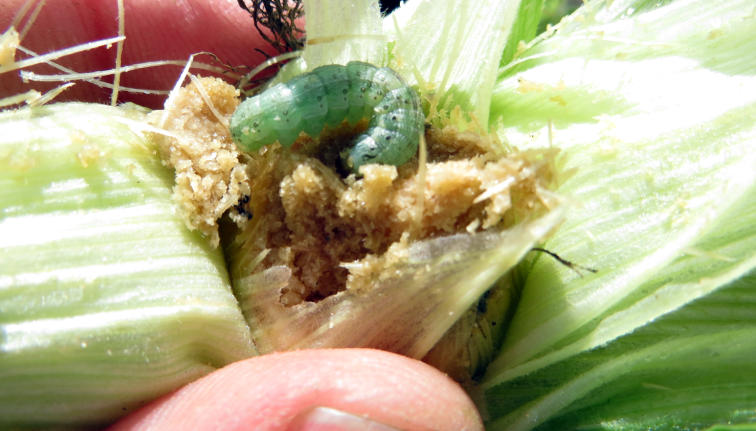
CEW is a pest that attacks many different crops, including tomato, hemp, tobacco, cotton, soybean and corn. In the southern United States, the damage from CEW is more severe due to the warmer climate and its ability to over winter. In the north it typically does not over winter. Migrating adults arrive in the northeast between mid-July and late August, and can produce between one and two generations. Adult moths will lay their eggs on fresh corn silk. Upon hatching, the larvae will feed on corn silks before entering the ear to feed on the kernels, reducing yield and appearance of the cob. In uncontrolled areas, heavy infestations can cause almost 100% of the ears to be infested.
Appearance of Corn Earworm
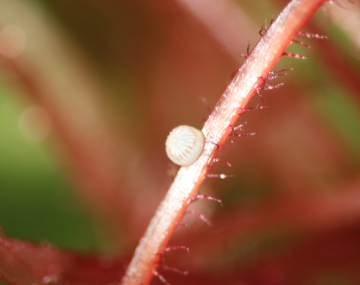
- CEW eggs are small, white and have a hemispherical shape. They are about half the diameter of a pin head, and are laid singly on corn silks.
- CEW can vary in appearance, but all larvae have a tan head with alternating light and dark stripes running the length of its body. Its total length is about 1.5 inches (38 mm) long when fully grown. The body also has microspines that can be easily seen with a magnifying glass or a hand lens.
- The color of CEW larvae can vary from light green, pink, brown or black. All will have a lighter colored underside.
- For more information on how to ID CEW larvae, see the Cornell IPM Sweet Corn Larval Pest Identification fact sheet.
- CEW pupae have a brown color and are about 1 inch (25 mm) in length.
- CEW adult moths have a yellowish-brown color with an approximately 1.5 inch (38 mm) wingspan. The front wings have a light tannish brown color, with a darker wing tip and dark gray irregular lines and a distinctive dark spot near the center. The hind wings have a whitish color with irregular dark markings. The moth’s eyes are light green.
CEW eggs are about half the diameter of a pin head, making them very hard to spot when scouting for CEW.
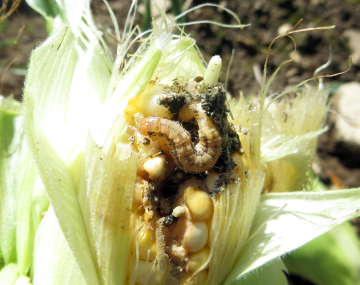
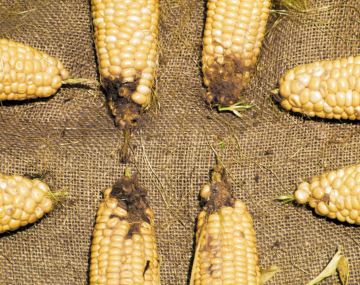
CEW larvae will enter into the top of corn ears through the silk, feeding on kernels and leaving behind fecal matter.
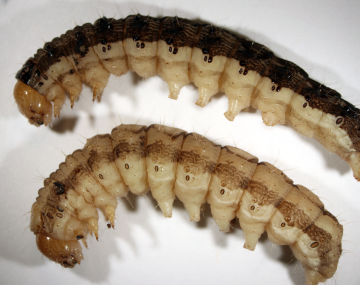
CEW larvae can vary in appearance, but all have a tan head and small microspines along the body.
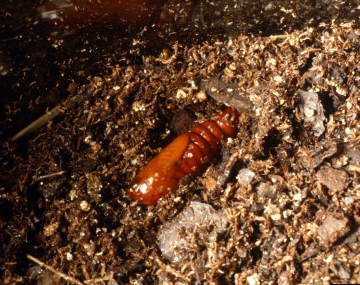
CEW larvae burrow into the soil to pupate. The pupae are brown and are about 1 inch (25 mm) in length.
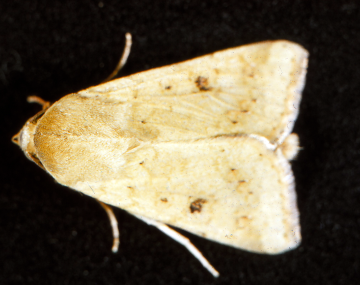
Adult CEW are yellowish-brown in color. Their wingspan is about 1.5 inches (38 mm). Note the dark spots near the center of the forewings.
Life cycle of Corn Earworm
- Adult moths lay eggs on warm, moist and cloudy evenings at dusk. Eggs will hatch between 2 and 10 days depending on the temperature.
- Young larvae move down the silk channel and enter the ear where they feed on developing kernels. Here the larvae eat the kernels down to the cob and leave excrement (frass) near the tip of the ear.
- Once fully developed, the larvae will leave or fall off the corn ears to the ground. They then burrow 3 to 5 inches (76 to 127 mm) into the ground to pupate for 10 to 25 days depending on the temperature.
- After pupation, moths will emerge from the ground. The total development cycle of CEW from egg to adult takes about 30 days during the summer.
- In New York State, CEW larvae do not typically overwinter; however, overwintering is becoming more common in certain areas. With ongoing climate change, these areas appear to be expanding.
- CEW flights in New York State usually begin in mid-July and continue through September, but in overwintering locations, adult CEW have been detected as early as late May.
Damage of Corn Earworm
CEW larvae will eat kernels around the tips of the ear. This makes the corn less appealing to consumers and reduces total harvest.
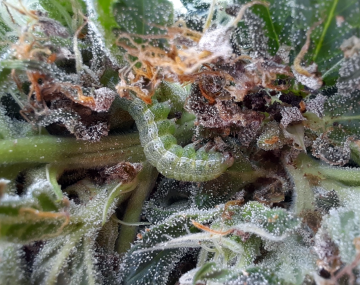
Another host plant of CEW is hemp, where the larvae feed on flower buds and developing seeds.
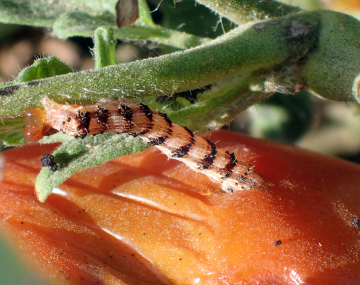
CEW will also feed on tomato plants, when it is then called the tomato fruitworm.
Management of Corn Earworm
Pest monitoring
- Scouting for eggs and CEW damage is very difficult. CEW eggs are very small and laid individually, and the larvae enter and feed on corn ears with little external damage.
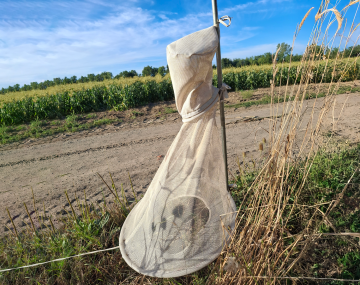
- It is better to rely on pheromone or black light traps to monitor CEW populations. Spray intervals for CEW can be based off of weekly trap catches.
- For more information on monitoring CEW, see the Cornell Pheromone Traps for Sweet Corn fact sheet.
- For more instruction on sweet corn trap monitoring, watch Cornell IPM’s Sweet Corn Pheromone Trap Network Setup and Monitoring video.
- The Sweet Corn Pheromone Trapping Network has been monitoring CEW populations in NY since 1997. To get weekly trapping reports visit the IPM sweet corn network website.
Control
- Cultural control: Planting early in the season can help avoid most of the damage from CEW. If sweet corn is harvested before mid-August, it will suffer from little to no damage.
- Biological control: Certain species of insects, such as the big-eyed bug, parasitic flies and Trichogramma wasps will feed on or parasitize corn earworm eggs and larvae. For more information, see the Trichogramma ostriniae wasp fact sheet on the Cornell IPM website.
- Bt corn hybrids: Certain field and sweet corn hybrids are available that possess resistance to CEW. These hybrids contain the Bt trait, which enables the plant to produce insecticidal proteins that help protect against CEW feeding. Refer to seed company guidelines when using Bt or other corn hybrids.
- Chemical control: Refer to your local Cornell Cooperative Extension or state guidelines when applying insecticides to crops.
- Responsible pesticide application should be planned when applying any insecticide to crops. This should be done to ensure that resistance to pesticides is minimized in the targeted pest population, while minimizing damage to beneficial insects and pollinator populations.
- Use the EIQ (Environmental Impact Quotient) calculator to access the environmental and health impacts different pesticides have before selection.
Any time you use a pesticide, you must read and follow the label directions and comply with all applicable laws and regulations related to pesticide use. Also be sure that any pesticide used is approved for use in your country and state/province.
Pheromone traps, such as heliothis traps, are more effective for monitoring CEW populations than scouting in fields.
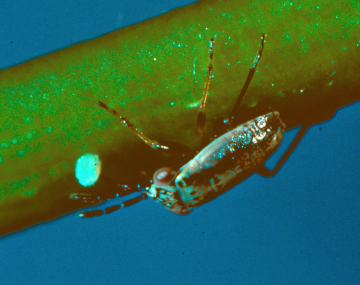
Big-eyed bugs are among the natural predators of CEW.
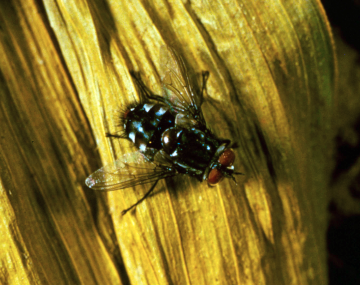
Parasitic flies and Trichogramma wasps are parasitoids of CEW eggs and young larvae.
Authors
Marion Zuefle
Vegetable IPM Coordinator, Cornell Integrated Pest ManagementLukas Rood
Temporary Program/Extension Aide, Cornell Integrated Pest Management
Last updated: October 2025
Modified from an article written by A.A. Muka: Muka, A.A. “Corn Earworm.” Cornell University Library eCommons, with url “https://hdl.handle.net/1813/42364”.
This factsheet was developed in part with funding support from the New York State Department of Agriculture and Markets.
- Cook, Kelly A. and Weinzierl, Rick. “Corn Earworm.” University of Illinois IPM, https://ipm.illinois.edu/fieldcrops/insects/corn_earworm.pdf. Accessed 22 October 2025.
- Foster, Rickey E. “Vegetable Insects: Corn Earworm.” Purdue University Department of Entomology, https://extension.entm.purdue.edu/publications/E-31/E-31.pdf. Accessed 22 October 2025.
- CEW can vary in…—photo by Marion Zuefle, Cornell IPM
- CEW eggs are about…—photo by Marion Zuefle, Cornell IPM
- CEW larvae will enter…—photo by Marion Zuefle, Cornell IPM
- CEW larvae can vary…—photo by Marion Zuefle, Cornell IPM
- CEW larvae burrow into…— photo by Joe Culin, Clemson University
- Adult CEW are moths…— photo by NYSAES, Cornell University
- CEW larvae will eat…—photo by Alton N. Sparks, Jr., University of Georgia
- Another host plant of…—photo by Marion Zuefle, Cornell IPM
- CEW will also feed…—photo by Whitney Cranshaw, Colorado State University
- Pheromone traps, such as…—photo by Marion Zuefle, Cornell IPM
- Big-eyed bugs are…— photo by Jack Kelly Clark; Statewide IPM Project, University of California
- Parasitic flies and Trichogramma…—photo by J. Ogrodnick, Cornell IPM
- (315) 787-2379
- mez4 [at] cornell.edu