Apple Powdery Mildew (Podosphaera leucotricha)
Fruit Fact Sheet
Powdery mildew of apples is a disease occurring worldwide that can decrease shoot growth, affect shoot vigor, reduce the winter hardiness of buds and cause russeting on fruit.
In this fact sheet
- Causal agent of apple powdery mildew
- Symptoms of apple powdery mildew
- Disease cycle and epidemiology of apple powdery mildew
- Managing apple powdery mildew
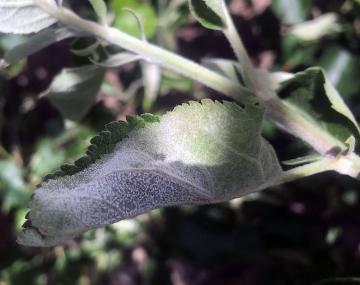
white color is evidence of conidia that contribute to disease spread. Photo: D. Strickland.
Powdery mildew occurs in all apple-producing regions worldwide, especially where warm, humid climate conditions prevail. Young expanding plant tissues are particularly susceptible to the disease. Therefore, powdery mildew is especially important in nursery production and non-bearing orchards, where terminal shoot growth continues producing susceptible leaf tissue into late summer or early fall. Losses from the disease vary depending upon the inherent susceptibility of the cultivar, environmental conditions, and management practices. In the Northeast, the disease can be significant in dry years or following mild winters and may be more of a problem in orchards planted near lakes and rivers, where higher humidity occurs. Powdery mildew infections decrease shoot growth, affect shoot vigor, reduce the winter hardiness of buds and can cause russeting on fruit.
Causal agent of apple powdery mildew
Apple powdery mildew is caused by the ascomycete fungus Podosphaera leucotricha. In addition to apple, P. leucotricha may infect crabapple, pear, and quince. On peach fruit, it may cause a disease known as rusty spot. P. leucotricha is an obligate biotroph, meaning that it can only survive or reproduce on living host tissue. The pathogen overwinters in infected buds, and in this way, may have inadvertently been spread into new growing regions.
Symptoms and signs of apple powdery mildew
Powdery mildew infects young green tissues of the plant, as well as developing blossoms. Symptoms of the disease are variable and depend on the cultivar, when infection occurred, degree of infection, and weather conditions. Diagnosis is typically done by inspection for the visible presence of the fungus, seen as white mycelium and spores—the mildew. Late in the season, small black spherical fruiting bodies (chasmothecia) form on the mildew surface, which may be visible to the naked eye.
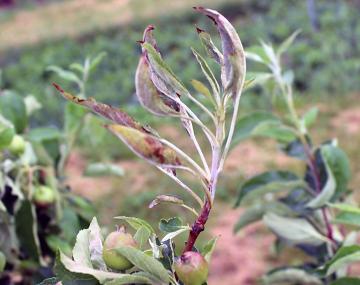
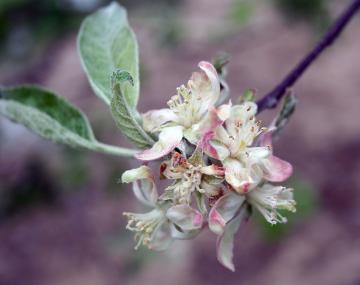
Leaves are most susceptible to infection in the first few days after they open. Patches of white mycelium form on the underside of the leaf where the cuticle is less developed (Fig. 1). Chlorotic (yellow) spots may show on the upper side of the leaf above the white patch. Mildew lesions on the upper leaf surface appear powdery white but eventually turn a darker brown. Infected leaves tend to crinkle, curl, or roll upwards along the edges, giving them a narrow appearance (Fig. 2). Severely infected leaves may drop prematurely during the summer. Under favorable conditions, the disease will spread over the leaf and progress down the petiole to colonize the entire young, green shoot. If buds are forming at this time, the powdery mildew fungus may infect them and overwinter in the bud tissues. Unless killed by cold winter temperatures, these less vigorous buds typically open five-eight days later than healthy buds the following spring. When infected buds push in early spring, the fungus advances its primary infection into new, succulent growth, giving rise to infected shoots (Fig. 3) or flower clusters (Fig. 4). These serve as the source of spores for secondary infections.
Primary infections on terminal shoots and flower clusters appear stunted and may be killed outright in the spring or may survive the season and die in late fall or winter. Although less common, blossom infections are important because they either fail to set fruit or produce small, stunted and russeted fruit (Fig. 5) unsuitable for fresh market sale.
Disease cycle and epidemiology of apple powdery mildew
Powdery mildew development is most severe under warm, humid weather conditions. Conditions favorable for conidial germination and infection occur between 50°F to 77°F (10°C to 25°C), optimum 66°F to 72°F (19°C to 22°C), with high relative humidity. Slow to no conidial germination will occur below 39°F to 50°F (4°C to 10°C) and above 86°F (30°C). Rain and leaf wetness are detrimental to infection, because conidia (the fungal spores) cannot germinate when immersed in water.
The pathogen overwinters as mycelium in dormant flower and shoot buds infected during the previous growing season. Mildew-infected buds are more susceptible to winter freezing injury and have reduced winter hardiness. Most (96%) of mildew-infected buds of cv Jonathan were killed during winters with temperatures at or below -11°F (-24°C).
Infected buds break dormancy later than healthy buds, and as they grow, the fungus colonizes young leaf tissue, shoots and flower clusters. From these primary infections, masses of conidia form, which spread by wind to healthy, young leaves. If conducive weather conditions occur and the cultivar is susceptible, infection takes place, and secondary, sporulating lesions form on the young leaves leading to subsequent infection cycles. Under warm, dry weather conditions, powdery mildew will continue to colonize and cover the leaves, petioles and shoot, gaining access to the developing bud tissue where it will establish an overwintering site in the dormant buds, completing the cycle (Fig. 6).
Small black fruiting bodies called chasmothecia may form amongst the mycelial colonies if the fungus undergoes sexual reproduction in the late summer. These chasmothecia also allow the fungus to successfully overwinter, although they are not a major source of primary inoculum the following year.
Apple powdery mildew disease cycle illustration
Fig. 6 The disease cycle of Podosphaera leucotricha.
- Fungal mycelium overwinters within host bud tissue.
- Disease progression begins with a primary infection of either the shoot growth, blossoms, and/or developing fruit in the early growing season. An inset shows a microscopic view of conidia with conidiophores.
- Powdery mildew colonizes other leaves of the host.
- Conidia develop because of these infections and spreads, leading to secondary infection of other leaves and nearby host trees. This cycle is repeated throughout the growing season.
- Developing buds become infected with fungal mycelium, which will overwinter to become the next year’s source.
- An inset shows a microscopic view of the fungal ascospores, the result of sexual reproduction.
Management of apple powdery mildew
Susceptible and resistant cultivars
The most effective method to manage powdery mildew is to avoid planting highly susceptible varieties. Susceptible cultivars include: Baldwin, Cameo, Cortland, Cox’s Orange Pippin, Crimson Crisp, Cripps Pink (Pink Lady), Crispin, Ginger Gold, Golden Delicious, Granny Smith, Honeycrisp, Idared, Jonagold, Jonathan, Liberty, Monroe, Mutsu, Paulared, Prima, and Rome Beauty. The modern cultivars EverCrisp, NY1 (SnapDragon), and SweeTango appear to be moderately resistant. Other moderately- resistant to resistant apple varieties include the cultivars Ambrosia, Autumn Glory, Britegold, Delicious, Empire, Enterprise, Fuji, Gala, Jonafree, Nitany, and Winesap.
Pruning
As part of normal pruning operations, dead, distorted or stunted terminal shoots will likely be removed, although their removal likely will not contribute significantly to reducing overwintering infected buds. Pruning to maintain an open tree canopy will reduce the humidity level, increase light penetration, and increase the temperature in the canopy making it less conducive for the pathogen, as well as improving fungicide spray deposition.
Fungicides
Management with fungicides is needed on susceptible varieties, although resistant varieties may also become infected when inoculum is present and optimum environmental conditions prevail. Note that since rain is not required for conidial germination, care should be taken to maintain mildew sprays even during prolonged dry periods (when applications for apple scab are typically not warranted). To reduce selection pressure for fungicide resistance and to achieve disease control, application timing should occur at 7- to 10-day intervals from tight cluster to petal fall. This will protect young, growing tissues from secondary infections. After petal fall, the interval may be widened to 12-14 days on susceptible varieties growing in humid climates to protect trees until terminal bud set. Research suggests that increasing the frequency of applications may be more effective than using higher application rates.
Fungicides for effective powdery mildew control fall into three major classes: demethylation inhibitors (DMIs), quinone outside inhibitors (QoIs), and succinate dehydrogenase inhibitors (SDHIs). Pathogen resistance to the DMIs has led to diminished effectiveness of this fungicide class. The QoIs are presently the most effective fungicide class. Like the DMIs, QoIs and SDHIs are prone to selection for resistance in the pathogen. To prevent the emergence of fungicide resistance, apply fungicides according to label instructions and in rotation with other fungicides of differing Fungicide Resistance Action Committee (FRAC) grouping. Several other fungicides are labeled for use against apple powdery mildew. Refer to the Cornell Integrated Pest Management Guidelines for Commercial Tree Fruit Production for specific fungicide options and application timings.
Authors
David Strickland
Plant Pathology and Plant-Microbe Biology Section, Cornell UniversityJuliet Carroll
Cornell Integrated Pest Management Program, Cornell UniversityKerik Cox
Plant Pathology and Plant-Microbe Biology Section, Cornell University
Last updated: 2020
- Figure 1. Distortion and curling upward of a leaf caused by secondary infection of powdery mildew. Photo: D. Strickland.
- Figure 2. Terminal shoot of cv. ‘Jonagold’ covered with powdery mildew. Photo: D. Strickland.
- Figure 3. Primary infection of an apple shoot that grew from a bud infected the prior year. Photo: K. Cox.
- Figure 4. Primary infections from overwintered, infected flower buds cause distortion of blossoms. Photo: K. Cox.
- Figure 5. Russeting of ‘Jonagold’ fruit from early-season powdery mildew infectionPhoto: D. Strickland.
- Figure 6. Disease cycle of apple powdery mildew. Illustration: K. Cox.
- aew232 [at] cornell.edu
Professor
School of Integrative Plant Science
Plant Pathology and Plant-Microbe Biology Section
Cornell AgriTech
- (315) 787-2401
- kdc33 [at] cornell.edu
Senior Extension Associate, Emerita (retired – active)
School of Integrative Plant Science
- jec3 [at] cornell.edu