Apple Maggot (Rhagoletis pomonella)
Fruit Fact Sheet
The apple maggot (AM), a native insect of eastern North America, originally bred in large fruited hawthorns (Crataegus spp.). Later, it adopted apples as another host, and it has become a major fruit pest in the northeastern United States and Canada.
In this fact sheet
- Biology of Apple Maggot
- Damage of Apple Maggot
- Monitoring Apple Maggot
- Management of Apple Maggot
- Guide to Stages
The apple maggot (AM), a native insect of eastern North America, originally bred in large fruited hawthorns (Crataegus spp.). Later, it adopted apples as another host, and it has become a major fruit pest in the northeastern United States and Canada. Thorough control is necessary because marketed apples must be free from all AM injury. AM normally has a single generation a year, although there are two exceptions: AM may have a partial second generation in the southern part of its range, and some individuals remain in the soil two winters before emerging as adults.
Biology of apple maggot
Adults
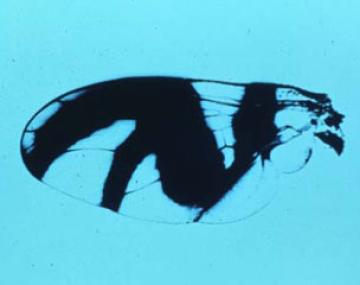
The first AM adults emerge from the soil from mid-June to early July. Peak emergence occurs during mid- to late July and is usually completed by the end of August. Emergence patterns vary considerably among different geographic locations and even within a specific area, depending on the host and environmental parameters, particularly temperature, soil type, and rainfall. Female flies are black, about 5.2 mm in length, with a wingspan of about 9.3 mm. They have a painted abdomen with four white cross bands (fig. 1). The males are smaller and have three cross bands on a rounded abdomen. AM wings are clear and marked with characteristic black bands (fig. 2). Newly emerged flies are sexually immature and spend considerable time on apple leaves feeding on honeydew excreted by aphids and other insects. The flies mature sexually 7 to 10 days after emergence and congregate on the fruit, where mating occurs. After mating, the female punctures the apple skin with her ovipositor to lay eggs. Females can lay an average of about 300 eggs over a 30-day life span.
Eggs
AM eggs are usually deposited singly just beneath the skin of the apple. The elongate (0.7 mm), curved eggs are smooth and white in color. Eggs hatch after a 2- to 10-day incubation period, depending on the ambient temperature.
Larvae
The legless, cream-colored maggots are elongate, about 7 mm long at maturity, and have a blunt posterior that tapers down to a rounded point containing two black mouth hooks (fig. 3). The larvae pass through three instars, spending 20 to 30 days feeding within the fruit. The larvae develop more rapidly and mortality is lower in earlier-maturing, soft cultivars than in firmer fleshed, later-ripening apples. Upon completing their third-instar feeding, the maggots drop to the ground, burrow into the soil, and molt to a fourth instar, which is quickly followed by another molt to the pupal stage.
Pupae
AM pupae are found within puparia made from the third-instar skin (fig. 4). The brownish-yellow puparia are about 4 mm long. The majority of pupae are located within 50 mm of the soil surface. Pupae pass the winter in diapause.
Damage of apple maggot
AM injury varies in appearance and severity among apple cultivars. Oviposition punctures may cause the fruit to become dimpled or distorted (fig. 5), and in softer cultivars the tissue around the wounds may darken and decay. These punctures or stings appear as pinpricks on the fruit surface (fig. 6). Young larvae tunnel throughout the apple, leaving small, brownish, irregular, threadlike trails (fig. 7). As the larvae grow, the tunnels become more conspicuous and are further enlarged by bacterial decay (fig. 8). Eventually, the apple becomes soft and rotten. This internal breakdown proceeds more rapidly and is more· severe in the softer-fleshed, earlier-maturing cultivars.
Monitoring apple maggot
Crop scouts and consultants have used traps to monitor AM populations for many years, but this approach, useful as it is, may not necessarily be recommended in all cases. Some orchards have such high or such low AM populations that monitoring for them is not always time-efficient. That is, in some blocks, sprays are necessary every season, often on a calendar basis; however, in some blocks the populations are so low that they are rarely needed at all. However, most commercial NY orchards have moderate or variable pressure from this pest, and in these cases monitoring to determine when potentially damaging numbers of them are present allows growers to apply only the number of sprays necessary to protect the fruit from infestation.
Sticky panels
Sticky yellow panels were some of the first traps for AM, and have been in use for over 70 years; these can be very helpful in determining when AM flies are present. The insects emerge from their hibernation sites in the soil from mid June to early July in New York, and spend the first 7–10 days of their adult life feeding on substances such as aphid honeydew until they are sexually mature. Because honeydew is most likely to be found on foliage, and because the flies see the yellow panel as a "super leaf", they are naturally attracted to it during this early adult stage. A few of these panels hung in such an orchard can serve as an early warning device for growers if there is a likely AM emergence site nearby.
Many flies pass this period outside of the orchard, however, and then begin searching for fruit only when they are ready to mate and lay eggs. That means that growers don't always have the advantage of this advance warning, in which case the catch of a single (usually sexually mature) fly indicates that a spray is necessary immediately to adequately protect the fruit. This can translate into an undesirable risk if the traps are not being checked daily and are used to signal an immediate response, something that's not always possible during a busy summer.
Red sphere traps & lure
To regain this time advantage, more effective traps have been developed, which are in the form of a "super apple" — large, round, deep red, and often accompanied by the scent of a ripe apple — in an attempt to catch that first AM fly in the orchard. Because this kind of trap is so much more efficient at detecting AM flies when they are still at relatively low levels in the orchard, the traps can usually be checked twice a week to allow a 1–2-day response period (before spraying) after a catch is recorded, without incurring any risk to the fruit. Research done in Geneva over a number of years indicates that these traps work so well that it is possible to use a higher threshold than the old "1 fly and spray" guidelines recommended for the panel traps. Specifically, it has been found that sphere-type traps baited with a lure that emits apple volatiles attract AM flies so efficiently that an insecticide cover spray is not required until a threshold of 5 flies per trap is reached.
Recommended practice
The recommended practice is to hang three volatile-baited sphere traps in a 10- to 15-acre orchard, on the outside row facing the most probable direction of AM migration (towards woods or abandoned apple trees, or else on the south-facing side). Then, the traps are periodically checked to get a total number of flies caught; dividing this by 3 gives the average catch per trap, and a spray is advised when the result is 5 or more. Be sure you know how to distinguish AM flies from others that will be collected by the inviting-looking sphere.
In home apple plantings, it is theoretically possible to use these traps to "trap out" local populations of AM flies by attracting any adult female in the tree's vicinity to the sticky surface of the red sphere before it can lay eggs in the fruit. Research done in Massachusetts suggests that this strategy can protect the fruit moderately well if one trap is used for every 100–150 apples normally produced by the tree (i.e., a maximum of three to four traps per tree in most cases), a density that makes this strategy fairly impractical on the commercial level.
A variety of traps and lures are currently available from commercial suppliers; among them: permanent sphere traps made of wood or stiff plastic, disposable sphere traps made of flexible plastic, and sphere-plus-panel ("Ladd") traps. The disposable traps are cheaper than the others, of course, but only last one season. Ladd traps are very effective at catching flies, but are harder to keep clean, and have performed no better than any other sphere trap in our field tests. Brush-on stickem is available to facilitate trap setup in the orchard. Apple volatile lures are available for use in combination with any of these traps. These tools are available from a number of orchard pest monitoring suppliers, among them:
Management of apple maggot
Current options for management of apple maggot include Imidan, Assail, Altacor, Avaunt, Delegate, Exirel, certain premixes such as Endigo, Leverage, Besiege, and the pyrethroids. Growers on a Delegate or Altacor program for leafrollers/internal leps should get some protection against moderate AM pressure. For those not using Imidan in their cover sprays, Assail will provide excellent control of apple maggot as well as internal lepidoptera where populations are still OP-susceptible.
Guide to apple maggot stages
Commercial orchards do not usually harbor resident apple maggot populations. Their presence and injury may be more readily observed on infested, abandoned trees.
- Adults
Timing (in New York State): June 15 through September
Where to look: On early varieties and maturing fruit. Presence or migration may be monitored with sticky traps - Eggs (Sting)
Timing (in New York State): 7-10 days after first emergence of adults
Where to look: On sunny side of tree, more mature fruit; small but visible puncture, may cause dimpling - Larvae (Maggot)
Timing (in New York State): 2-10 days after eggs are laid
Where to look: In the flesh of the apple; tunneling may appear as a brownish, irregular, thread-like trial - Pupae
Timing (in New York State): Late July through early November
Where to look: In soil within 50 mm (2 in) of surface
Figure 9
Size comparison between the apple maggot life stages.
Authors
- Monique Rivera
Department of Entomology, Cornell University - Michael Basedow
Eastern New York Commercial Horticulture Program, Cornell Cooperative Extension - Janet van Zoeren
Lake Ontario Fruit Program, Cornell Cooperative Extension
Last updated: 2022
Modified from an article written by W. H. Reissig: Reissig, W.H. (1991). Apple Maggot. New York State IPM Program.
- Figure 1. An adult female apple maggot. Photo: NYSAES, Cornell University
- Figure 2. Apple maggot wing. Photo: NYSAES, Cornell University
- Figure 3. An apple maggot larva. Photo: NYSAES, Cornell University
- Figure 4. Apple maggot puparia. Photo: NYSAES, Cornell University
- Figure 5. Oviposition punctures. Photo: NYSAES, Cornell University
- Figure 6. An oviposition sting. Photo: NYSAES, Cornell University
- Figure 7. A threadlike trail through an apple. Photo: NYSAES, Cornell University
- Figure 8. Tunnels worsen overtime. Photo: NYSAES, Cornell University
- Figure 9. Size comparison of life stages. Illustration: Hannah Tolz, Cornell IPM
- aew232 [at] cornell.edu
- (585) 797-8368
- jev67 [at] cornell.edu
- (518) 410-6823
- mrb254 [at] cornell.edu
- monique.rivera [at] cornell.edu