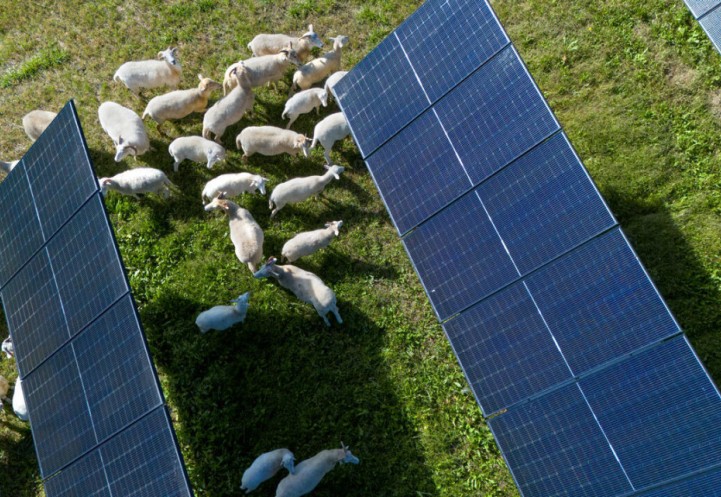
How can you use land within solar arrays?

To meet New York state’s aggressive renewable energy goals, many new solar projects will be built on flat, cleared land. This is putting pressure on New York farmers through increased land rent, loss of acreages to solar development and potentially through the erosion of the agricultural economies in places near large power transmission lines. What if we could learn how to produce both energy and food? Learning what kinds of agriculture can be combined with energy generation could be part of a solution that will preserve New York’s farming communities while continuing to grow food for our state and beyond.

New York state statistics

70%

of NYS electricity

will be renewable by 2030 (NYS Climate Act)

42%

of rural NYS landowners

oppose large scale solar siting

44%

of rural NYS landowners

support community large scale siting

Our research areas

Agrivoltaics is a growing area of interest globally, as countries integrate solar energy production into their landcapes. Cornell researchers are studying:

What crops grow in New York solar arrays?

Researchers are testing  a range of crops in different kinds of solar farms around New York.

Validating new monitoring technology

eDNA is genetic material that is shed by organisms and can be collected in the environment and used to identify species. Project results will be used to develop best management practices for pollinator-friendly solar energy development, including siting, vegetation management and design.


What solar projects have support?

Learning from New York residents what solar projects have support, and which communities wish to avoid. 


Assessing the impact of solar on farmland values

As New York embraces climate and renewable energy goals, farmers, landowners and rural New Yorkers are seeing a rise in large-scale solar developments. 


Prioritizing an engagement-focused effort

As New York state’s land-grant institution, we strive to become a leader in applied solar energy research by prioritizing an engagement-focused effort that capitalizes on existing partnerships between academic researchers, extension educators, community and government organizations and the industry.


Assessing the amount of current and former agricultural land

New York state has a large amount of former agricultural land that could be used for renewable energy, reforestation, increased agricultural production or other uses. 


Related news

Solar panels

News

$5M grant will fund study of how solar panels can boost crops

The New York State Energy Research and Development Authority has awarded the College of Agriculture and Life Sciences $5 million to build solar arrays at university farms in Ithaca and the Hudson Valley.

  • Cornell University Agricultural Experiment Station
  • Hudson Valley Lab
  • Natural Resources and the Environment Section
An infrared gas analyzer assesses photosynthetic light response in radish plants grown on a solar farm near Albany, New York.

News

A series of studies by Cornell researchers is testing how crops might grow when planted between rows of solar panels on a solar farm in New York state.

  • Natural Resources and the Environment Section
  • School of Integrative Plant Science
  • Soil and Crop Sciences Section
Two people in yellow jackets plant crops in between solar arrays

News

The process of combining agricultural production and solar panels on the same farmland, known as agrivoltaics, has seen a great leap in Cornell research activity.

  • Cornell University Agricultural Experiment Station
  • Agrivoltaics
  • Energy