Advanced cloth face mask research through material and design studies
Project Overview
Advanced cloth face mask research through material and design studies
This project evaluated how different cloth mask materials and designs perform after repeated cleaning, with the goal of balancing filtration effectiveness and wearer comfort. Results showed that most fabrics retained – or even improved – filtration efficiency after 40 decontamination cycles, but often became less breathable due to shrinkage, fiber damage, and detergent buildup.
The study also introduced a new method for assessing mask fit during movement using 3D head scans, enabling more accurate evaluation of leakage and comfort.
These findings provide evidence-based guidance for designing reusable, high-performing cloth masks, and the fit-assessment method offers a scalable tool for improving not only masks but also broader wearable headgear.
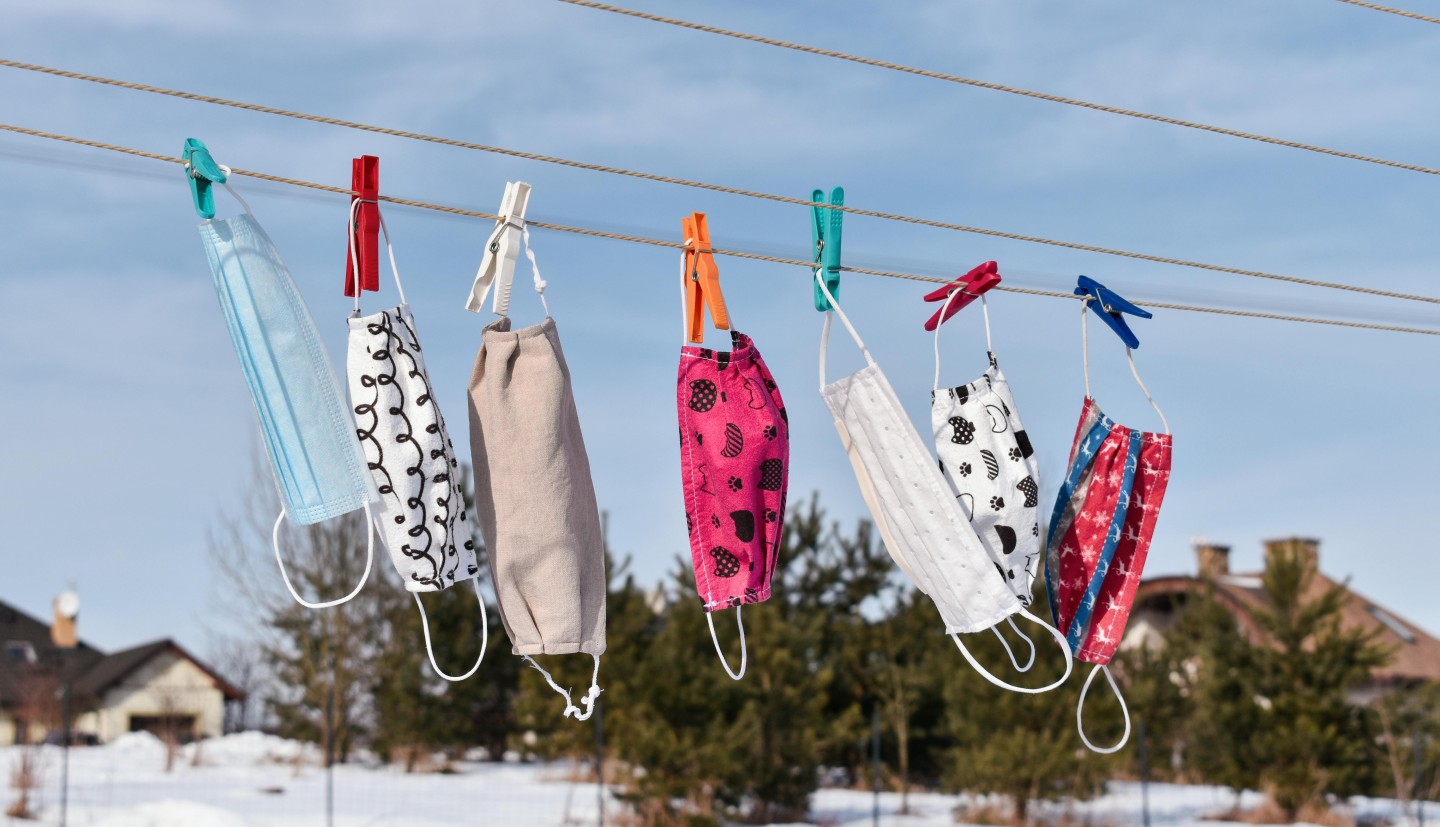
Improvised, handmade, and manufactured cloth face masks rose in prevalence in response to the Covid-19 pandemic, but more information is needed about the effectiveness and comfort of using and reusing common fabrics to capture exhaled aerosols. The main goal of this project is to identify materials and layering strategies for cloth masks that are effective yet still comfortable and will withstand repeated cycles of decontamination.
1. We studied the effect of decontamination – via 40 rounds of conventional home laundering, dishwasher sterilization, or microwave-generated steam – on air permeability and filtration efficiency among a variety of fabrics (3 knit, 7 woven, and 3 nonwoven).
2. Because cloth face mask design had not been addressed formally in research, we also conducted studies on dynamic fit of face masks. Proper initial (static) and persistent (dynamic) fit of face masks is crucial for both minimizing leakage and maximizing comfort. Therefore, we used 3D head scans of different face postures to evaluate specific design features of cloth face masks, with adult and child volunteers. .
The Impacts
1. Our decontamination work found that while most fabrics maintained or improved their filtration efficiency after 40 decontamination cycles, the air permeability of many fabrics decreased due to detergent buildup, fiber breakage, and fabric shrinkage. Tightly woven cotton fabrics had unacceptably low air permeability and filtration efficiency. Knit and nonwoven structures had the best balance of properties; although we do not recommend these fabrics as single-layer masks, they have potential use in multilayer masks.
2. We developed a new methodology to assess the dynamic fit of face masks, a methodology that can be implemented within an iterative design process to enable new face mask prototypes that optimize comfort, fit, and filtration performance, with possibilities as smart wearable devices.
While public interest in and need for face masks has thankfully waned for the time being, our work will provide scientifically validated information when the need arises again. Further, the design results we generated can be generalized beyond cloth face masks to other face masks and headgear (medical and non-medical).
Principal Investigator
Project Details
- Funding Source: Hatch Multistate
- Statement Year: 2025
- Status: Completed Project
- Topics: Protective gear, public health, face masks