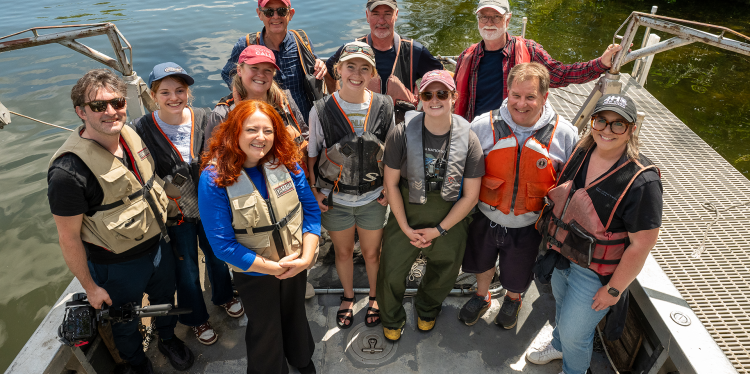
Paul: Welcome to Extension Out Loud, a podcast from Cornell Cooperative Extension. For this episode, I'm joined by Megan Cochrane, Great Lakes outreach coordinator from New York State Sea Grant, to talk summer boating safety and how a little preparation can make your time on the water safer and more enjoyable.
Our conversation covers the essentials from life jackets and float plans to weather awareness and boating rules. We also cover tips for paddlers, including how to stay visible, why you should carry a whistle or other sound signaling device, and more Whether you're a seasoned boater or heading out for the first time, this episode offers clear, easy-to-follow advice that can make all the difference on the water.
So stay with us for this episode of Extension Out Loud to learn more. So Megan, let's, let's start out with the primary question is, what are the main risks someone faces when they set foot on a boat?
Megan: When it comes to boating, it's a really great way to get outside, spend time with your family and friends, and enjoy some of the incredible waterways that we're super fortunate to have here in New York.
Of course, like any outdoor activity, there's certainly some risks that people should be aware of so that they can take the proper steps to minimize some of those risks. Some of the most common risks, I'd say, include collisions with other vessels or objects, falling overboard, drowning, and, uh, equipment failures that can happen on the water.
But what often contributes to these risks isn't just one dramatic event, but rather just a lack of preparation. So things like changing we- uh, weather conditions, being an inexperienced operator, not understanding navigation rules, not carrying the proper safety equipment, or simply just not paying attention on the water can all increase the likelihood of something potentially going wrong.
I also wanted to mention, too, that, you know, alcohol can also be a factor. Um, according to the US Coast Guard, their most recent recreational boating statistics, alcohol use is actually one of the leading known contributing factors in fatal boating incidents.
Paul: Thanks for that very uplifting start. Well- Appreciate that
Megan: well, yeah. And I'll say, you know, I know it can feel, like, a little bit overwhelming, especially maybe to a new boater, but the good news is, is that a lot of these risks can certainly be managed by planning ahead and being alert on the water.
Paul: So it really does bring me to a question that I had about boating rules and regulations.
Where do you go to find out about those, and do they change by body of water? Does Lake Champlain have different boating regulations than Lake Erie?
Megan: So when it comes to boating regulations, I would start with the New York State Parks, Recreation and Historic Preservations website, 'cause they'll have information on your, your local waterways here in New York.
There's regulations that would apply to all bodies of water, and then there's other regulations that might be water body specific. There's also a lot of regulations that are vessel specific as well.
Paul: So there's a lot to learn before you actually drop your boat in the water and take off.
Megan: Absolutely. Yes.
Paul: What are three or four of the key elements for safe boating if, if you're new to putting your boat in the water?
Megan: If I could give, you know, new boaters a few pieces of advice, I would say, first and foremost, make sure that you take your boating safety course. As of January 2025, New York State now requires all operators of a motorized vessel to have a boating safety certificate But even, you know, just beyond, I guess, ensuring that you're legally compliant by having this certification, the boating safety course is designed to help people understand navigation rules, emergency procedures, and just general safe boating practices.
So it really gives you a lot of the tools that you need to be knowledgeable on the water. So that's a good place to start. Second, I would say wear your life jacket. Uh, we often say that the best life jacket is one that you'll actually wear. Third, make sure that you're checking the water before you head out, and then also continue to monitor weather conditions while you're on the water, since they can change pretty rapidly.
What can start as a really calm morning can end up getting a little rough and choppy in the afternoon, so you gotta keep an eye on things. Last thing is, that I'd recommend is just to have a float plan. So a float plan is letting someone know where you're going, so where you're putting your boat in and taking out if you're launching from a dock, when you expect to return, and who else is gonna be with you.
So that's just great to have an emergency contact on land that knows what your plan is for the day. So altogether, I'd say these four things or so can really go a long way in preventing problems before they happen.
Paul: As far as life jackets are concerned, who needs them?
Megan: The short answer is that everyone, uh, needs to have a properly fitted life jacket available.
In New York State, there are some specific requirements depending on age, the type of vessel that you're on, and the season. For example, children under age 12 are required to wear a life jacket while underway on most recreational boats, including your paddle craft, which is your canoes, kayaks, et cetera.
And then anyone on a personal watercraft, such as like a jet ski, or if you're being towed behind a boat on a raft or something like that, uh, you also have to be wearing one at all times. Really, aside from the legal requirements, it's just best practice just to always wear your life jacket on the water.
They obviously need to be easily accessible on your boat, but even then, you know, emergencies can just happen so quickly, so you don't always have time to grab it from out from where it's stored. So it's better just to wear it.
Paul: Being Somewhat seasoned. I remember life jackets being these orange, puffy, kind of stiff things that you put on.
Have there been any changes in life jackets in the past, let's say, 50 years ?
Megan: There's definitely a lot of different types of life jacket options nowadays. I don't know exactly how new they are, but, but so say someone that's on a canoe, kayak, or paddleboard, they might want something that allows for a little more freedom of movement that is less bulky than what you're talking about.
So these could be your inflatable life jacket options. So these are type 5s. And they're quite nice 'cause they're lightweight, pretty comfortable to wear, and basically they work with, uh, they either auto-inflate when they get wet, or you can manually pull a tab to activate the CO2 cartridge that inflates it.
But with these, you just need to make sure that the CO2 cartridge is full and in working order before you go out.
Paul: If I put a, uh, electric motor on my canoe, does that then make me a motorized boat, or am I still a canoe?
Megan: Anytime you have a, a motor that you, yeah, even if you're putting it on the back of a canoe, you then become a motorized vessel.
The requirement was that anyone operating a motorized vessel needs to have the New York State Boating Safety Certificate. So that's taking that eight-hour course before going out on the water. Canoes and kayaks do come with some unique considerations. Just because they're smaller vessels, they tend to be more affected by wind, waves, changing weather, and they're much lower to the water, so it can be harder for large boats to see.
So it's really important to make sure that you're as visible as possible when you're out in one of these lower profile, um, vessels. For anyone that is going out on a kayak, canoe, or even a stand-up paddleboard, some of the New York State safety equipment requirements for those include having, you know, your life jacket on board or wearing it, and then having a sound signaling device such as a whistle
Paul: Okay.
That's something I hadn't even thought about. If you're going out, too, in
Megan: low light conditions, you also should have navigation lights, though I wouldn't necessarily recommend going out in the dark in a canoe or kayak, so.
Paul: Megan, are there any other quick tips that we haven't covered yet that we should let people know about before we wrap this up?
Megan: There is one thing that I wanted to mention, you know, when you're, we were kind of talking, like, any new types of life jackets out there. Uh, there is kind of one new innovation with, um, you know, safety technology, and I figured I would just mention it. But it's, uh, electronic visual distress signals or electronic flares.
So most people are familiar with your more traditional marine pyrotechnic flares that you need to have on board. So the electronic ones are a fairly new, US Coast Guard approved alternative. So with the traditional marine flares, they're one-time use. They expire after a certain period of time, and can be quite difficult to find someone that can help dispose of them properly if they do expire.
Whereas these new electronic flares are battery operated, so therefore they're reusable 'cause you can easily replace those batteries. You can also test them beforehand to make sure that they're working. Mm-hmm. So I just wanted to mention that in case, you know, some boaters out there are considering restocking some of their emergency equipment on board.
Um, might be something to look into. When it comes to, like, um, boating rules and regulations and, like, where people can go to learn a little bit more, I mentioned the, uh, New York State Parks website, but I also wanted to mention the, uh, US Coast Guard also offers a ton of safety information on their website, um, such as how to make a float plan that I mentioned, how to find a properly fitted life jacket, and then also how to perform, like, a vessel safety check.
Paul: Mm-hmm.
Megan: Um, and then you can also go to our New York Sea Grant website, which is nyseagrant.org/safe-boating, where we've compiled actually a list of all of these resource links. Um, and we also have some helpful fact sheets that outline all of the New York State required emergency equipment that you need to have on board for each type of vessel.
So kind of just a nice outline in getting all of those regulations straight.
Paul: Well, that's excellent, and we'll surely link to those, uh, websites so that people can easily find those. I wanna thank you very much for taking your time, and we hope that everybody out there has a, uh, safe boating season this summer.
Megan: Thank you so much for having me.
Paul: Thank you for listening to this episode. Extension Out Loud was produced and edited by Paul Treadwell. For more information about this episode, including show notes and the transcript, visit extensionoutloud.com. And be sure to subscribe to Extension Out Loud on your favorite podcast director