Brooks Crickard, assistant professor of molecular biology and genetics in Cornell’s College of Agriculture and Life Sciences, studies the mechanisms cells use to self-correct when DNA replication goes wrong, including the strategies enzymes use to find the original genetic blueprint stored in our chromosomes. His basic research could someday help inform prevention or treatment of illnesses caused by disrupted genome replication, especially cancer.
What causes DNA to become damaged?
Most people are aware that poor environmental conditions can cause damage to our DNA – things like cigarette smoke, air pollution, and sun overexposure – but what’s less well known is that as our cells divide and replicate their genome, that replication process can actually be dangerous. Double strand breaks, which is what we study, happen when a DNA strand is basically snapped in half, and you can get those up to 10 times per normal cell cycle. Those need to be fixed or else it can lead to cancer development or other genome-based illnesses.
How do our cells respond to damaged DNA?
One option is the cell just stops dividing. It goes into a quiescence state where it doesn’t divide, doesn’t replicate, until it can fix the problematic DNA. Cells can also trigger a programmed death. If the genome is so badly damaged that they can’t fix it, that particular cell will say, “Destroy yourself,” to prevent the damage from turning into a cancer cell. The third way, which is what we study, is that cells send out specialized proteins to go find an undamaged piece of the genome from other chromosomes and use that to repair the damage. All of us have two copies of any gene – one that we get from mom and one from dad – and in recombination, cells can use those template genes from the dad or the mom chromosome to fix the damage and restore the information that was lost and prevent that error from persisting in the genome. This kind of recombination happens during human reproduction, but not only then. Those parent chromosomes continue to be a resource that protects us throughout our lives.
What are the specialized proteins that cells use to find undamaged DNA?
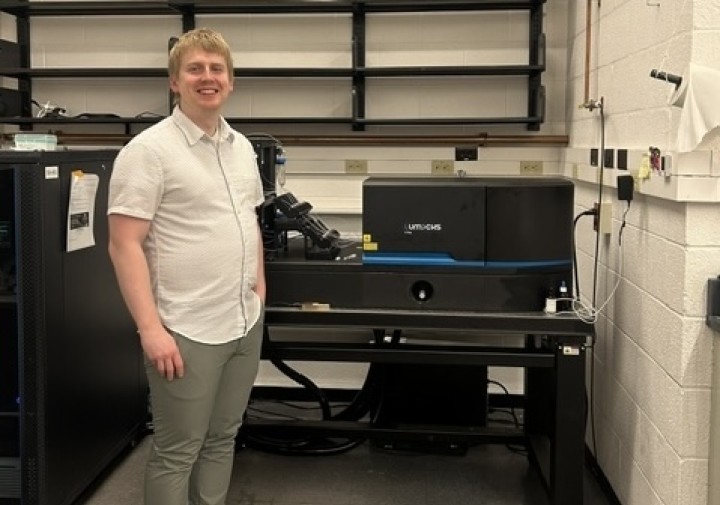
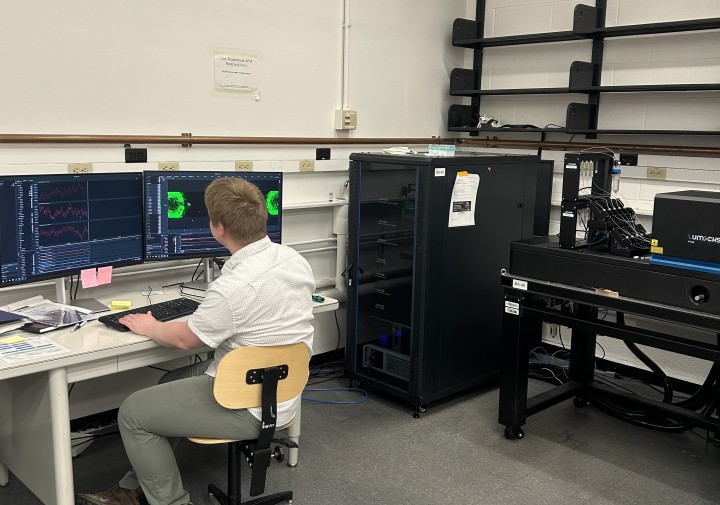
They’re enzymes called Rad51 and Rad54. If both strands of DNA break in half, the cell will convert part of those double strands into a single strand. Then Rad51 will form a filament that wraps itself around the DNA that’s been damaged to temporarily hold it together. And then Rad51 and Rad54 will together go search for matching DNA sequences in the genome and use that information to repair the break. My lab, in collaboration with Michelle Wang [the James Gilbert White Distinguished Professor of the Physical Sciences in Cornell’s College of Arts and Sciences], recently uncovered the mechanism that these enzymes use to search for matching DNA sequences. We found that when they attach to DNA, they actually twist it so it opens just slightly. The DNA gets converted into these loop-like structures, and as the loops are twisted open by Rad54, it makes it easier for Rad51 to find the DNA sequence it’s looking for. Mitch Woodhouse, a graduate student in my lab, is first author of the new paper, and he performed most of these experiments.