Jim R: I love trout fishing and I love where trout live, and I want my grandkids to be able to do that.
Paul: Welcome to Extension Out Loud, a podcast from Cornell Cooperative Extension. In this episode, we head streamside with Cornell Cooperative Extension of Oswego County 4-H, and the volunteers from the Tug Hill Black River chapter of Trout Unlimited Chapter 589, as they guide youth through a two-day introduction to the craft and ecology of fly fishing.
Day one at the Mexico, New York Extension office covered sports fundamentals and salmon and trout life cycles. Participants identified aquatic insects like caddisflies, and tied simple imitative flies, linking stream biology to the fly on the leader. On day two, I met the group as they toured the Salmon River Fish Hatchery in Altmar, New York, then stepped into a nearby field to practice casting.
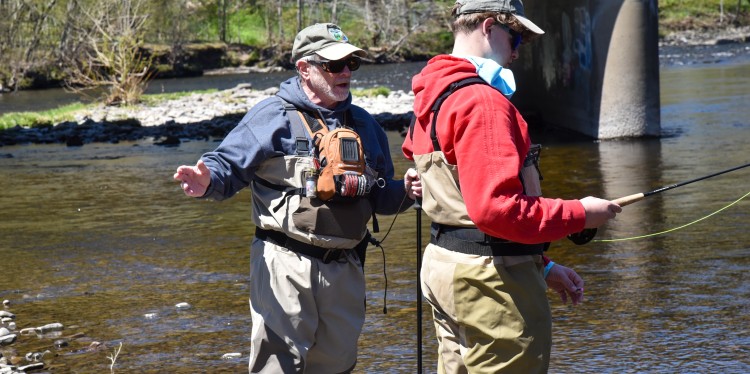
Each youth paired one-on-one with a Trout Unlimited volunteer. As the day warmed, they waded into the Salmon River, turning practice into application, and more than a few casts into bright rainbow trout. This episode is about skills and stewardship, how assembling and casting a fly rod, reading insect life, and tying a simple pattern can cultivate ecological literacy and a lifelong connection to place.
Stay with us as we wade into the current.
Linda B: I'm Linda Brosh. I'm the 4-H teen coordinator for Cornell Cooperative Extension of Oswego County. Um, while I do coordinate the entire, uh, 4-H program, my educational responsibilities are teaching environmental education and outdoor recreation. Today is our introduction to fly fishing.
This is a program that I brought back three years ago. It's a partnership with Trout Unlimited Chapter 589, and we work together to introduce area youth 12 years and older to fly fishing. We teach them everything from, uh, the life cycle of char and salmon, to what they eat, and we learn how to... They tie four to five flies, and they learn how to cast and fly-fish.
So today, we are here on the banks of the Salmon River in the no-fly zone in Altmar, New York, and we've got our participants out in the river fishing away. And fish is on, because they're catching little six-inch rainbow trout.
Jim R: Jim Roswood, member of Trout Unlimited here in the Tug Hill Black River. I love trout fishing and I love where trout live, and I wanna be able to do this for quite a while.
I want my grandkids to be able to do that, and I think the only way we can do that is to gather- youngsters involved in it, kids that wanna be active in it, kids are gonna protect the resource.
Rose G: My name is Rose Grulitch. I'm the youth program coordinator for TU 589, and this is our third year of the Youth Fly Fishing Program, Introduction to Fly Fishing.
My husband and I both joined TU in 2015 when he retired, and, uh, about four years ago I said I wanna do more with the kids and for the kids. We fished a lot on the river. We'd run into a lot of people that had young kids, and they'd be like, "Wow, I wish we could teach them how to do this."
Paul: What's the benefit of working with 4-H?
Rose G: I think for us it's just the name 4-H means a lot. People know what it is when you talk about it. They know about the programs we have. This program specifically fills a niche that we don't have. Typically, Trout Unlimited has a Trout Waters youth camp that's a week long, totally immersive, does everything we're doing except over a longer period of time and more immersive, but the kids have to be 14 to do it.
So it leaves out that 10 to 14 age group. They have nowhere to go, nowhere to learn unless they've got a mentor in their family. So this really worked out well.
Linda B: Connecting with an organization like Trout Unlimited extends the learning opportunities for any 4-H program. While we may have some interest and skill set in the program, connecting with an organization where everyone has a passion for that sport and th- their expertise just provides more volunteers.
Trout Unlimited, one of their initiatives is to get more youths in the outdoors- Mm-hmm ... and more youth participating in their passion, which is fishing for trout, char, salmon.
Garret B: My name's Garrett Brancie. I'm the president of the Tug Hill Black River chapter of Trout Unlimited. TU is really glad to have Cooperative Extension to work with.
It allows us to... We've got a group of volunteers that wants to share our passion for fly fishing and cold water conservation. Cooperative Extension is really well connected through the s- local, local school systems and 4-H, so it really allows us to share the opportunity with the local youth, recruit the, the class of participants.
And Cooperative Extension also has experience working with youth in these types of events- Yeah ... educational things a lot, so it's r- a really nice pairing. We're really lucky to have Linda and the rest of the team from Cooperative Extension help us put it together.
Jim L: My name is Jim Lewis, and I'm Miles Lewis' father.
We came down from Watertown yesterday and today. We heard about the program from Rose. We met her at a Fly Tying s- symposium down in Utica And she mentioned that the Cornell Cooperative Extension of Oswego County was putting this on. It was a, a great opportunity, and I'm very into fly fishing, so I'm trying to get h- my son into it, Miles, and I figured this would be a perfect opportunity.
My father taught me, and Miles is getting to an age where his attention span is, is holding. Mm-hmm. And it's not a device, so we'll take it, you know? And the more fishing he does, the more fishing I get to do, the more fishing we get to do together.
Paul: What's the value of a program like
Linda B: this, then? There's many learning values of this fly fishing program.
The youth themselves that participate, many of them have a passion for fishing, and it gives them the opportunity to learn how to do this art form when they may not have adult in their world that has the skill set. So they have the opportunity to build a knowledge base. Then they also have an opportunity to learn underneath these wonderful volunteers, these mentors, who have so much to share in their fly fishing experience.
They have an opportunity to learn about career fields through our visit to the Salmon River Fish Hatchery. And being outdoors, it calms the soul and s- takes all your troubles away, and on this stunning blue sky day, you can't complain. Thank you
Paul: for listening to this episode. For more information about this episode, including show notes and the transcript, visit extensionoutloud.com, and be sure to subscribe to Extension Out Loud on your favorite podcast directory.