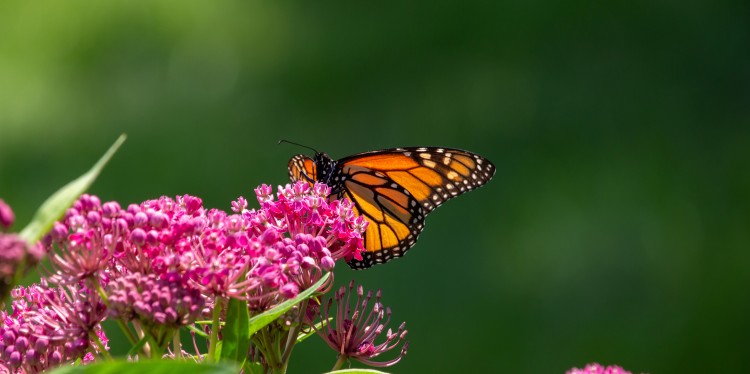
Monarch butterflies and other pollinators are essential to ecosystems and agriculture, supporting the reproduction of flowering plants and the production of fruits and vegetables. But decades of habitat loss, pesticide use and the disappearance of native plants have driven steep population declines.
A new study from Cornell AgriTech, published in the journal Horticulturae, investigates why the native wildflowers that pollinators need most are among the hardest to grow from seed. Researchers Alan Taylor, Masoume Amirkhani, Michael Loos and Sıtkı Ermiş examined the seed biology of 28 pollinator-friendly native plant species, then focused on six key species to develop techniques for breaking seed dormancy and test how germination responds to different moisture conditions.
“We’re looking at the technology of the seeds,” said Taylor, a professor in Cornell’s School of Integrative Plant Science. “What is the quality of the seeds? What’s the germination? What is the dormancy, and how do we break it? It’s really about the seed biology.”
The six focal species were chosen based on USDA Natural Resources Conservation Service (NRCS) guidelines for the eastern Appalachian region. “Species are divided by blooming periods so that the monarch has something available throughout the season – early, middle and late,” said Loos, a research support specialist on the project. “The NRCS program requires at least two species in bloom for each period. We selected three milkweed species and three nectar plants that cover that full span.”
Milkweeds are critical because monarch caterpillars feed exclusively on them, while the nectar species support adult monarchs and other pollinators. The team also prioritized regional ecotypes – seeds genetically native to the Appalachian region – working with multiple companies to source seed lots.
The fundamental challenge the researchers confronted is that many native wildflower species have innate seed dormancy, a natural survival mechanism that prevents all seeds from germinating at once.
“That dormancy is there for a reason,” Taylor said. “It’s nature’s way of making sure not every seed germinates at the same time, so if there’s a drought or a flood, some seeds can still germinate and come up later. It’s not convenient in agriculture, where you want everything to pop up at once, but it’s a completely different strategy.”
The scope of the issue became evident early in the study. Among the 42 commercial seed lots tested from 28 species, only 62% achieved more than 50% germination. This was surprising, given that 98% of those same lots were labeled as having more than 50% viability.
The gap was largely due to dormancy, Taylor said. Moreover, successful germination and seedling establishment starts with seed lot selection for high-quality seeds of any pollinator-friendly species.
To break that dormancy, the researchers turned to gibberellic acid (GA3), a naturally occurring plant hormone that has been studied for decades for its role in germination. Seeds were soaked for 24 hours in solutions of GA3 combined with hydrogen peroxide. The peroxide served a dual purpose: It helped break down seed coat barriers, and as it decomposed it released oxygen, keeping the submerged seeds alive during the extended soak. A treatment of 1.0 mM GA3 in 0.3 percent hydrogen peroxide consistently improved germination across the six focal species compared to untreated controls.
The team also examined how each species responded to different soil moisture levels, an important factor for understanding where restored plantings will succeed. The three milkweed species showed strong germination across a broad moisture range, making them adaptable to a variety of sites. Echinacea purpurea (purple coneflower), however, required wetter conditions.
“Echinacea would be more suited to a mesic environment – a zone with a bit more moisture,” Loos said. Monarda fistulosa (wild bergamot) and Rudbeckia hirta (black-eyed Susan) performed best under moderate moisture conditions.
Another challenge the researchers are working through is the absence of approved seed treatments for these species. “There are no pesticides labeled as a seed treatment fungicide for these plants, but we do see mold growth that can negatively affect germination,” Taylor said. “So we’re looking at strategies to address that.”
The findings have practical implications well beyond the laboratory. The dormancy-breaking and moisture-response data provided the basis for the development of a seed pelleting technology the team has created – pellets the size and shape of a corn seed that contain multiple species and can be planted with standard farm equipment.
“The big-picture outcome we’d love to see is many acres planted with not just six species, but 30 or 40 species within these pellets,” Loos said, “so we can create new environments for monarchs and pollinators. These could be introduced into fallow sites to create mini ecosystems where pollinators can flourish, and it would be easy for farmers to implement using equipment they already have.”
By building a deeper understanding of how native seeds behave, this Cornell AgriTech research is helping to make pollinator habitat restoration practical and scalable across New York and the broader Appalachian region.
Christina Szalinski is a freelance writer for the College of Agriculture and Life Sciences.