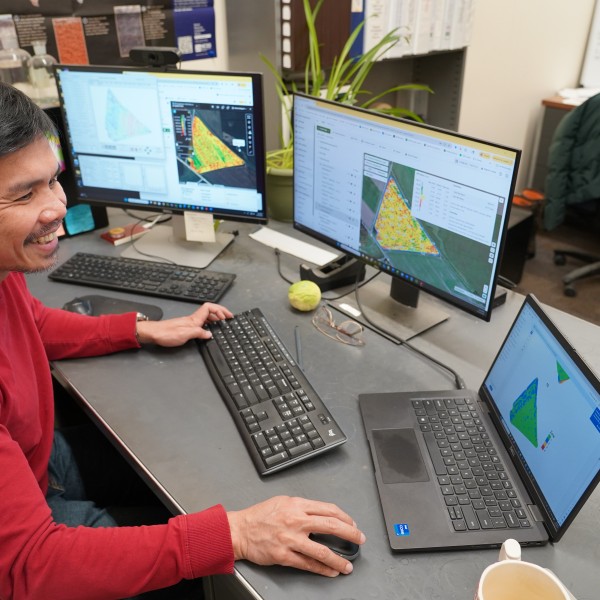
Their first goal was to determine the ideal grid size. When grid sampling, a field is broken down into smaller sections, commonly in 0.5, 1.0, or 2.5 acre sizes. From each section, random soil cores are taken and mixed into one sample for laboratory analysis. The results give a snapshot of soil conditions in that part of the field, helping farmers see where nutrients are high or low. Consequently, they can plan to apply lime or fertilizer only where needed within the field.
“Our precision agriculture team wanted to determine which grid size gives the best balance between cost and detail,” said Marcaida. “We also wanted to show how farmers and crop advisors can efficiently fine-tune their lime and fertilizer plans by grouping their grids into management zones.”
The team began comparing grid sizes ranging from 0.5 to 2.5 acres. They found that fields with greater variability benefit from 0.5 acre grids to capture the differences more accurately. For fields that were more uniform, larger grids were fine (and less costly).
Based on these findings, the team recommends starting with 0.5-acre grids to establish a good baseline understanding of how soil properties change across the field, and then to group similar grids into nutrient management zones for future sampling. Each zone represents a combination of areas with comparable soil test results or characteristics, allowing farmers to manage inputs more efficiently.
“The results of the study showed how detailed soil information can help farmers make better lime and fertilizer decisions, avoid unnecessary costs and get the most out of every acre,” Marcaida added.
“The results of the study showed how detailed soil information can help farmers make better lime and fertilizer decisions, avoid unnecessary costs and get the most out of every acre.”
So, what does this mean to the farmer? When fields show a lot of variability, grid sampling can reveal where fertilizer application can be reduced without sacrificing yield, a possible cost saving. In other cases, the opposite might be true. Some areas may need more fertilizer or lime to catch up, so it is also possible that grid sampling results in a larger expense for liming materials or fertilizer. However, in this case, the additional expenses will likely result in better yields as well.
Ultimately, the key takeaway is that grid sampling takes the guesswork out of soil sampling and within-field nutrient management. Farmers can see where to spend and where to save based on real data from their farm.
“The immediate benefit is getting to know the fertility variations of the nooks and crannies of the field,” said Marcaida. “It helps farmers with their planning and helps them direct their resources to the areas of their fields that need it the most.”
Read the whole study or the What’s Cropping Up? extension article to learn more about what they found.
There’s still more to learn about grid sampling. The team is now evaluating the use of grid sampling for assessments of P loss risk, using the New York P-index. Stay tuned!
Madeline Hanscom ‘22 is a communications assistant for the Nutrient Management Spear Program.