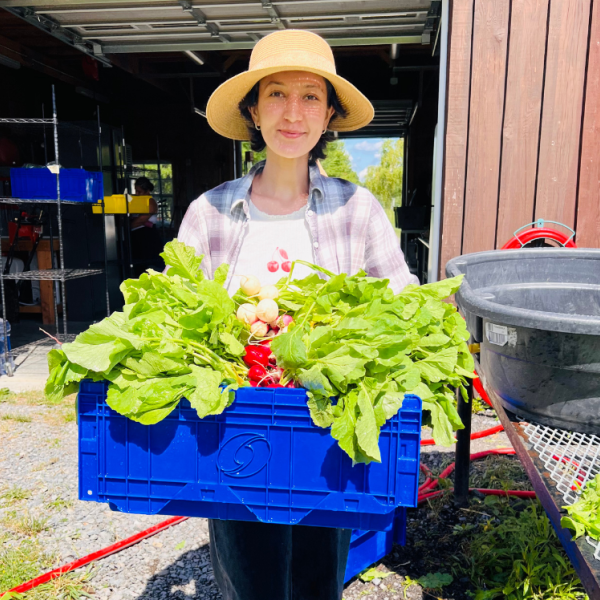
Rebecca Stup ’23, MS ’26, is a master’s student in the lab of Antonio DiTommaso, a weed ecologist and associate dean and director of the Cornell University Agricultural Experiment Station (Cornell AES). DiTommaso’s lab has been exploring planting wildflower strips along farmland as a strategy to increase biodiversity, attract pollinators and combat weeds.
Pollinators in the U.S. have declined sharply over the past decade, and last winter saw the single-largest loss of honeybee colonies in history. Meanwhile, some weeds are developing resistance to the most commonly used herbicides. Research in Europe has shown that flower strips near farm fields increase biodiversity and aid pollination and natural pest control. Stup is performing research at two Cornell AES farms to study how weed and insect communities differ in conventionally managed field margins vs. field margins seeded with native plants and wildflowers. The overarching goal is to develop strategies that maximize biodiversity and ecosystem services while minimizing weed–crop competition.
What research questions are you asking?
For my master’s thesis, I’m looking at the “margins” or edges of farm fields – which frequently grow up into a reservoir for weed species – and comparing margins that are planted with a carefully chosen mix of native wildflower seeds vs. margins that are untreated vs. margins that are sprayed with the herbicide glyphosate. I started working in the DiTommaso lab four years ago, as an undergraduate in plant sciences, and I’ve continued to work with him for my master’s degree.
Do wildflower strips benefit farmers?
There’s a lot of research, especially in Europe, showing that wildflower strips provide ecosystem services like attracting pollinators, attracting beneficial predator insects that attack pest insects, and preventing soil erosion. Other studies have found that wildflower strips attract ground beetles, which eat the weed seeds. But most of the weed control benefit is less about the insects, and more that the perennial flowers grow quickly and close out the canopy pretty early, so most weeds can’t compete with that. A lot of the most problematic weeds here in the Northeast are annuals that prefer more disturbed, open areas. But once the perennials are established and soil is not disturbed, the increased shade provided suppresses those weeds.