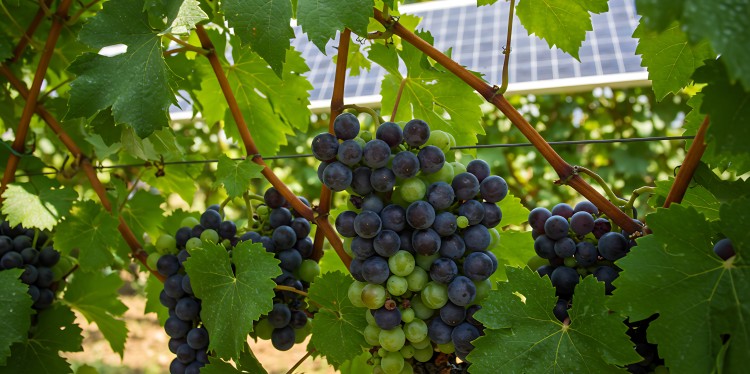
Cornell researchers have identified a promising way to increase revenue for Concord grape farmers in western New York and provide clean energy for the region.
In a new study published September 1, 2025, in Applied Energy, they analyzed the potential of “agrivoltaics” – co-locating grape cultivation and solar energy production – using vertical solar panels within vineyards. Their model shows that removing every fifth row of grapes and replacing them with vertical bifacial solar panels could generate approximately $400 per acre annually.
“The average vineyard in the Lake Erie region is about 200 acres,” said Miguel Gomez, the Robert G. Tobin Professor of Applied Economics in the Charles H. Dyson School of Applied Economics and Management, who led the financial analysis of the study. “That’s about $80,000 in increased profits for the grower.”
And while removing every fifth row of grapevines would be optimal for maximizing grape growing and energy harvesting, it also means 20% less pruning, weeding and maintenance of the trellis systems.
Farmers have been growing grapes in western New York for over 100 years. Concord grapes, however, which are popular for juices and other products, are not generally as profitable as wine grapes.
“[Agrivoltaics] could reduce the annual financial losses of Concord growers and generate a lot of power if you put it across the region,” said Justine Vanden Heuvel, professor of viticulture in the College of Agriculture and Life Sciences and a co-author of the study. She noted that there are around 30,000 acres of Concord grapes in western New York and another 18,000 or so in Pennsylvania. According to a 2020 analysis, many of these farms could be operating at a break-even or a loss.
The researchers’ analysis suggested vertical bifacial panels – which are straight up and down, have solar cells on both sides, and have a negligible impact on airflow – are a better option than tilted panels – which would gather more solar energy but also take up more room, make it harder to drive tractors or harvesters through the vineyard, and reduce airflow.
“Airflow is really important in terms of reducing opportunities for fungal diseases,” Vanden Heuvel said.
Concord grapes work especially well in this hybrid solar concept because they require fewer spray-on treatments, such as fungicides, than wine grapes, so the panels will get less dirty, Vanden Heuvel noted. Less spraying also helps because farmers don’t need to drive through the vineyard with a tractor as often, meaning less opportunity to damage the panels, she said.
Installing solar panels can be a significant investment. K. Max Zhang, the Irving Porter Church Professor of Engineering at Cornell Engineering and co-author of the study, said that while it would be possible to put panels high above the vineyard and leave all the rows of grapes, it would be much more costly to install. To help defray costs, a farmer could lease their land to a solar developer that would manage the financing, construction and maintenance of the panels. Gomez said, “You’re basically renting rows of your production that make your whole farm more financially viable.” Over the course of a year, the panels could generate around 16,000 megawatt hours, their study showed, and the solar company’s investment would be recouped in 14 years.
The researchers’ next step is to implement a hybrid solar-grape installation on a pilot plot at Cornell AgriTech. If successful enough to encourage growers throughout the region, it “would generate considerable power for New York,” Vanden Heuvel said.