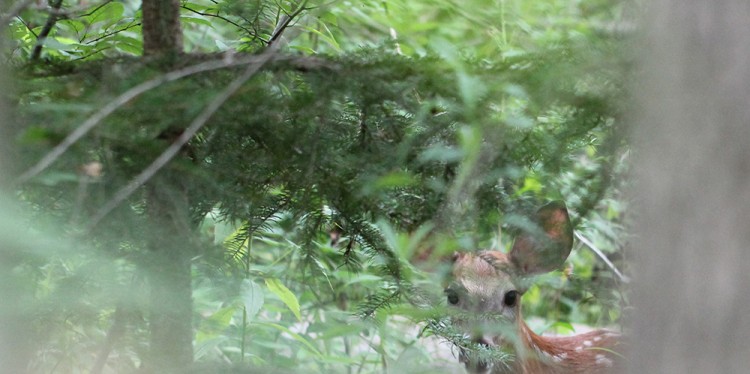
The primary audiences for the AVID protocol included forest landowners, Cooperative Extension volunteers (Master Forest Owners, Master Naturalists), and land trust staff. We recruited volunteer participants from across New York using Cooperative Extension web sites, newsletters, and other contact methods. AVID project participants provided localized data concerning deer damage to vegetation and forest regeneration.
Since the start of this project, we conducted more than 140 AVID training events in New York including at least 2,480 participants. Volunteers established plots at >90 sites across New York demonstrating that AVID provided a valued citizen-science approach for both teaching people about forest regeneration and assessing deer impacts to seedlings.
Results
Forest landowners were trained to recognize and address deer impacts to vegetation (over-browsing) so they could take appropriate management actions (e.g., hunting, fencing, or slash walls) on their properties. Data that AVID project participants contributed to the statewide database clearly showed that deer negatively affected seedling growth for several important hardwood species (e.g., maple, ash, oak, cherry, etc.) at most sites (>80%) where AVID plots were established. If seedling height growth was less than 10% per year, that was a red flag that deer may be over-browsing forest regeneration at a site.
See: Curtis, P., K. Sullivan, P. Smallidge, and J. Hurst. 2021. AVID: A rapid method for assessing deer browsing of hardwood regeneration. Forest Ecology and Management 497 (2021) 119534.
Public Value Statement
Master Forest Owner and Master Naturalist volunteers, along with Cooperative Extension staff, shared their knowledge about potential deer impacts to forest regeneration and biodiversity with hundreds of New York State landowners each year impacting management on thousands of forested acres. These forest owners were trained to recognize and address deer impacts to vegetation (over-browsing) so they could take appropriate management actions (e.g., hunting, fencing, or slash walls) on their properties, if desired.
The public potentially benefited from more diverse and resilient forests which offers a variety of ecosystem services (e.g., recreation, wood products, water quality, etc.). Establishing sufficient and diverse tree regeneration is critical for maintaining the integrity and future of forests and associated wildlife in New York State.