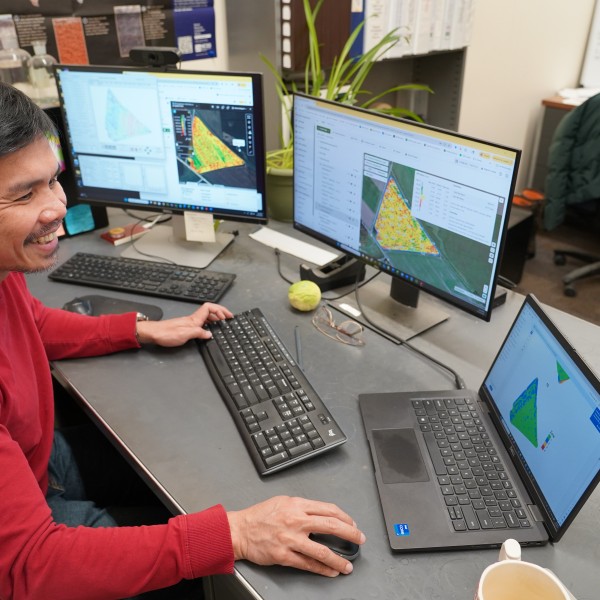
Academic focus: Bayesian statistics, dependent (time series, spatial, functional, etc.) data, missing data
Lab website: www.danielrkowal.com
Research summary: My research aims to provide reliable, scalable and interpretable statistical inference for a variety of “messy” data. Such data might include many variables, temporal or spatial dependencies, missing data, nonlinear associations, irregular distributions, etc. – or some combination of these. I design Bayesian models and algorithms to handle these complexities, quantify uncertainties, and make predictions and decisions.
What do you like to do when you’re not working?
I enjoy being active outdoors: hiking, skiing, running, competitive sports or (sometimes) working in the garden. I’m an avid sports fan, so I’m always watching the major events each season – football, basketball, tennis, baseball, hockey, track and occasionally soccer. I read as much fiction as I can, and I’m always excited to grill farm-fresh veggies and salmon.
What (specifically) brought you to Cornell CALS?
I believe the most innovative and impactful research in statistics is inspired by unconventional collaborations and new data-driven problems from other fields. Cornell CALS features an astonishing combination of research breadth and depth, including many research areas that are completely new to me. It’s fertile ground for statistics research with real potential for impact in the life sciences.
What do you think is important for people to understand about your field?
Statistics is not rigid: It is not about finding the one “right” statistical method for a type of dataset or class of problems. There are so many ways to build a (Bayesian) model and leverage the model output to provide better estimates and predictions, more precise (i.e., powerful) uncertainty quantification, and optimized recommendations for decision-making. That process is most successful when there is good communication between statisticians and scientists.
Why did you feel inspired to pursue a career in this field?
There’s a kind of interesting tension in applying mathematical precision to the uncertainties of the real world. I’ve always been drawn to math and especially applications of math. But working with real data requires confronting its imperfections and the accompanying uncertainties. That we can rigorously quantify uncertainty, and then make mathematically optimal decisions under this uncertainty, is endlessly fascinating to me.
What’s the most surprising/interesting thing you’ve discovered about Cornell and/or Ithaca so far?
On campus, I’m continually surprised by the proximity of nature and the spectacular views seemingly around every corner. In Ithaca, I feel so spoiled to have such easy access to all the fruits and veggies from local farms.