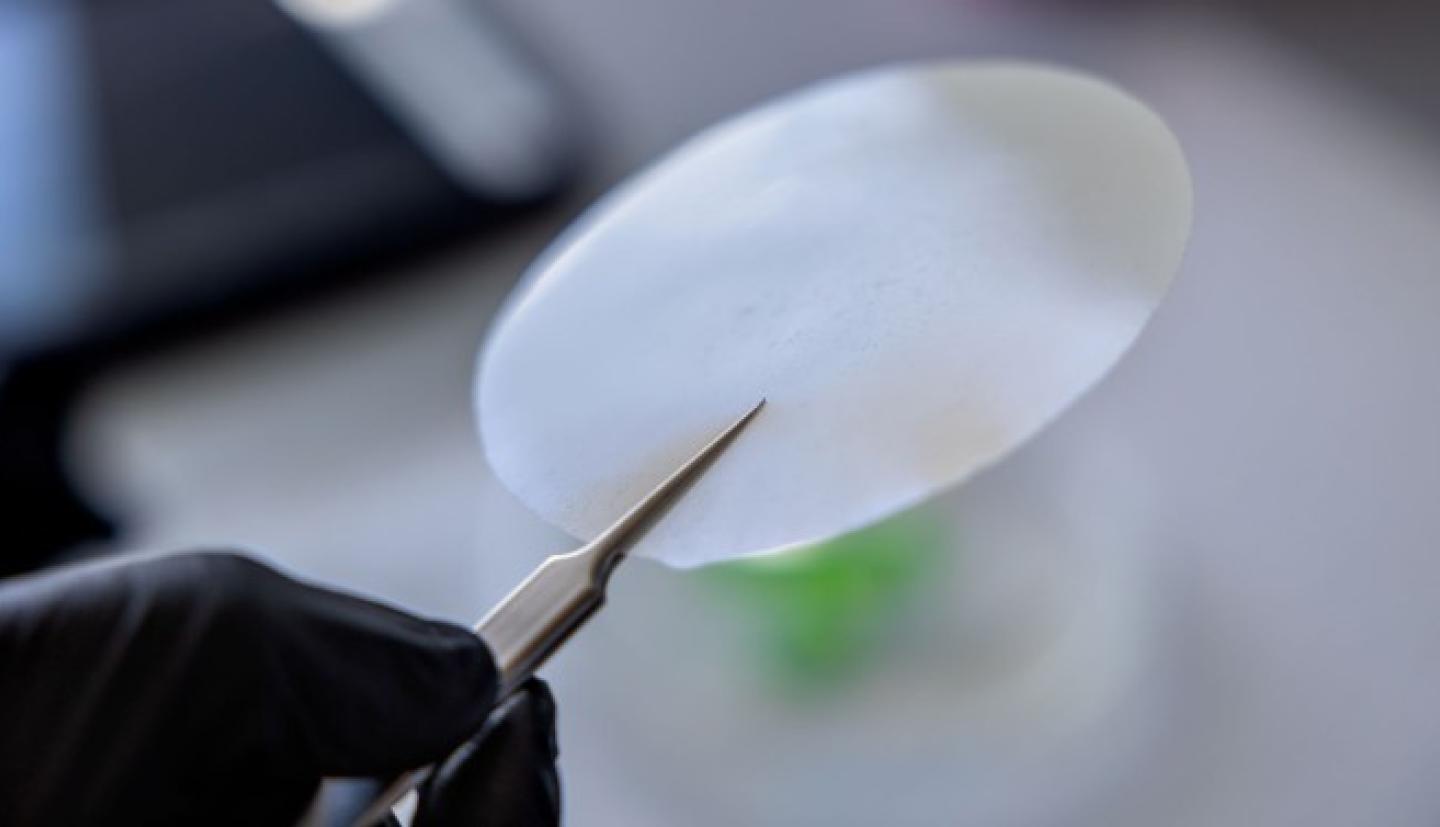
Joshua Herskovitz, Ph.D. ’20, who studied in the laboratory of Julie Goddard, professor of food science in the College of Agriculture and Life Sciences, grafted the corn-derived polylactic acid polymer with the antioxidant nitrilotriacetic acid to use it in food packaging. Kay, following up on Herskovitz’s work, figured out the material’s “interfacial pKa,” which tells you at which pH the foods in this packaging might work to keep from spoiling.
As the antioxidant is bound to the polylactic acid, the preservative can interact with the food but not migrate into it.
“In other words, you get the shelf-life benefit of the preservative without consuming it,” Goddard said. “This allows for cleaner label foods, which consumers are really looking for these days.”
Active packaging technology using bioderived and biodegradable materials, such as polylactic acid offers a way to reduce the two biggest contributors to municipal solid waste, Goddard said.
In 2018, the United States produced 68.13 million tons of food waste and 35.68 million tons of plastic waste, according to the Environmental Protection Agency. That plastic and food combination was 42% of all landfilled municipal solid waste, which contributed significantly to methane and carbon dioxide emissions.
“As a food scientist, I’m excited about new ways to reduce food and packaging waste,” Goddard said. “I’m not anti-preservatives as a whole, we need to remember things we use in the kitchen like heat, salt and lemon juice are important ingredients in food preservation.”
“So if we take preservative out of our food, at the same time, we need to think about the environmental impact if food spoils faster,” Goddard said. “Using a greener active packaging technique, we can extend shelf life while moving closer to a circular plastic economy.”
Goddard, a faculty fellow at the Cornell Atkinson Center for Sustainability, said this is an opportunity to show how this new preservation technology can work, and to address the larger environmental picture of reducing what goes to landfill. “We want to reduce food waste,” she said, “and bring along bioderived materials to do that.”
The research, “Interfacial Behavior of a Polylactic Acid Active Packaging Film Dictates its Performance in Complex Food Matrices,” was supported by the U.S. Department of Agriculture’s National Institute of Food and Agriculture.
This article first appeared in the Cornell Chronicle.