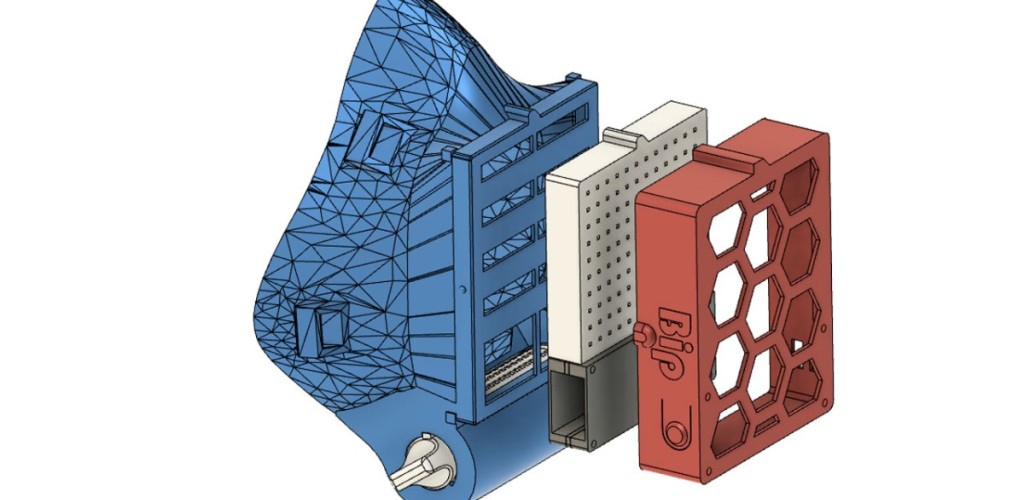
A new 3D-printable mask design, inspired by animal noses, promises easy breathing for users while maintaining similar levels of protection against pathogens found in N95 and surgical masks. The general concept may also be useful for improving industrial air filters found in heating, ventilation and air conditioning.
Many animals have a strong sense of smell that is created by winding air flows in their nasal cavities. A meandering air path creates more surface area inside an animal’s snout and more distance and time for odorants and particles to travel, increasing the likelihood that particles will get caught on skin surfaces inside the nose where odor receptors can sense them. Such structures make for highly efficient filters that capture particles in the air without a drop in air pressure than can make breathing feel labored.
“One of the benefits of our filter is you can easily breathe air in and out,” said Sunghwan “Sunny” Jung, associate professor of biological and environmental engineering in the College of Agriculture and Life Sciences. At the same time, the bio-inspired mask design matches the efficiency of clinically approved N95 and surgical masks and can capture particles as small as 10 micrometers, which is necessary to prevent airborne viruses that are carried in aerosols when people cough or talk, Jung said.
Jung is a senior author of the paper, “On the Design of Particle Filters Inspired by Animal Noses,” published March 2 in the Journal of the Royal Society Interface. Co-senior authors include Saikat Basu, assistant professor of mechanical engineering at South Dakota State University, and Leonardo Chamorro, associate professor of mechanical science and engineering at the University of Illinois, Urbana-Champaign.
The new masks and air filters were developed after studying the nasal structures of nine species of animals. These included mice that are 50 times, dogs that are 200 times and pigs that are 700 times more sensitive at smelling than humans.
The authors posted their open-sourced 3D-printable mask and filter designs for anyone who wishes to optimize them. While the paper provides a proof of principle, the authors caution that the mask designs are intended for others to continue and improve upon the research, as their designs have not been clinically proven to protect against disease.
Jisoo Yuk, a doctoral student in Jung’s lab, is the paper’s first author.
The study is funded by the National Science Foundation.