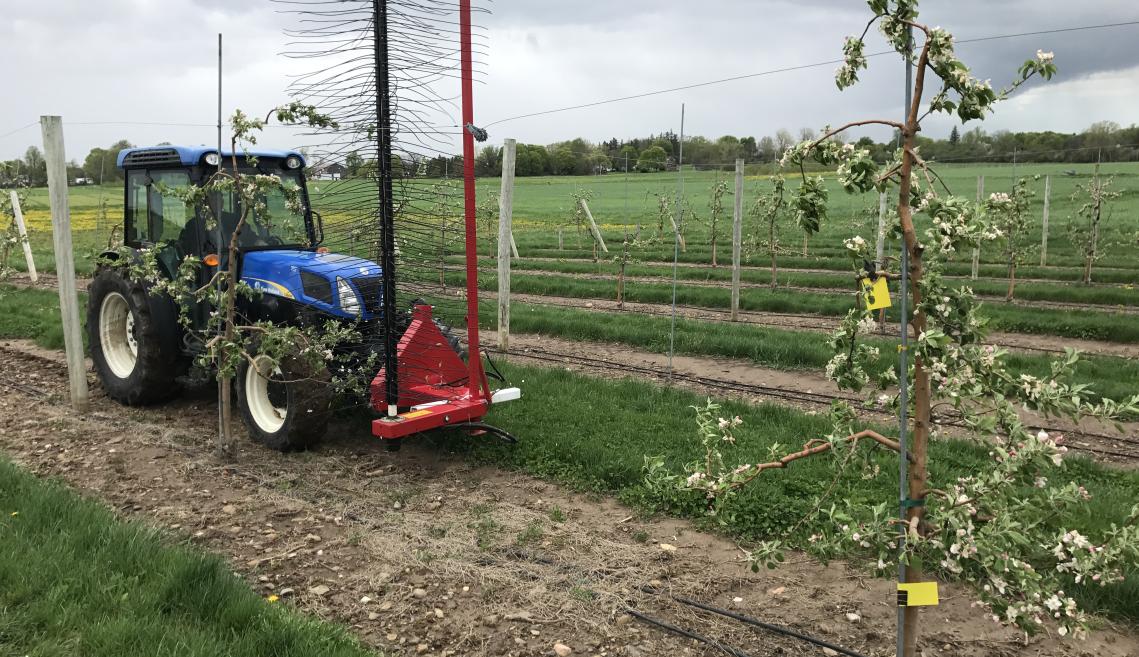
New findings from the lab of Kerik Cox, associate professor of plant pathology and plant-microbe biology, indicate that there may be hope for producers vying to use these technologies.
Published by the American Phytopathological Society in September, the paper — “Assessing and minimizing the development and spread of fire blight following mechanical thinning and pruning in apple orchards,” — demonstrates that timing is critical.
“Fire blight is a really infectious disease, so picking the right time frames for mechanical thinning and pruning makes a difference,” said Cox. “Otherwise, if done when trees are susceptible to the disease, machines could potentially spread the disease across an entire orchard.”
The research, conducted from 2018 to 2019, included the evaluation of fire blight risk and spread following mechanical thinning in Gala and Idared orchards at Cornell AgriTech in Geneva, New York. The work aligned with early bloom, when season temperatures were cooler and there were few open flowers available for infection.
Additionally, the team assessed the same orchards following mechanical pruning and thinning in July and August, before and after bud set, when shoot growth is slowed, making it less susceptible to infection.
As an additional insurance for disease prevention, his lab analyzed the potential efficacy of streptomycin — an antibiotic routinely used to control fire blight— following mechanical thinning and pruning during both time periods.