But for a staple such as cassava, which is consumed daily by millions of people in sub-Saharan Africa, there is another important consideration: Will people eat it? For several new varieties introduced to the market, the answer has been a resounding “no.”
“There are some improved cassava varieties out there that seem to offer better results for farmers, but the consumers don’t like them because they lack some preferred attributes,” said Paula Iragaba, Ph.D. ’19, whose doctoral work at Cornell focused on understanding the social dynamics of food choices and analyzing the genetic background underpinning preferred cassava traits of smallholder farmers.
A research study funded by NextGen Cassava, a project in the Department of Global Development, aimed at doing just that. Iragaba and a team of researchers from Cornell and the National Crops Resources Research Institute of Uganda sought to determine which traits consumers want in cassava. Their study appeared in the African Crop Science Journal.
The main problem with the new varieties, they found, is the texture: If the cooked cassava root is too hard, children and the elderly find it too difficult to eat.
“Breeding cassava varieties that grow better is great. But if farmers don’t use them, then it’s not effective,” Iragaba said. “Cassava isn’t just meant to be grown – it’s a staple food for majority of smallholder farmers in sub-Saharan Africa. I wanted to find a scientific way to understand the traits end-users actually want.”
Iragaba designed and conducted a survey of hundreds of smallholder farmers in Uganda, revealing that the softness of cooked cassava is a major influence on which kinds of varieties farmers actually adopt.
“In some households, cassava is served at all three meals,” Iragaba said. “So if the children and the older people aren’t going to eat it, then the variety won’t get adopted, no matter how well it may grow.”
Understanding what consumers want on their plate was the first step. The next was developing a reliable, low-cost method that breeders could use to assess root softness early in the breeding cycle.
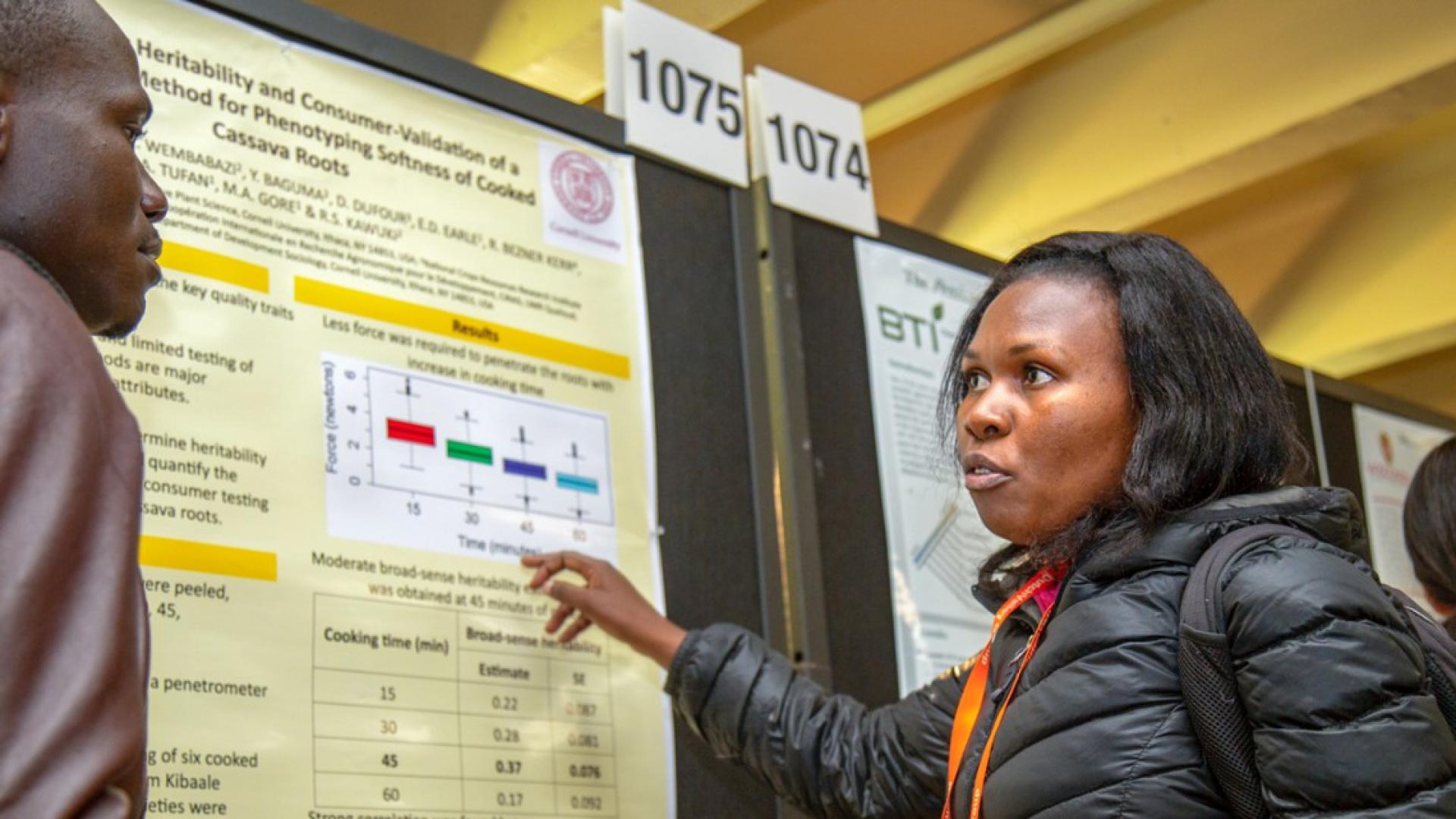
Enter the penetrometer, a common tool used in the lab to test the strength of a material. Iragaba designed a study to track consumer preference with results obtained from a penetrometer.
Her analysis showed a positive correlation between what farmers said they wanted and what the penetrometer showed in the lab.
“Now there’s a starting point for cassava breeders to use for measurements and to ensure that what’s being advanced in the breeding program has the desired trait,” she said.
Study co-author Mike Gore, Ph.D. ’09, the Liberty Hyde Bailey Professor of molecular breeding and genetics, said the findings provide powerful insights that will help reshape breeding for preferred cassava traits.
“All the advanced plant breeding technologies developed and implemented by our project and others will be useless if the improved varieties are not adopted by cassava consumers,” Gore said. “Paula’s work is an important step toward making sure Ugandans can truly benefit from these varieties, and gives us a model to follow in other countries where cassava is a key crop.”
Professor Rachel Bezner Kerr, a co-author on the study, said that “This interdisciplinary research will provide valuable information for plant breeders about people’s preferences in cassava varieties in the future, including gender differences.”
Cornell co-authors include Gore, Bezner Kerr and adjunct assistant professor Hale Tufan in the Department of Global Development.
NextGen Cassava is funded by the Bill & Melinda Gates Foundation and from UK aid, a British government initiative.
Matt Hayes is associate director for communications for global development in the College of Agriculture and Life Sciences.