

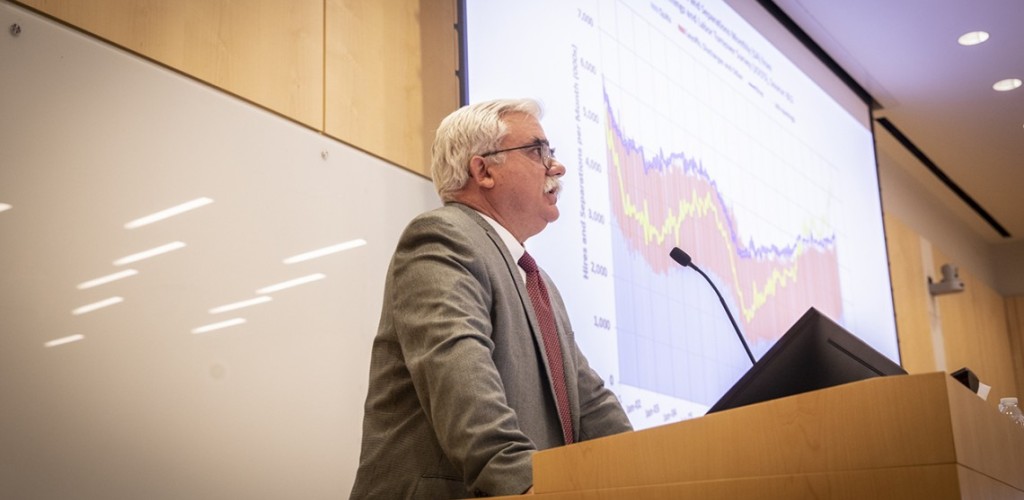
The U.S. economy has been on a long, slow upward trend for eight years, but a Cornell economist predicts that – like all good things – the steady growth will soon come to an end, likely by the end of the year.
It won’t be a disastrous scenario like the 2009 recession, but rather a garden-variety reaction to the Federal Reserve raising interest rates and, in turn, interest-sensitive sectors cooling off, he said.
“The leading indicators show no signs of immediately slowing down, so I’m not saying the economy’s in bad shape – not at all,” said Steven Kyle, associate professor of applied economics. “Nevertheless, we’re likely nearing the peak of the business cycle in the near future – next year, more likely, but for sure in a year and a half.”
Kyle opened the 2019 Agricultural and Food Business Outlook conference, presented by faculty of the Charles H. Dyson School of Applied Economics and Management, Jan. 18 in Stocking Hall. Farmers, ag lenders and others interested in agricultural economics attended the annual conference to hear the latest data and research on the national and New York state economies, food retailing, the dairy industry and specialty crops.
On the national economic front, leading indicators suggest near-term growth and a longer-term slowdown, Kyle said. The current 3.9 percent unemployment rate is unlikely to go much lower, “though it could jiggle around that level if the economy stays as strong as it is,” he said.
The fact that inflation is picking up means the Federal Reserve will continue to raise interest rates in response. “That’s their job,” he said. “That causes the interest-sensitive parts of the economy – most notably housing – to cool off, and that generates a recession. So, I think that’s what we’re going to have, barring some unknown disaster.”
Kyle also predicted gross domestic product growth of 2 percent to 2.5 percent in 2019, with lower growth possible later in the year. If GDP growth levels off, the unemployment rate could increase to around 4 percent by a year from now, he said.
Interest rates will go up, but only by 0.25 percent at a time. That translates to a rate of 2.75 percent to 3 percent by year’s end, unless the economy cools off faster, he said. Those higher interest rates mean a continued strong dollar, which will help dampen inflation, as well as commodity prices, he said.
The big unknowns include a potential global economic slowdown. Signs of slow growth in two of the world’s largest economies – China and the European Union – are worrying, he said. There’s also the troubling possibility of a constitutional crisis in the United States.
“I worry about that,” Kyle said. “What worries me more is what politicians might do to divert our attention from it.”
Another unknown is what will happen regarding trade with China. A trade war has already begun, Kyle said: “Be glad you’re not a soybean farmer. If you’re a soybean farmer, you’re not happy right now.”
Kyle opened his talk by grading his predictions from last year – and giving himself an A-minus. “I was right to count on continued growth,” he said, “but I underestimated just how strong the growth would be.”


