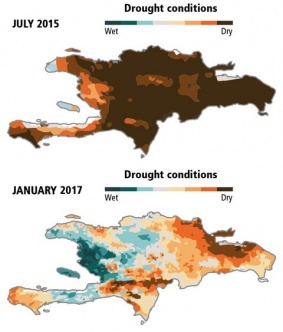
Drought Conditions in July of 2015 and January of 2017
Climate change is impacting the Caribbean, with millions facing increasing food insecurity and decreasing freshwater availability as droughts become more likely across the region, according to new Cornell research in Geophysical Research Letters.
“Climate change – where mean temperatures rise – has already affected drought risk in the Caribbean. While our research focused on the role of human-causes for the strong 2013-16 drought there, our findings and climate-model projections show that drought in the region will likely to become more severe over time,” said lead author Dimitris Herrera, postdoctoral associate in earth and atmospheric sciences.
Since 1950, the Caribbean region has seen a drying trend and scattered multiyear droughts. But the recent Pan-Caribbean drought in 2013-16 was unusually severe and placed 2 million people in danger of food insecurity.
In Haiti, for example, over half the crops were lost in 2015 due to drought, which pushed about 1 million people into food insecurity, while an additional 1 million people suffered food shortages throughout the region, according to the United Nations Office for the Coordination of Human Affairs.
Examining climatological data from the 2013-16 Pan-Caribbean drought, anthropogenic warming accounted for a 15 to 17 percent boost of the drought’s severity, Herrera said.
Climate model simulations indicate the most significant decrease in precipitation in the Caribbean might occur May through August – the rainy season. A failed rainy season in spring and summer, added to a normal dry season in the late fall and winter, prolongs a drought.
Beyond growing crops, the Caribbean also faces dwindling freshwater resources, due to saltwater intrusion from rising seas and pressure from agricultural and municipal sectors.
“This paper documents that human activity is already affecting the drought statistics of the region,” said Toby Ault, assistant professor of earth and atmospheric sciences, and a fellow at Cornell’s Atkinson Center for a Sustainable Future. “Hot temperatures in the future will probably continue to play an increasingly important role in exacerbating droughts.”
Although the Caribbean has recently been affected by catastrophic hurricanes – such as Maria and Irma – that caused significant and rapid damage, persistent droughts can slowly bring havoc to vulnerable Caribbean countries, said Herrera: “This is especially true for the agriculture and tourism sectors of this region, which are the most important contributors to gross domestic product in most Caribbean nations.”
Other authors are of “Exacerbation of the 2013-2016 Pan Caribbean Drought by Anthropogenic Warming,” are John Fasullo, National Center for Atmospheric Research; Sloan Coats, Woods Hole Oceanographic Institution; Carlos Carrillo, Cornell; Benjamin Cook, NASA Goddard Institute for Space Studies; and A. Park Williams, Lamont Doherty Earth Observatory, Columbia University.
The research was supported by the National Center for Atmospheric Research, the National Science Foundation and NASA.