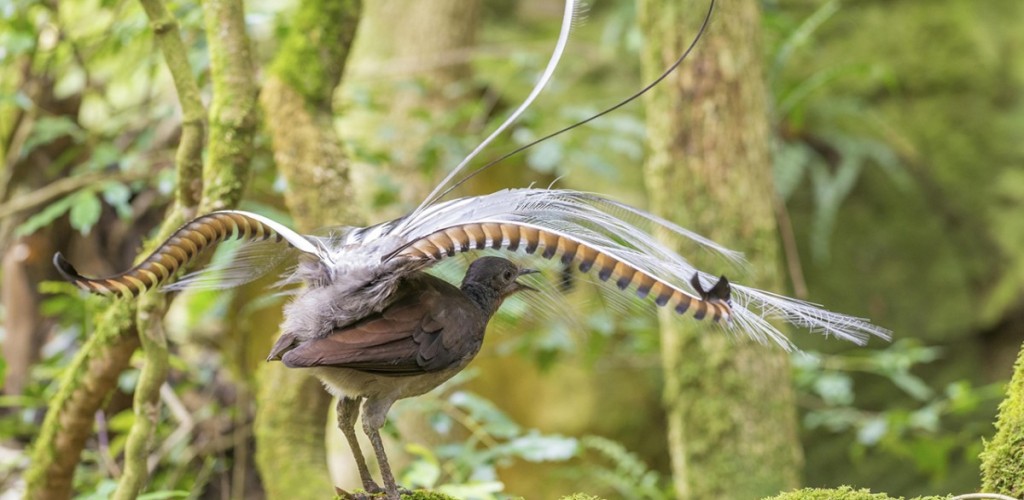
Australia’s Superb Lyrebird – the most astonishing animal mimic in the world – has been communicating with memes through song and dance for millions of years.
“These days we usually think of memes as bits of culture transmitted through social media, like little dancing bananas,” says Irby Lovette, director of the Cornell Lab of Ornithology’s Fuller Evolutionary Biology Program. “But the lyrebirds are spreading memes too. They’re picking up sounds from their environment, incorporating them into their song repertoires, and then learning from one another.”
Lovette is the Cornell leader of a research project, funded by a $650,000 grant from the National Science Foundation, to understand the evolution of culture among these avian mimics who can out-kookaburra the kookaburra and perfectly replicate the whirring of a camera motor or the wail of a car alarm.
The project is the brainchild of former Cornell Lab scientist Anastasia Dalziell, now at the University of Wollongong in Australia, and Justin Welbergen of the Hawkesbury Institute for the Environment in Sydney, Australia.
“We want to understand the natural patterns of song everywhere that Superb Lyrebirds occur,” Dalziell said. “Lyrebirds have all these isolated, discrete populations in valleys throughout southeastern Australia, and they all sound wildly different from one another.” The displaying birds coordinate their hops, tail-shakes and side-steps with their vocalizations; these dance displays also vary among populations.
The research team will also compare recorded songs from the past with today’s lyrebird songs. The scientists will conduct a series of experiments in which they “seed” a new song into a group of lyrebirds and track how it is passed from one lyrebird to another. Analyses of small blood samples will reveal the story of how lyrebird groups may be related or if a few outlying populations have diverged enough to be considered new species.
Teams of Cornell undergraduates will collect sound and video recordings and find lyrebird nests in Australia. Cornell’s May-August summer break dovetails with the time when male lyrebirds are displaying to woo a mate and females are building nests.
In the 1930s, foxes were introduced to Australia and quickly developed a taste for lyrebirds. In response, 32 lyrebirds were captured and released in Tasmania, the large island off the southern coast of Australia, to prevent their being wiped out by foxes. Lyrebirds had never lived in Tasmania before but are now numerous there.
“We know where the lyrebirds were captured on the mainland and what they were singing and imitating in the 1930s,” Dalziell says. “But what do the Tasmanian lyrebirds mimic now? How does that compare to the first population on the island, and did they retain any of their original songs from the mainland?”