

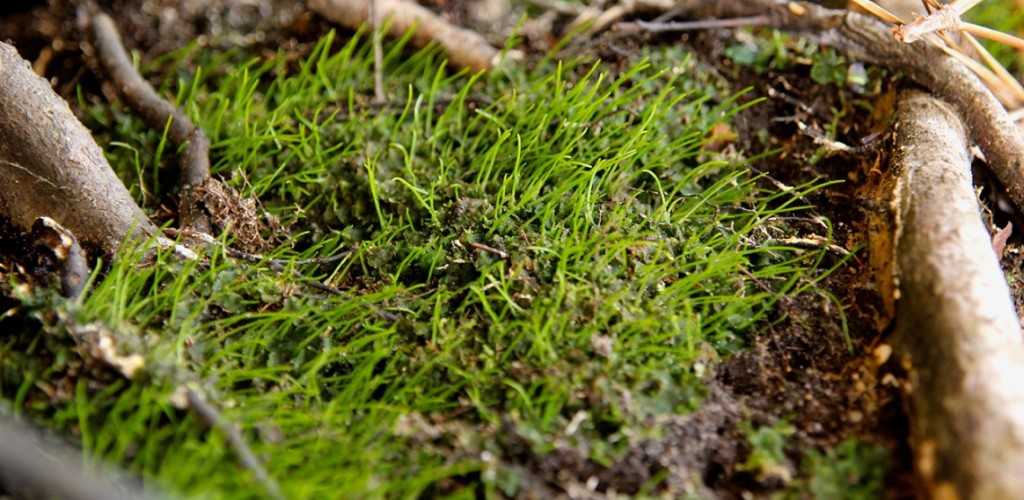
To root out the scientific complexities between nitrogen-fixing soil bacteria and its close alliance with plants, the National Science Foundation has awarded a $1.1 million Dimensions of Biodiversity grant to the Cornell-affiliated Boyce Thompson Institute (BTI). Unlocking the genetic and ecological detail behind this symbiotic relationship may help reduce agricultural dependence on synthetic fertilizer.
Fay-Wei Li, assistant professor at BTI, and his colleagues Jed Sparks, Cornell professor of ecology and evolutionary biology; John Meeks, professor of microbiology and molecular genetics at the University of California, Davis; and Juan Carlos Villarreal, assistant professor at Laval University, Quebec, will investigate the genetics, ecology and symbiosis between hornwort, a flowerless green plant, and cyanobacteria (blue-green bacteria) that live in moist soil.
“Hornwort is a remarkable plant, and only a few remarkable plants can form symbiotic relationships with nitrogen-fixing bacteria,” said Li, adjunct assistant professor of plant biology at Cornell and principal investigator.
Commercial agriculture has depended on synthetic fertilizers in the U.S. for more than a century, said Li. These fertilizers can damage soil and leach into water, creating environmental problems, such as boosting poisonous blue-green algae found in lakes and waterways.
The hornwort – which thrives in wet soil conditions – receives nutrients from naturally occurring bacteria living in the soil. Conversely, compared with other similar microbes, cyanobacteria are less dependent on the plant.
“In other words, cyanobacteria could be an ideal partner for engineering symbiotic nitrogen fixation into crop plants – and possibly reducing the need for so much fertilizer,” said Li. “If one can transfer such symbiotic ability to crop plants, it could be possible to transform agriculture by reducing dependence on synthetic fertilizer.”
The NSF’s Dimensions of Biodiversity grants promote novel ways to fill scientific knowledge gaps in understanding Earth’s biological diversity. In collaboration with the Science Teachers Association of New York State, an educational video will be made to showcase plant-cyanobacterium symbioses.
The grant funds three graduate students, 10 undergraduates and five high school students, who will be trained to conduct the research. Undergraduate and high school interns are admitted through the BTI Summer Internship program; for the past two years, at least half have been members of underrepresented minorities or first-generation college students.


