Flying always had a strong pull for John G. O’Neill. As a sophomore at Cornell in 1940, the farm boy from western New York took to the skies for the first time as part of a civilian pilot training program in Ithaca. Global events would soon put those aerial skills to the test: The outbreak of World War II meant a high demand for talented and daring pilots.
As war raged in Europe, O’Neill left the College of Agriculture in spring 1941 to enlist in the U.S. Army. A fighter pilot, he flew the twin-engine P-38 Lightning with the 49th Fighter Group, 9th Fighter Squadron, known as the “The Flying Knights.” Combat tours took him to the aerial battlefields over New Guinea in the Pacific theater, where in 1943 he shot down eight enemy planes.
O’Neill returned to the U.S. a hero. He served as a military flight instructor before turning his flying skills into a business, purchasing seven planes and running one of the largest crop-dusting ventures in New York. Never one to sit still, he became involved in oil and brokerage businesses. He married twice and had four children. In 1966, he died of leukemia.
“He did a lot of living in those 45 years,” said his brother, Paul O’Neill.
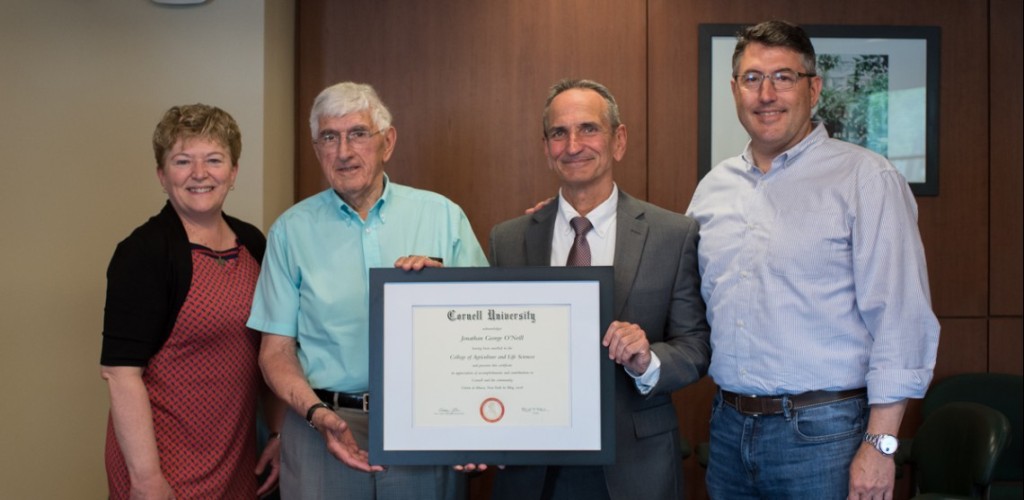
The fighter pilot from the Class of 1943 never returned to Cornell. In a ceremony May 26, Kathryn J. Boor ’80, the Ronald P. Lynch Dean of the College of Agriculture and Life Sciences, presented his family with a certificate of acknowledgement, officially making him a nondegree alumnus. The award marked the 75th anniversary of what would have been his graduation year.
“It’s an honor to be able to recognize Mr. O’Neill’s accomplishments and bring him back into the CALS family as a nondegree alumnus,” Boor said. “Like many during that period, he answered history’s call to serve our nation, for which we are eternally grateful.”
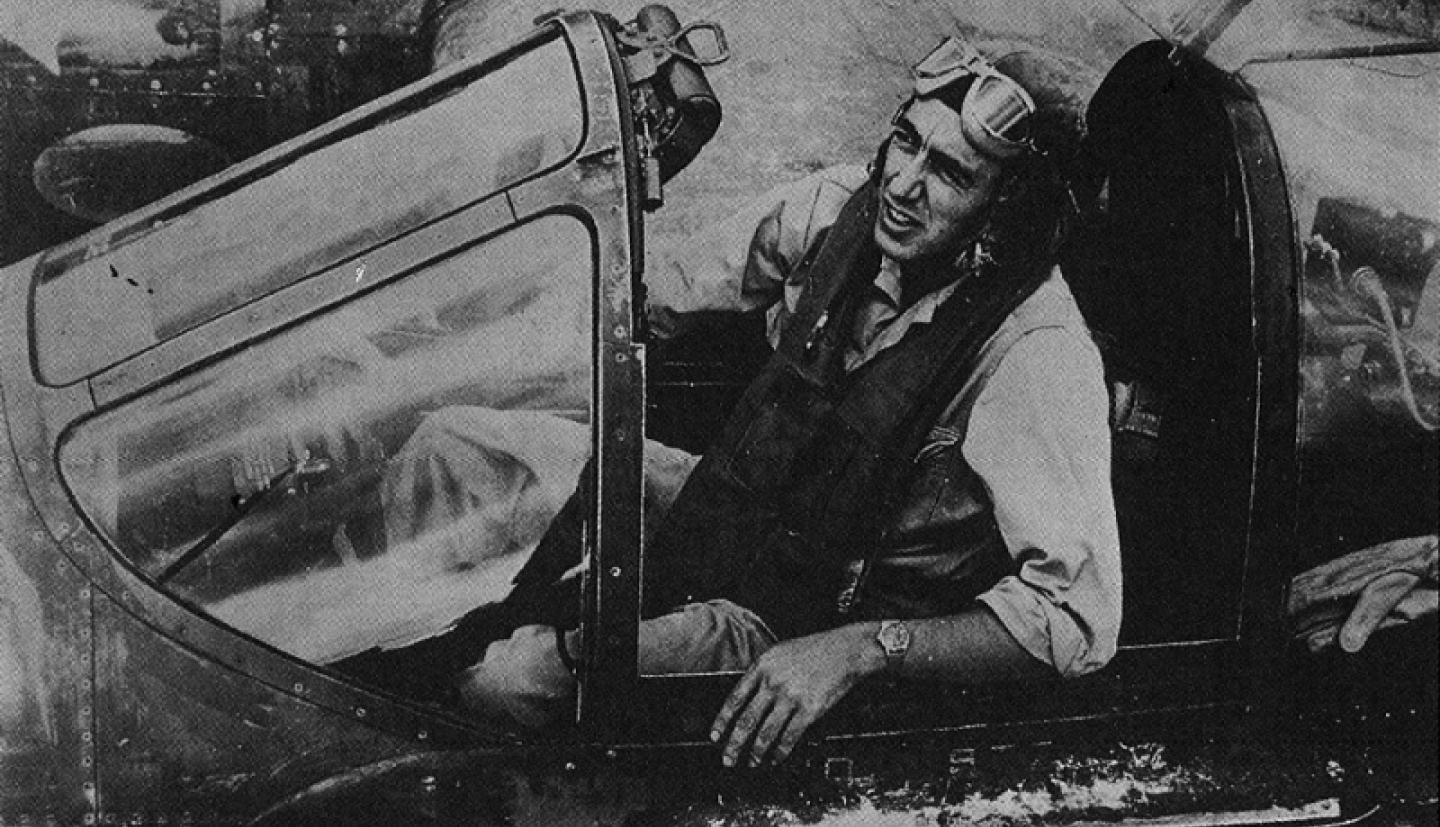
O’Neill, known by the nickname “Jump” for his ability to evade enemy fire, flew with the Humpty Doo Unit deployed in New Guinea. He fought in extensive combat missions alongside Capt. Richard Bong, renowned as the American pilot who downed the most enemy planes in WWII.
“They were the hotshots of the time,” Paul O’Neill said of the formidable fighter pilots that helped win the war.
“I grew up hearing stories about him and what a great guy he was, what an exciting guy,” said Erik O’Neill ’87, John’s nephew. “He lived with his hair on fire, it seemed, his whole life. Everything was to the fullest.”
That hotshot attitude sometimes landed the pilot in trouble. During training in San Francisco he performed an inside loop over the Golden Gate Bridge. The military considered a court martial for the stunt but, as his brother recollected, “they needed the pilots more than they needed the punishment.”
“He just wanted to fly,” said his youngest son, Jon, who was 6 years old when his father died. “My mother kept his memory alive very well.”
In the spring, Jon visited sites in New Guinea and the Pacific to retrace part of his father’s journey. The trip was led by Justin Taylan, founder of the organization Pacific Wrecks. “It was a very overwhelming trip,” Jon said.
Donna Esposito, Ph.D. ’00, a historian and curator at Pacific Wrecks, first alerted Cornell to O’Neill's achievements and initiated the effort to recognize him for all he did in service to the country.
Jon was too young to know how his father would feel about the Cornell acknowledgment, but said he felt grateful.
Paul surmised, with the jesting of a brother who knew the ace pilot well, “He would have enjoyed the recognition.”