

periodiCALS, Vol. 8, Issue 1, 2018
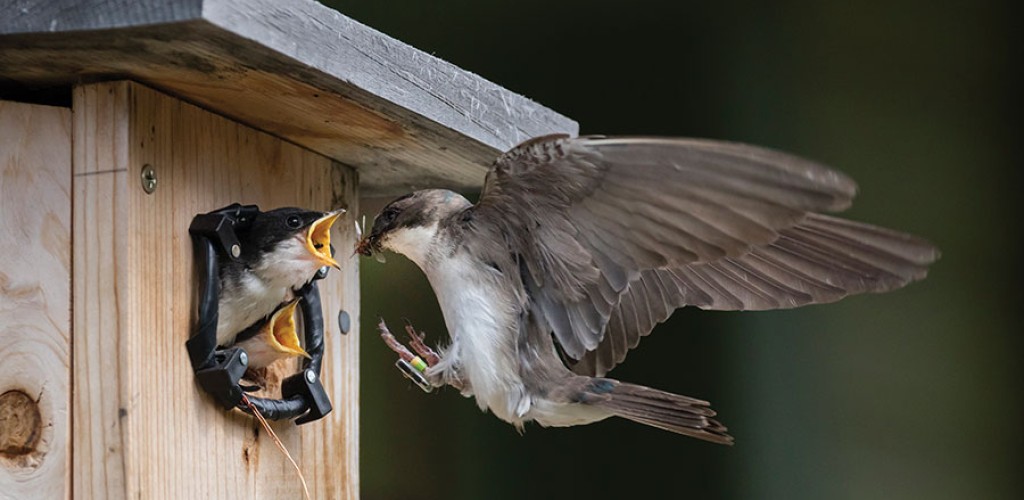
Tree swallows are particularly nosy neighbors. These gregarious songbirds flit from nest to nest, poking around in the cavities of old trees that fellow swallows call home. The most socially active birds tend to sport the brightest feathers, a flashy display of their convivial acumen.
But life for a tree swallow is not one big party. Understanding how individuals deal with stress—and what happens at the biological level when faced with high-stress situations like evading a predator or surviving when food is scarce—is leading to new insights into the links between social connectedness, health and future performance.
“If you look across species, from tree swallows to humans, social bonds are often really good predictors of many aspects of stress resiliency and health,” said Maren Vitousek, assistant professor in the Department of Ecology and Evolutionary Biology. “But we don’t yet know whether or how social interactions change the biology of individuals that experience them, in ways that have long-term consequences for their health.”
To answer these questions, Vitousek and postdoctoral associate Conor Taff are testing the interactions of tree swallows to see if there’s something about their social behavior that influences changes in their biology. Previous research has shown that more socially connected birds are better able to keep reproducing when faced with high-stress situations, and to avoid adverse health events and even mortality. Now the researchers are searching for connections that reveal what’s happening at the biological level that influences health and performance, from neuroendocrine function to even gut microbial composition.
The work has tantalizing implications for biological research. In terms of human health, the findings could help researchers develop biomarkers of social connectedness or stress resistance, or even treatments designed to mimic or reverse these changes.
“The multi-layered social connectedness of humans can be a good predictor of the likelihood someone who is exposed to a major stressor will respond favorably,” Vitousek said. Traumatic episodes like natural disasters, terror attacks or war events can result in deleterious long-term effects on health.
“We know these short-term events can have lasting repercussions on human health, but we don’t fully understand the mechanism. How tree swallows respond to stress can tell us a lot about our biology; what we learn from this work could have important implications for human health and well-being.”


