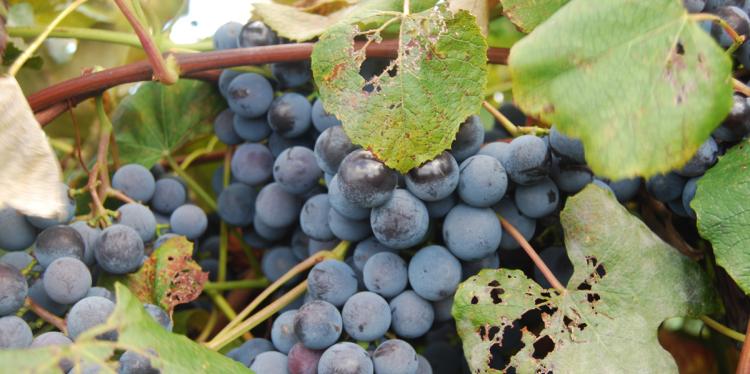
Concord grapes have provided the economic backbone for communities in the Lake Erie region of New York for more than 200 years. But a dramatic reduction in nationwide juice consumption is straining the industry.
Cornell grape experts and food scientists at the College of Agriculture and Life Sciences (CALS) are stepping up to give Concord growers new opportunities for their products and to diversify vineyard operations in New York, the second-largest producer of Concord grapes in the nation.
New initiatives to help revitalize grower markets were announced April 12 at the New York State Concord Grape Summit, held at the Grape Discovery Center in Westfield, New York. Gov. Andrew Cuomo called for the summit in his 2018 State of the State address to identify challenges and opportunities for New York’s Concord grape industry, which produces approximately 121,000 tons of Concord grapes on 30,000 acres of vineyards.
At the summit, which brought together Cornell researchers and key stakeholders to discuss strategies to reinvigorate the industry, the state announced more than $1.5 million for various programs, including important new work at Cornell. The funding:
- Provides $300,000 for food science research and development of new Concord-based products. The projects include use of state-of-the-art technologies like high pressure processing (HPP) to make minimally processed, ready-to-eat or -drink products with fresh grape flavor; and developing denatured Concord juice for use in production of neutral red wines, building on an initial public-private partnership among Cornell, the New York Wine & Grape Foundation and the National Grape Cooperative Association/Welch’s;
- Supports, in partnership with Cornell, a vine certification program to ensure disease-free planting stock; and
- Creates the Vineyard Improvement Program to help Concord grape growers renovate vineyards, plant new vines and diversify vineyard operations.
“Cornell CALS and our Cooperative Extension system have long partnered with Concord grape growers to improve yields, apply new harvesting techniques and pioneer applications of precision farming technologies such as the use of robotics and drones,” said Kathryn J. Boor ’80, the Ronald P. Lynch Dean of CALS. “I applaud Gov. Cuomo’s vision in convening the summit to help our grape-growing community in western New York. As we have seen throughout our long history as New York state’s land-grant institution, improvements in agricultural efficiency must also be accompanied by innovative thinking around new products and new markets.”
The Lake Erie region is the largest and oldest home for Concord grape growing in the world. Concord grapes make up 80 percent of the total tonnage of all grapes produced in New York.
In its 200-year history, the Concord industry has survived its share of difficulties. Growers’ fortunes have risen and fallen with changes in prices and production, as is the case with any agricultural commodity, but the current downturn appears to be more severe and long-lasting.
Grape growers have experienced several years of high yields, leading to an oversupply, lower prices paid to growers and the closing of one juice processor.
Two decades ago, Concord producers in New York averaged about three tons of grapes per acre. Now the region harvests closer to six tons per acre, a result of extensive research and outreach by Cornell grape experts in Cattaraugus, Chautauqua, Erie and Niagara Counties in New York, along with Erie County in Pennsylvania. The region supports more than 800 farms growing mostly labrusca (American grape) varieties such as Concord and Niagara. These varieties are used for juice, jam and other products, including many wines.
Cornell’s grape breeding program has released more than 30 varieties of grapes for wine, juice and fresh consumption for New York’s farmers to plant.