


Cornell University scientists are beginning to unravel the complicated connections between viruses, the environment and wasting diseases among sea stars in the waters of the Pacific Northwest.
As ocean temperatures rise and oceanic diseases proliferate, species like sea stars struggle to survive, and scientists are looking for underlying causes. To bring clarity to the sea star disease problem, the scientists propose a new, broad nomenclature in a study published March 7 in Frontiers in Marine Research.
Previous scientific work suggested that sea star-associated densovirus (SSaDV) was the best candidate pathogen responsible for sea star wasting disease (SSWD) among about two dozen species affected by it. But the researchers noticed viruses did not correlate in some hard-hit species.
“Disease among sea stars is likely caused by multiple factors, not just one factor like SSaDV or rising temperature. The ‘disease’ is actually multiple diseases. Understanding this, it’s a lot more complicated to explain than simply a virus – like SSaDV – coming along or water temperature increasing by way of climate change,” said lead author Ian Hewson, associate professor of microbiology.
Sunflower sea stars – whose 16 to 24 arms exceed 3 feet long – were once prolific throughout the Salish Sea, which borders Washington state and Canada’s British Columbia. In 2013-14 wasting disease decimated their population.
The paper suggests renaming the wasting disease to Asteroid Idiopathic Wasting Syndrome because the term correlates with an array of symptoms, “which is more correct for describing this situation, as there are likely multiple diseases present,” Hewson said.
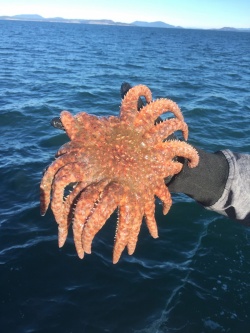
The wasting disease appears to have mostly run its course, said Hewson. “It has been waning in recent years and is currently present at low levels. The ultimate consequence of the disease is that there has been a huge reduction in sunflower stars and a few other large starfish species.”
Other sea stars appear to have been less affected, if at all, based on surveys by other researchers, said Hewson. “The loss of very large starfish, like the sunflower stars, which are top predators in their ecosystems, has caused a shift in the abundance of their prey – urchins and other small invertebrates – for a while. We don’t expect the sunflowers to return to pre-disease numbers any time soon.”
The group does not let climate change off the hook. “Since some of those disease causes may include swings in temperature or precipitation, ultimately which may be related to climate change, we need to focus our efforts on remediating climate change,” he said.
Other authors of “Investigating the Complex Association Between Viral Ecology, Environment, and Northeast Pacific Sea Star Wasting” are graduate student Kalia S.I. Bistolas; Eva M. Quijano Cardé, doctoral student in veterinary medicine; Jason B. Button ’14; Parker J. Foster ’15; Jacob M. Flanzenbaum ’17; Chaunte K. Lewis ’16; and researcher Jan Kocian.
Funding was provided by the National Science Foundation and the Atkinson Center for a Sustainable Future.


