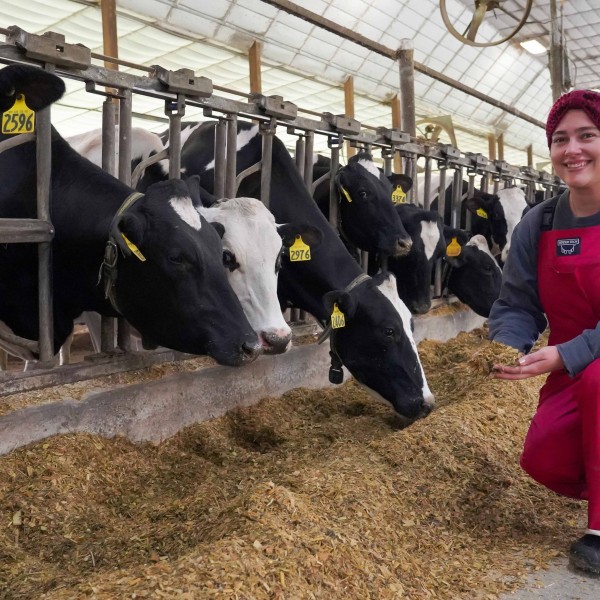
Dairy that is fermented and brewed like beer could soon be on tap as Sam Alcaine, M.S. ’07, assistant professor in the Department of Food Science, turns dairy waste into a flavorful drink with an alcoholic kick.
The research is more than a compelling addition to the craft beer craze: Alcoholic dairy products could be a solution to an increasing problem for New York’s powerhouse Greek yogurt industry.
The production of Greek yogurt creates acid whey, a leftover liquid with very little protein and few profitable uses. Alcaine, former product innovation manager at Miller Brewing Co., thinks there may be a place for alcoholic dairy beverages made from whey.
“There’s this whole movement around craft beer and spirits, but dairy doesn’t play in that space at all,” Alcaine said. “If we could convert whey into something that people want to drink, it opens an entirely new economic arena for entrepreneurs and brewers to explore and innovate within.”
But turning dairy into a drinkable alcohol is no simple task. Lactose, a sugar in dairy, cannot be broken down and converted into alcohol by traditional brewer’s yeast. Alcaine’s lab is working on several fronts to form a solution.
One idea is to combine multiple strains of bacteria and various species of yeast to create a co-fermentation that produces alcohol. The first bacterial strain would digest lactose and give off galactose as a byproduct, which could in turn be converted by another yeast strain into alcohol.
Another variation Alcaine is researching uses barley, a traditional source of amylase enzymes that break down starch into simple sugars that are fermented into beer. Barley also contains enzymes capable of breaking down lactose, but they work at different temperatures than those typically used for brewing and have not been used in beer making.
Alcaine has found that a precise mix of time and temperature can break down lactose into the glucose and galactose needed by brewer’s yeast to produce alcohol. The alternate source of sugars also means unique flavor profiles. Traits like the breed of the cow producing the milk influences the flavor of the resulting alcohol.
The methods have already shown results: a low-alcohol beer – about 2.7 percent alcohol by volume – with a sour and salty flavor comparable to German-style gose (pronounced GOZ-ah) beer and other concoctions similar to pulque, a traditional central Mexican drink made from agave.
More research is needed to refine the process, but Alcaine thinks dairy alcohol could be on the market within a few years.
“Right now, brewers use farm products like corn, rye and barley to make alcohol. Dairy is a natural addition, especially now, when consumers are demanding novel and interesting flavors,” Alcaine said.