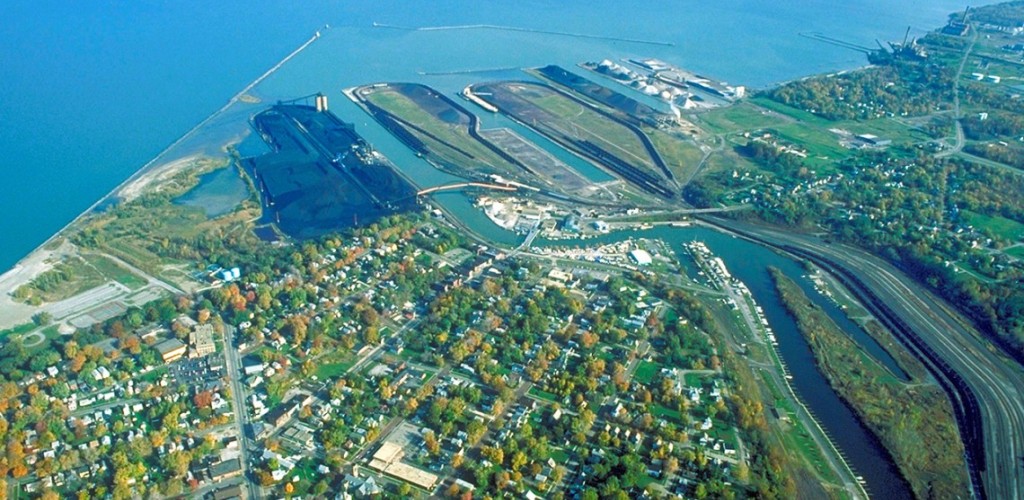
In ports throughout the Great Lakes, landscape architects, scientists and engineers may soon spin muddy sediment into environmental gold.
Brian Davis, Cornell assistant professor of landscape architecture, and Sean Burkholder, assistant professor of landscape and urban design at the University at Buffalo, received a $1.6 million grant from the Great Lakes Protection Fund for their Healthy Port Futures project proposal. Over the next three years they will complete design research that supports innovative pilot designs for managing sediment in small and medium ports starting in northeastern Ohio.
“Our project tries to build on recent work called ‘beneficial use’ of dredged material. It positions sediment and dredged material not as a waste product that must be disposed of as cheaply as possible, but instead as a resource, a building block for the community and ecology,” said Davis, a fellow at Cornell’s Atkinson Center for a Sustainable Future.
Dredged material is the mud – sand, silt, clay and gravel – that builds up in harbors and ports, impedes shipping traffic and periodically must be cleared. It’s an expensive process.
“We are working with research partners and communities to develop alternatives for managing sediment, especially strategies for working with the energy of natural systems to get sediment to desirable places and keep it out of undesirable places,” said Davis, who explained that small- or medium-sized ports ask the federal government to dredge their shipping channels to improve traffic flow.
“The old way of relying on the federal government to dredge channels can no longer be assumed, because – for some of these ports – the funding does not exist and the regulatory hurdles are difficult. We’re trying to help these port communities in the Great Lakes consider this as an opportunity to develop strategies focused on value creation.”
Ultimately, the designs will be adaptable to changing environmental and economic demands and may be used to enhance operational efficiency. Port cities may adopt waterfront approaches for both recreational and ecological purposes, and concurrently offer cost-effective ways to maintain navigation channels.
Rather than dumping dredge back into a lake or taking it to an industrial disposal facility, the sediment could be used to create parkland or wetland, or to improve real estate values, with a goal to improve ecological performance, said Davis. “Think of it as sustainability, like a triple bottom line: economic value, social value and cultural well-being.”
Also on the research team are modeling lead Kimberly Hill, University of Minnesota; aquatic habitat specialist Jeff Schaeffer, United States Geological Survey, Great Lakes Science Center; and data analyst Matt Lewis, Michigan Aerospace.