Over winter break in January, 14 Cornell Tradition undergraduates traded creature comforts for work gloves to help clean up homes in Puerto Rico, which is still reeling nearly five months after Hurricane Maria devastated the island.
Some students worked in the Villa Calma community in the city of Toa Baja, where a nearby river had swelled, flooded and deposited large amounts of mud.
“Home interiors had mud-stained walls, and the floors were covered in several inches of mud,” said Natalia Gulick ’21, who spent time on the island when she was growing up. “We set to work, shoveling and raking the mud out of the interiors and finishing off by power washing. It was incredibly laborious.”
The students also shoveled mud, cleared debris and removed fallen trees and overgrown weeds in Humacao, and they handed out gifts to children for Three Kings Day, a Christian holiday.
Aoife Casey ’19, a volunteer firefighter with the Cayuga Heights Fire Department, generated the initial idea and worked with Cornell Tradition to partner the students with Mentes Puertorriquenas en Accion (Puerto Rican Minds in Action), a group of young people based on the island working for social change, led by executive director Alejandro Silva Diaz ’11.
Despite some optimistic media reports, local residents told the Cornell students they believed 60 to 70 percent of the island remained without electricity, and many people still lacked fresh water. The group brought water bottles with filters and stayed off the beaches, as sewage contamination threatened swimmers.
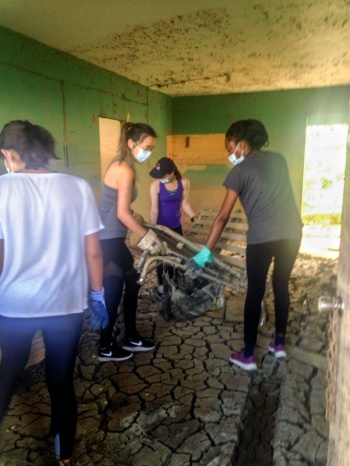
Cornell Volunteers in Puerto Rico
Courtney Cheng ’19 said the Puerto Rican citizens have looked beyond organizations like the Federal Emergency Management Agency (FEMA) for help after the hurricane. “I saw many signs rejecting FEMA, and it’s really the local community leaders who take charge in aiding relief efforts,” she said, explaining that municipal governments lack money to help. Individuals rebuild their own homes without subsidies, she said.
“From this trip, I learned that I had gotten too comfortable with my way of life,” Cheng said. “I was taking things like running water, heat and air conditioning for granted.”
Alexis Pollitto ’18 recalls how her hometown area in New Jersey handled Hurricane Sandy in 2012. “Sandy can in no way compare to the damage of Hurricane Maria in Puerto Rico,” she said. “The damage I witnessed through this natural disaster still hits close to home. I wanted to give back to a place that could benefit from help.”
Casey said she admired the strength of the Puerto Rican people, whom she saw smiling through adversity. “Dire obstacles did not slow them down,” she said. “Many businesses were closed, homes were destroyed, electricity was scattered, and the majority of the streetlights were completely demolished. I didn’t hear any complaints, nor was anyone phased by these conditions.”
The team effort was tremendous, fast-paced and efficient, said Cedric Kouam ’19. “The shovels were filling the wheelbarrow so fast that we were able to remove all the mud from [a] lady’s house on the same day,” he said. “She walked in her house and could not believe it. Her facial expression completely changed. Her smile reminded me of my [late] grandmother’s smile. It deeply touched me because of the connection I felt, and I was reminded of how connected we are as people around the world.”
Funding for the trip was provided by the Cornell Commitment office and the Frank H.T. Rhodes Cornell Tradition Endowment, established by the Atlantic Philanthropies.