

In the wondrous world of fangs, venom and webs, five Cornell undergraduates have captured and prepared about 300 arachnids from North America for this summer’s “Spiders: Alive and Deadly” – a major exhibit that opens at the Royal Ontario Museum in Toronto on June 16.
The exhibit is being produced by the Australian Museum in Sydney.
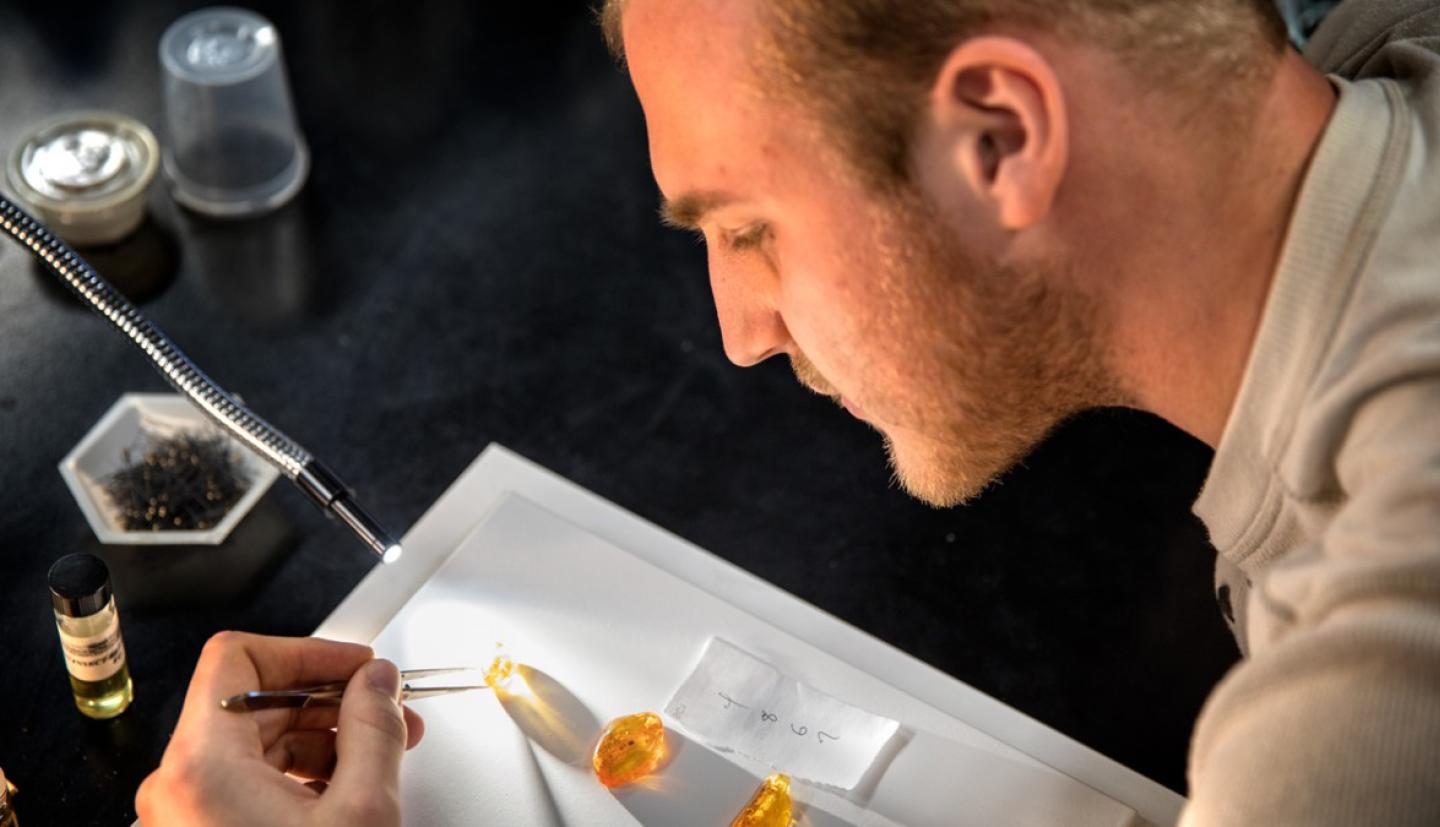
“Spiders are squishy, so typically they are preserved in alcohol,” said Linda Rayor, senior lecturer and research associate in entomology, who is collaborating with the Australian Museum. The group used pins, gel and freeze-drying techniques to place the spiders into life-like postures: “The spiders look ready to walk out of the display cases and that took a lot of work. They look bloody amazing,” she said.
Throughout last summer and fall, the Cornell undergraduates combed woods, and scoured fields in Ithaca – and collected them from Florida, Louisiana and Arizona – to find a diverse sampling. Also, the group prepared 15 tarantulas from a 50-year-old collection Rayor inherited.
“I really enjoyed collecting spiders at night,” said Leeah Richardson ’20, who worked on spider positioning. Her favorites? “I really like agelenids, grass spiders” she said. “Their funnel-shaped webs are really interesting, and when you disturb them, [the spiders] retreat, which makes them challenging to collect.”
To find spider specimens, Richardson advises: “If you shine a flashlight out across a field – holding the flashlight up next to your eyes – the spiders’ eyes will reflect back, and it’s a good way to locate some really interesting spiders.”

Arabelle Osicky ’19 found the collection and mounting experience enlightening. “Collecting spiders for the exhibit helped me to appreciate the uniqueness and beauty of spiders even more,” she said. One of her favorites is the ogre-faced spider, which creates webs they use like nets to catch flying insects. Late last summer, she collected a huge black widow in a tree stump while taking a walk in a Delaware woods.
Spiders dance, swim and spin webs. But these creepy crawlies benefit humans by keeping insect and pest populations under control. Kristianna Lea ’18, whose family owns a stone fruit farm in Isleton, California, appreciates spiders and keeps a field guide to spiders in her purse. She studies predatory assassin bugs, and their neurotoxins, which is the subject of her senior honors thesis.

Jake Gorneau ’20 favors the huge golden orb weaver – “very cool to see in the flesh.” These voracious Louisiana predators, whose favorite meals include insects, and very occasionally small birds, build webs over two meters in size.
In assembling the exhibit, Rayor worked with commercial entomologist and artist Lawrence Forcella, owner of God of Insects, Hastings-on-Hudson, New York, who fine-tuned the mounting.
Spiders may be found in Cornell’s backyard. Joe Giulian ’20 and Richardson found an emerald jumping spider – in all of its eye-catching, iridescent green splendor – in back of Mann Library.
“It was pretty unbelievable for us, as none of us had ever seen it before,” Giulian said.
At the Cayuga Nature Center’s BioBlitz last September, one participant found a bolas spider, which easily can be mistaken for a berry or seed, Giulian said.
“The bolas have peculiar, predatory behavior,” he explained. They attach a dense glob of silk – the bolas, Spanish for ball – to a long strand of silk, then swing the bolas around from a branch to snag male moths. Chemistry in the bolas mimics female moth mating pheromones, so unsuspecting male moths easily become ensnared.
Said Giulian: “Bolas spiders are a great testimony to the diversity of predatory lifestyles in spiders.”
The Australian Museum’s exhibit will be in Toronto for nine months, before touring North America for another four years.


