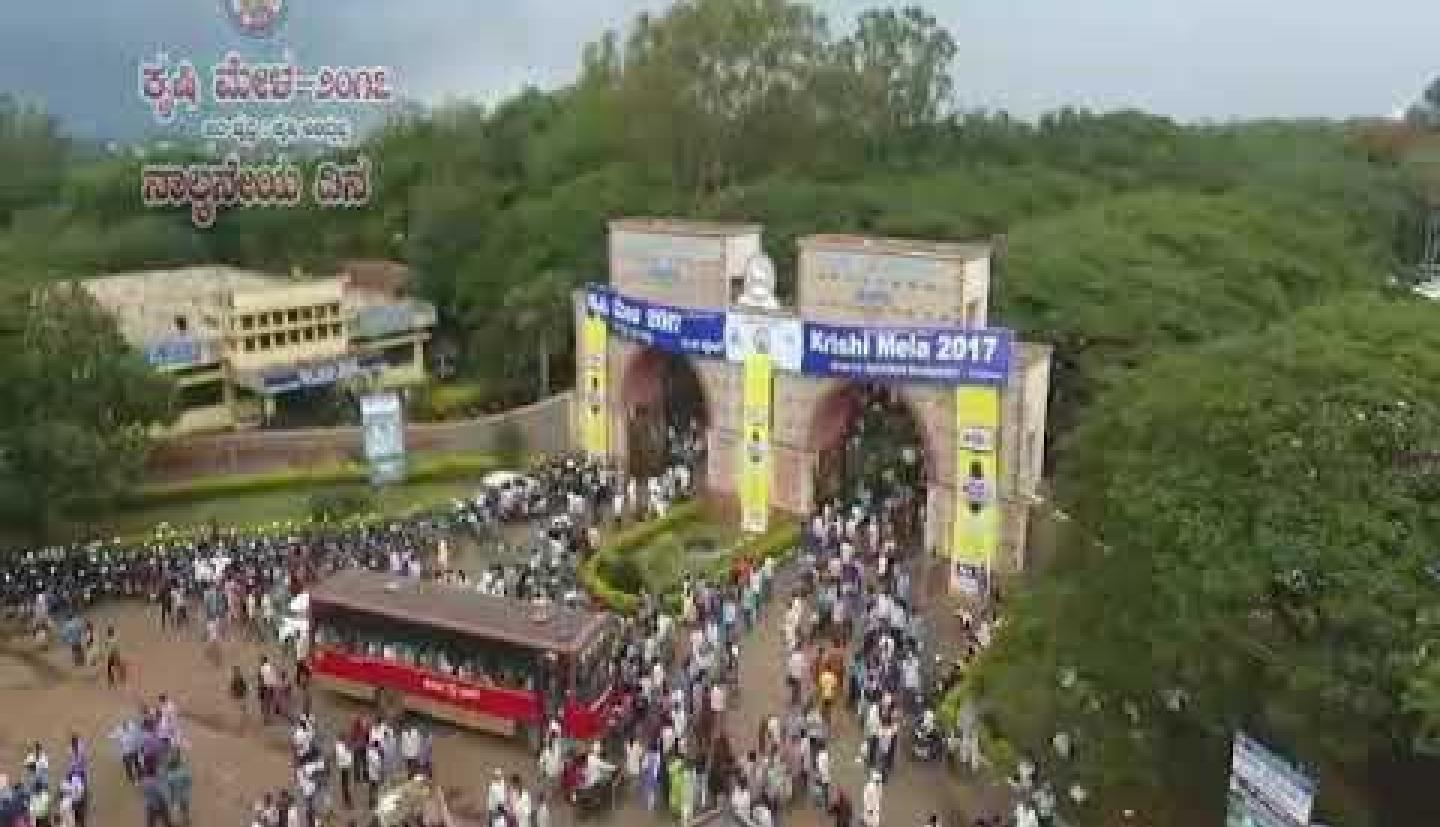
More than 1.6 million farmers attended the annual Krishi mela, or farmers’ fair, at the University of Agricultural Sciences (UAS) in Dharwad, India, Sept. 22-25. “The roads were totally jammed,” said K.V. Raman, adjunct international professor of plant breeding and associate director of International Programs in the College of Agriculture and Life Sciences (IP-CALS), who participated in farmer trainings during the event.
IP-CALS, with funding support from the Food and Agriculture Organization (FAO) to Cornell Sathguru Foundation, partnered with UAS-Dharwad in supporting the participation of 12 farmers from Bhutan, Bangladesh, Nepal and the Self-Help Women’s Association Group in Gujarat, India, from Sept. 19 to 24, in a farmer-to-farmer event.
“These farmers expressed great satisfaction and said it was a life-changing experience to interact with many farmers and understand the latest developments in agricultural technologies relevant to their own situation,” said Raman.
Exhibitors at more than 900 stalls demonstrated new crop varieties, advances in irrigation, heavy machinery, crop and livestock management, post-harvest and food processing technologies, use of information technology (IT), and showcased recent extension and research advances. The annual agricultural fair is aimed at farmers across the state of Karnataka.
“Particular emphasis was placed on crop, livestock and seed production, agricultural equipment, use of drones and IT,” said Raman. “Farmer groups also shared knowledge about sustainable agricultural practices including agro-ecology, and crop and livestock production management practices. In peer-to-peer learning opportunities, farmers talked about improving crop rotation, reducing inputs, enhancing biodiversity and practicing better water management.”
Kakoli Ghosh, coordinator of academia and research institutions at FAO-Rome, said the approach was in line with FAO’s global efforts to strengthen dialogue and peer-to-peer learning exchanges among farmers to share local, cost-effective and proven solutions from southern countries in support of regional initiatives and priorities.
Cornell and Sathguru Management Consultants, based in Hyderabad, India, have collaborated with UAS-Dharwad for more than two decades in facilitating food and agriculture development at the small-farmer level.
Ronnie Coffman, director of IP-CALS, who received an honorary doctorate from UAS-Dharwad in 2012, said Cornell’s projects with UAS-Dharwad have included technical support to improve existing farming systems with particular emphasis on wheat, millets, pulses and vegetables.
“The seed villages adopted under the UAS-Dharwad program include several thousand small-scale farmers who produce certified seed of ground nut, soy bean, pigeon pea, chick pea and millets,” said Coffman. He noted that the UAS-Dharwad seed village model is considered among the best seed programs developed under the state agricultural university system of India. During the mela, seed stalls were packed as farmers rushed to buy improved seed. Those who bought 3 kilograms or more were provided with a free tree sapling.
Several faculty from UAS-Dharwad have been trained at Cornell in seed and food technology, biotechnology and the use of novel extension tools. These faculty played significant roles in facilitating the mela, according to Raman.
Linda McCandless is communications director for IP-CALS.