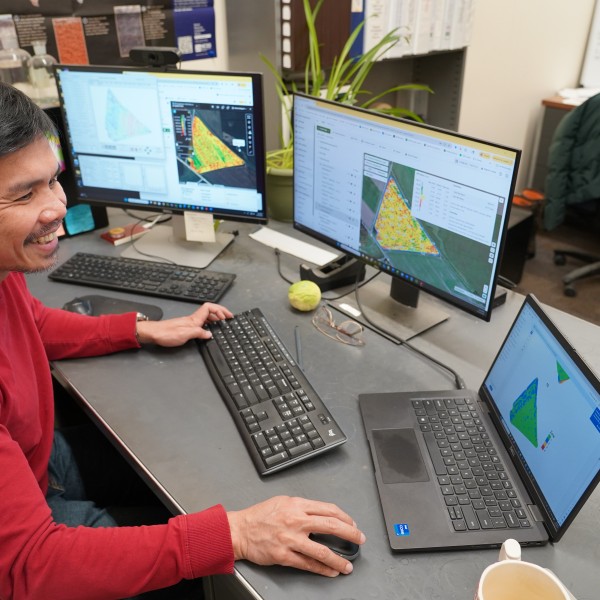
Kelly Robbins, assistant professor, School of Integrative Plant Science, Plant Breeding and Genetics Section
Previous positions: Director, Genomic Open-source Breeding Informatics Initiative (GOBII), Cornell. 2015-17; quantitative geneticist, Dow AgroSciences LLC., 2008-15.
Academic background: B.S., University of Tennessee, 2002; M.S. University of Georgia, 2005; Ph.D. University of Georgia, 2007
Last book read: “The Terror,” by Dan Simmons
What do you do when not working? I enjoy spending time with my wife and daughter, hiking, golf and ice hockey.
What gets you out of bed in the morning? Finding solutions for the complex challenges facing crop production locally and globally.
Current research project(s)? I’m currently collaborating with multiple international agricultural research institutions to develop advanced statistical models and computational tools to utilize genomic information and improve the efficiency of breeding programs in Sub-Sahara Africa and South Asia.
Courses you’re most looking forward to teaching? Bayesian Methods for Plant and Animal Genetic Improvement
What most excites you about Cornell CALS? The opportunity to collaborate with great scientists and conduct impactful research.
► Meet all our new faculty