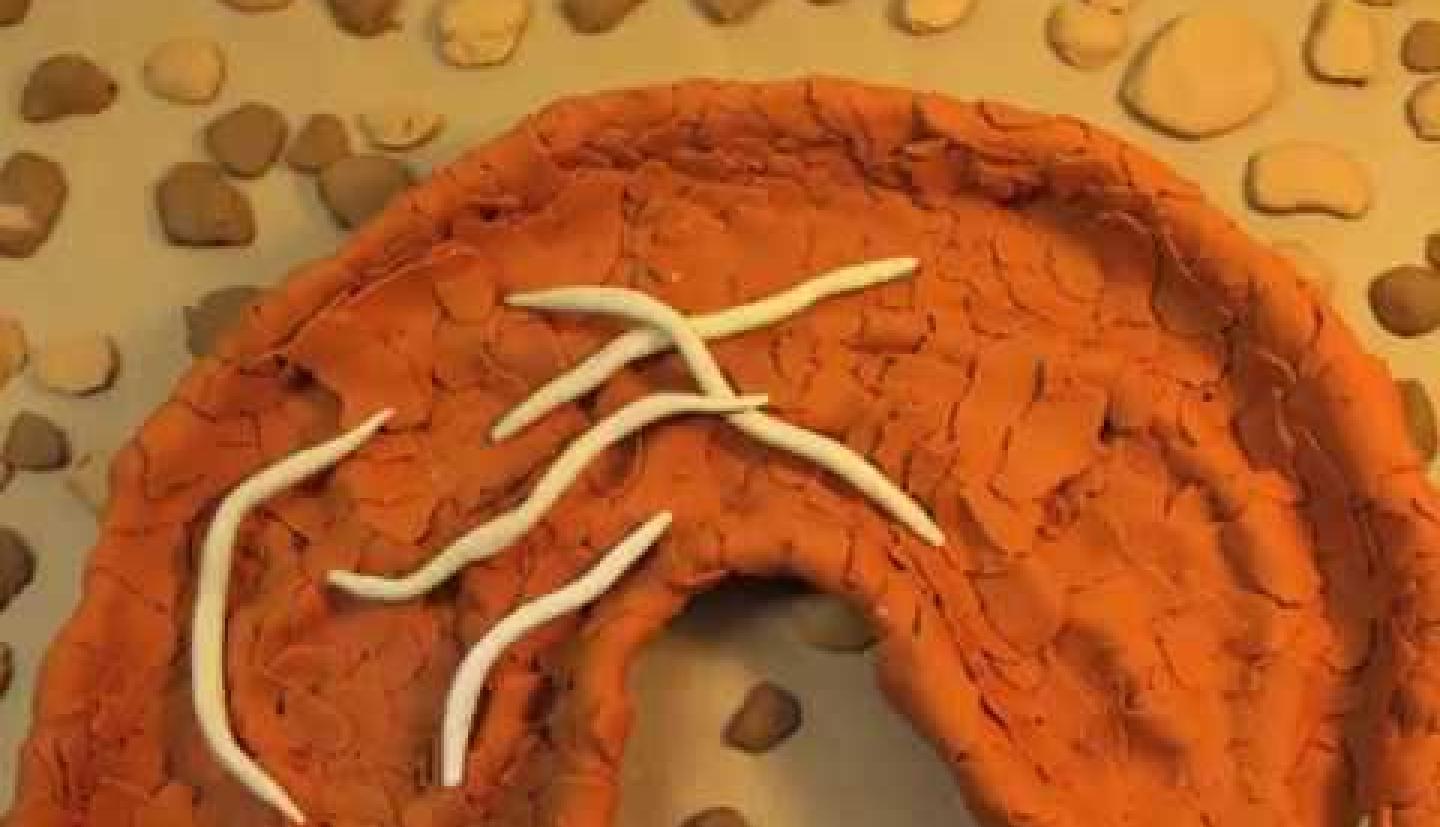
Clay animation, a technique famously employed to tell the stories of “Wallace and Gromit,” for example, uses stop-motion animation; clay models are photographed, moved slightly and photographed again. Like flip movies children create with stick figure drawings, when hundreds of these pictures are strung together and played back they create the illusion of action.
As part of his extension/outreach graduate assistantship in the field of entomology, Helmberger produced three short claymation videos in spring 2017: “Life Cycle of Entomopathogenic Nematodes” (tiny worms that infect insect larvae and kill them), “The Soil Food Web” and “Ecosystem Services in Agriculture.” The videos are posted on YouTube. The nematode video has been used in extension talks, and grade school teachers have shown the videos in their classrooms. This fall, Helmberger plans to produce two more videos as part of his assistantship.
“Soil biodiversity and ecology are subjects that don’t get a lot of attention even in educational media,” said Helmberger, who is investigating entomopathogenic nematodes as biocontrol agents as part of his master’s degree, in the lab of Kyle Wickings, assistant professor of entomology at the New York State Agricultural Experiment Station in Geneva. “These videos provide an accessible way of communicating soil ecology and biodiversity to lay audiences, especially young ones,” Helmberger said.
The son of two journalists, Helmberger, who describes himself as a “prototypical science nerd,” was fascinated as a child by centipedes, isopods and earthworms he found under rocks growing up in rural northern Minnesota. His college interest in soil ecology and the universe of critters that live underfoot only grew. This fascination, combined with a side interest in claymation, led him to propose creating the educational videos as part of his assistantship.
The videos, which are each under two minutes long, take Helmberger up to 20 hours to make. He has fine-tuned his process by planning ahead; he writes the script, creates models and sets, records the narration, takes the photos and edits the video.
He hopes his videos inspire viewers to recognize “when you’re walking over the ground, you’re not just walking over bare empty dirt; there’s a whole wide world beneath your feet.”