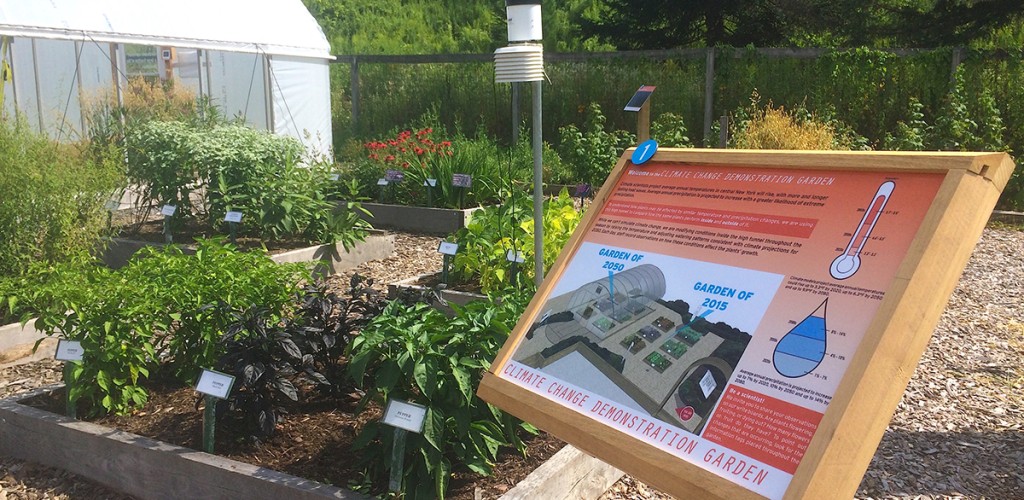
In the shadow of Barbara McClintock’s historic campus shed, plots of foliage thicken in the university’s Climate Change Demonstration Garden. Located at the Cornell Botanic Gardens, these raised beds provide a living illustration of how future temperature conditions may affect plants.
“Climate change is one of the biggest challenges we’re facing,” said Sonja Skelly, director of education at Cornell Botanic Gardens. “For the general public, climate change is something they hear about, but it can be out of sight, out of mind. It is some sort of future phenomenon. It is not going to happen in our lifetime. It’s going to happen to somebody else in another part of the world, other than ourselves.”
But it is here, and it is happening now. Skelly untangles the disconnect between climate change knowledge and societal unwillingness to engage. “We wanted something demonstrative, experiential, interactive and compelling,” she said. “We want to give people a sense of what climate change will do locally.”
Skelly, along with Josh Cerra, assistant professor of landscape architecture and Chris Wein, professor emeritus of horticulture, assembled a team of scientists and educators to create the garden concept in 2014, anchored by a controlled-environment high tunnel to approximate upstate New York temperatures predicted for the 2050s. The Toward Sustainability Foundation and the Atkinson Center for a Sustainable Future provided the original funding.
By the 2050s, the average temperature in New York’s Southern Tier may increase between 4.4 to 6.3 degrees Fahrenheit, according to a New York State Energy Research and Development Authority report. The number of days with temperatures rising above 90 degrees could increase, with a greater frequency and duration of heat waves. There will likely be increase of annual precipitation of 4-10 percent in this region and more intense-precipitation events.
Amid the beans, tomatoes, corn and squash at the Cornell Botanic Garden’s gated Pounder Vegetable Garden, the climate garden’s beds feature nectar resource plants – food for pollinators – as well as vegetable and grain plants. The plants are grown outside in the present climate and in the high tunnel, which approximates the temperatures three decades into the future.

The garden reveals how plants may be impacted by temperature variables. Nectar plants such as foxglove beardtongue (Penstemon digitalis) and hairy beardtongue (Penstemon hisutus) are magnets for pollinating bees, while wild bergamot (Monarda fistulosa) and scarlet bee balm (Monarda didyma) attract butterflies, pollinating bees and hummingbirds. All of these plants could flower differently due to higher temperatures.
“Climate change may cause some plants to bloom when pollinators are not present, particularly early in the blooming season. This is phenological mismatch,” said Skelly. Plants and pollinators that have time-sensitive relationships with migration, breeding, predation, reproduction and survival patterns could see these relationships disrupted by climate change, she said.
Said Skelly: “Essentially we’re using plants as a lens into the future. Plants are good communicators of what we can expect to see, and these plants may have an impact on our visitors who see them.”
The grounds of the Cornell Botanic Gardens are open from dawn to dusk, and the Nevin Welcome Center hours are Sunday through Thursday, 9 a.m. to 5 p.m.; and Friday and Saturday, from 9 a.m. to 6 p.m. The Pounder Garden, where the Climate Change Garden is located, is open from dawn to dusk daily. Tour information is available here.