

Plant geneticist Edward Buckler received the inaugural Food and Agriculture Sciences Prize from the National Academy of Sciences (NAS) April 30 in Washington D.C. The award recognizes his transformative research on agricultural crops crucial to global food security.
Buckler, a research geneticist at the U.S. Department of Agriculture-Agricultural Research Service (ARS) and adjunct professor of plant breeding and genetics at the Institute for Genomic Diversity at Cornell University, is a pioneer in genomics and statistical genetics to improve the resiliency and nutritional value of agricultural crops. The $100,000 prize recognizes research by a midcareer scientist at a U.S. institution who has made an extraordinary contribution to agriculture or to the understanding of the biology of a species fundamentally important to agriculture or food production.
The prize was established to elevate food and agriculture research in the scientific arena and highlight the critical need for scientists working toward more productive, sustainable agriculture and better health through nutritious food.
“My scientific ambition has been to improve human lives and reduce the environmental impact of agriculture by creating better crops,” said Buckler. “This award reflects the vital work conducted by teams of scientists as we harness powerful tools to explore the natural diversity of crops, and work to ensure food security across the globe.”
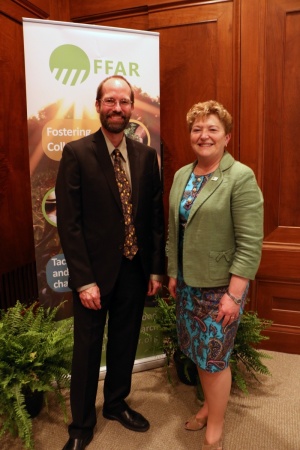
Buckler’s lab uses statistical genetics to spearhead genome-wide association studies in crops such as maize, cassava, grapes and biofuel grasses. For the past two decades, his cutting-edge research has been key in identifying genes responsible for variation in some of the world’s most important crops. His findings have made it possible for plant breeders to more efficiently select for traits like yield and the nutritional value in crops vital to human health.
Kathryn J. Boor, the Ronald P. Lynch Dean of the College of Agriculture and Life Sciences, said, “Agricultural research has never been more vital as our rapidly expanding human population confronts the environmental disruption caused by climate change. The work of Ed Buckler is bolstering agricultural crops and advancing scientific discovery essential to the lives of billions of people.”
His landmark explorations of the maize genome have uncovered ways to use the natural genetic diversity to improve productivity, sustainability and nutrition. In one study, Buckler and his team identified natural variation key for making maize varieties with 15 times more vitamin-A. The findings are helping to address a key driver of global malnutrition in developing countries.
He and his group also focus on other critical issues related to global food security, such as hybrid vigor, local adaptation, drought tolerance and disease resistance.
Due to its affordability and effectiveness, Buckler’s approach to analyzing natural genomic diversity has reached far beyond his lab. His methods are used to research more than 1,000 different species and have influenced how the human genome is studied. To make their work even more accessible to the scientific community, he and his group also developed original open-source software now used by thousands of research groups around the world.
“It is an honor to see Dr. Buckler officially receive the first-ever NAS Prize in Food and Agriculture Sciences,” said Sally Rockey, executive director of the Foundation for Food and Agriculture Research. “On behalf of the Foundation, we congratulate Dr. Buckler and look forward to his future contributions to food and agriculture.”
The NAS Prize in Food and Agriculture Sciences is endowed through gifts from the Foundation for Food and Agriculture Research and the Bill & Melinda Gates Foundation.


