

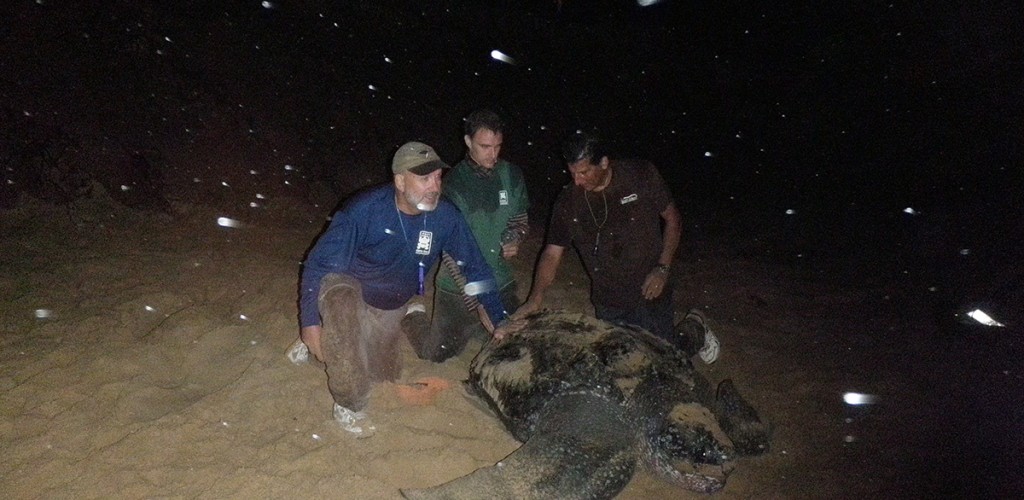
Endangered leatherback sea turtles are known for their open-ocean migratory nature and nomadic foraging habits – traveling thousands of miles. But a Cornell naturalist and his colleagues have discovered an area along the Mozambique coast that the turtles have made their permanent home, according to a study published in Nature’s Scientific Reports, Nov. 25.
Understanding this new behavior could assist scientists in helping boost the turtles’ population and lift them from environmental peril.
“They seem to be staying there year-round. We’ve found these turtles – a supposed nomadic migrant – congregating in coastal waters,” said Steve Morreale, senior research associate in the Department of Natural Resources. “We’ve identified an area where leatherback turtles are clustered together. Having a long-term, resident population of densely congregated leatherback turtles – in coastal waters – that’s really remarkable. It clarifies the ecology of this species, and as a result, we’ve broadened our scientific view.”
Leatherbacks, the world’s largest reptiles, do not have hard shells like other turtles. Instead, they have a softer, leather-like shell. The turtles can weigh up to 1,500 pounds and are eating machines, as one can nosh daily on hundreds of pounds of its favorite meal – jellyfish. Leatherback sea turtles and jellyfish are found throughout the world’s oceans, but the authors of this study think that these leatherbacks are likely enjoying a bountiful jellyfish supply in the Mozambique Channel.
Morreale and his colleagues tracked electronically tagged turtles using satellite telemetry. As expected, some leatherbacks journeyed up to 6,000 miles into the Indian and Atlantic oceans. But, nearly half were tracked into the Mozambique Channel, which runs between Mozambique and Madagascar, off the southern African coast. They further confirmed the turtles’ homebody behavior by taking skin samples and examining the animals’ stable isotope signatures, which provide a long-term chemical analysis of where the animal feeds, at which level of the food web they eat and whether they feed in the open ocean or along the coastal waters.
Scientists had seen this coastal feeding behavior before, but believed that leatherbacks sought only seasonal refuge along continental shores and coastal waters.

The vast oceanic distances that migrating leatherback turtles travel complicate conservation efforts, explained Morreale, but grasping this new behavior “makes it a little easier to protect, regulate, and to enforce protection – especially if it is in one country like Mozambique – than if they were spread throughout the world’s oceans.”
Other scientists on this work, “Coastal Leatherback Turtles Reveal Conservation Hotspot,” are lead author Nathan J. Robinson of the Leatherback Trust, Goldring-Gund Marine Biology Station, Costa Rica; Frank V. Paladino, Purdue University; and Ronel Nel of Nelson Mandela Metropolitan University, South Africa.


