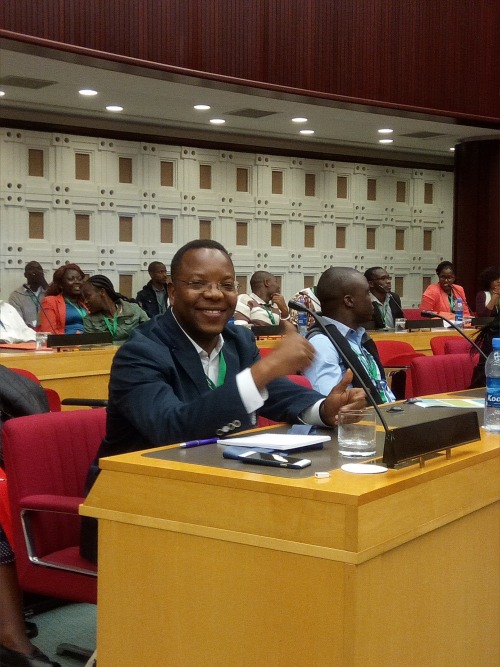
Edward Mabaya, M.S. ’98, Ph.D. ’03, has been elected president of the African Association of Agricultural Economists (AAAE). The election on Sept. 23 was held during the association’s 5th triennial conference, conducted this year at the United Nations Conference Centre in Addis Ababa, Ethiopia from Sept. 23-26.
Mabaya is associate director of the Cornell International Institute for Food, Agriculture & Development (CIIFAD), and a senior research associate at the Charles H. Dyson School of Applied Economics and Management. His research and outreach work focuses on agricultural development and food security in Africa.
Mabaya has been a pioneer in improving the availability of high-quality, locally adapted and affordable seeds for smallholder farmers in Sub-Saharan Africa. His research focuses on food marketing and distribution, seed systems and the role of efficient agricultural markets in Africa’s economic development.
“Having grown up on a small farm in rural Zimbabwe, I know firsthand about the power of agriculture in not only putting food on the table, but also in alleviating rural poverty. By working with the executive committee and members of the association, we hope to play a key role in shaping the future of agriculture in Africa,” said Mabaya.
AAAE is an association of agricultural economists and other professionals with special interest in agricultural economic issues and applied research that informs public policy for improving the productivity of African agriculture. According to the AAE, the group aims to further the agricultural economics profession and develop relevant policy options that show the trade-offs between productivity and income growth.
The AAAE hold an international conference every three years to bring together agricultural economists, development practitioners, policymakers, academics, researchers, and students. More than 450 members participated in this year’s meeting. Mabaya is the association’s 5th president.
In his acceptance speech, Mabaya promised to follow the association’s vision of “supporting capacity building activities of its members, with expanded opportunities for young scientists, and contributing significantly to policy research and development on African agriculture.”
CIIFAD Director Ralph Christy said “Ed will make an outstanding President of the AAAE. His election reflects the respect and confidence his peers have in his leadership, intelligence, and deep commitment to sustainable development of the African continent.”